


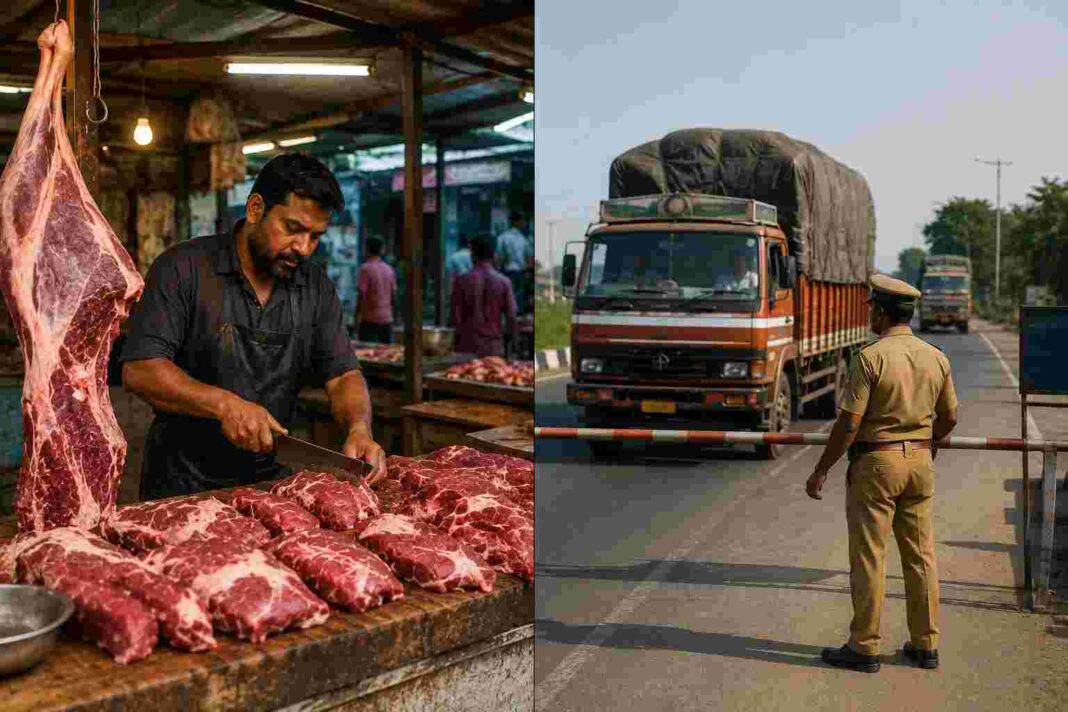
You can legally buy beef at a shop in Thiruvananthapuram, drive it 500 km to Karnataka, and suddenly become a criminal — without changing a single thing you did.
That’s not a hypothetical. That’s how beef laws India state borders actually work right now, in 2024, in the world’s largest democracy.
And most people have no idea.
The Map That Decides Your Guilt — beef laws India state borders
India doesn’t have one beef law. It has 28 different ones.
Each state writes its own rules. So the same piece of meat that’s perfectly legal in your bag in Kerala becomes a cognizable offence — meaning police can arrest you without a warrant — the moment you cross into certain neighbouring states.
Kerala allows slaughter, sale, and consumption of beef. No restrictions. The Kerala Slaughter of Animals Regulation Act doesn’t prohibit cattle slaughter.
Cross into Karnataka, and you’re under the Karnataka Prevention of Slaughter and Preservation of Cattle Act, 2020. Transport of beef across state lines? That can trigger a case. Penalties go up to seven years imprisonment and fines reaching ₹10 lakh under Section 8 of that Act.
Drive further into Maharashtra? The Maharashtra Animal Preservation (Amendment) Act, 1995 bans possession of beef from domestically slaughtered cattle. The Bombay High Court upheld this in Shaikh Zahid Mukhtar v. State of Maharashtra (2016), calling it constitutionally valid.
Seven borders. Seven different legal realities. One truck driver’s nightmare.
Wait — So What Exactly Are You Allowed to Carry?
This is where it gets genuinely confusing, even for lawyers.
Here’s a quick breakdown of the legal landscape:
- Kerala: slaughter and sale legal, no state-level beef ban
- West Bengal: no total ban, beef widely available
- Meghalaya, Nagaland, Mizoram: no restrictions, beef is a cultural staple
- Uttar Pradesh: the UP Prevention of Cow Slaughter Act, 1955 (amended 2020) — punishment up to 10 years, fine up to ₹5 lakh
- Gujarat: the Gujarat Animal Preservation (Amendment) Act, 2017 — life imprisonment possible under Section 6A for repeat offenders
- Rajasthan, Madhya Pradesh, Chhattisgarh: near-total bans, heavy penalties
Now here’s the counter-intuitive part that almost nobody talks about: buffalo meat is legal in most “beef-ban” states. The laws typically protect “cow, calf, bull, and bullock” — not buffalo. So the “beef” sold openly in Delhi markets is often buffalo, and it’s entirely lawful. The laws are about the animal, not the product on your plate.
The Supreme Court Case Nobody Quotes Correctly
You’ve probably heard people say “the Supreme Court banned beef” or “the Supreme Court allowed beef.” Both are wrong.
In State of West Bengal v. Ashutosh Lahiri (1994), the Supreme Court held that a total ban on cow slaughter is constitutionally valid as a Directive Principle under Article 48. But it also confirmed that states are not required to ban it — they just can.
Then in the Abdul Hakim Quraishi case (1958), a seven-judge Constitution Bench held that a complete ban on slaughter of bulls and bullocks useful for agriculture was reasonable, but a blanket ban on all cattle regardless of utility needed stronger justification.
The law has never been simple. It’s been a negotiation between religious sentiment, economic reality, and fundamental rights — and courts have been threading that needle for 70 years. For more cases where Indian law surprises you completely, check out more legal curiosities on thecourtroom.in.
The Truck Driver Who Became a Test Case
In 2023, multiple High Courts dealt with transport-related cattle cases where accused persons argued they were moving animals or meat through a ban-state, not selling there. The legal question — does “transport” equal “possession” equal “offence”? — still doesn’t have a clean national answer.
The Prevention of Cruelty to Animals Act, 1960 adds another layer: even in states with no beef ban, the manner of transport and slaughter is regulated federally.
So here’s what this means for you practically:
- Verify the slaughter laws of every state your route passes through, not just origin and destination.
- Check whether your cargo is “cattle” or “buffalo” — this one distinction can be the difference between jail and home.
- Keep documentation: the source, the slaughterhouse licence number, and veterinary certificates.
- Know that a transit through a ban state — even without unloading — can be enough for local police to detain a vehicle [Unverified as a universal rule; varies by state enforcement].
What Does This Say About Us?
The same food, the same journey, the same person — three different legal outcomes depending on which side of a line you’re standing on.
Is that federalism working as intended? Or is it a patchwork of contradictions that mostly punishes people who can’t afford a lawyer?
That question is very much still open.
This article is for informational purposes only and does not constitute legal advice; consult a qualified advocate for guidance specific to your situation.

