


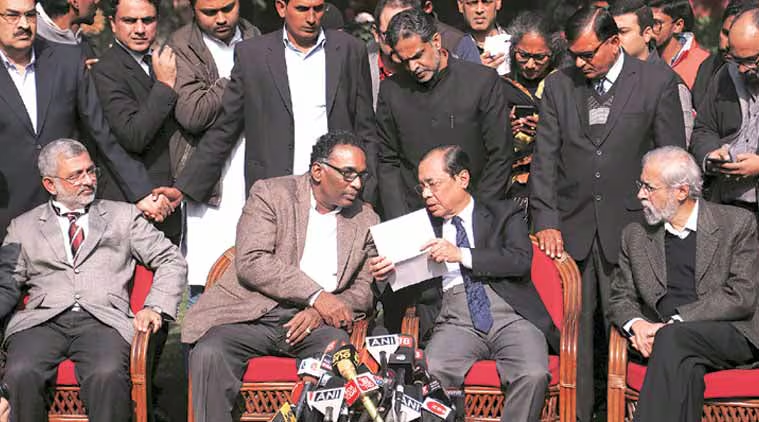
On January 12, 2018, four of India’s most powerful judges walked out of the Supreme Court and told the entire country that something was deeply wrong inside the highest court of the land.
That’s not a rumour. That’s not a political allegation. That happened. And it changed how every Indian looks at the Supreme Court — forever.
The 2018 Supreme Court Crisis That Nobody Saw Coming
Picture this. It’s a Friday afternoon in New Delhi. Four sitting judges — the four most senior judges in the Supreme Court, right below the Chief Justice — are standing in front of journalists at the residence of Justice Jasti Chelameswar.
They are holding a letter.
They are angry.
And they are about to make history.
The four judges were Justices Ranjan Gogoi, Jasti Chelameswar, Madan B. Lokur, and Kurian Joseph. Together, they accused Chief Justice Dipak Misra of arbitrarily deciding which judge gets which case — a power informally called “master of the roster.” Their core allegation: the system was being misused.
Never before, in the entire history of independent India, had sitting Supreme Court judges gone to the press to air grievances about their own Chief Justice.
The Dead Judge Who Started It All
So what pushed them over the edge? A dead CBI judge named B.H. Loya.
Judge Loya had been presiding over the Sohrabuddin Sheikh fake encounter case — a case in which BJP President Amit Shah and one Rohith Shah were the prime accused. Judge Loya died in December 2014 under disputed circumstances.
By January 2018, a PIL challenging the circumstances of his death was filed in the Supreme Court. On January 11, 2018, that PIL was listed before a bench presided by Justice Arun Mishra — not one of the four senior judges.
The four judges saw that listing as a trigger. They felt a politically sensitive case was being quietly handed to a particular bench. They had already written a private letter to CJI Dipak Misra two months earlier, raising their concerns. He never responded.
So on January 12, 2018, they went public.
What Were They Actually Saying? Here’s the Plain-English Version
The letter they released was formal and dense, but here’s what it really meant — the Chief Justice controls who hears which case in India’s top court. There is almost no formal rule governing this. One person decides, and that person was, according to these four judges, not deciding fairly.
After the press conference, CJI Misra did reorganise the court’s roster on a subject-wise basis — making it more transparent. But he kept control of the system. Whether that reorganisation was ever formally challenged in any court proceeding is [Unverified].
The reasons these judges gave the public, in plain terms, were:
- Case allocation was happening without transparency or seniority-based logic
- A politically sensitive matter (the Loya case) had been listed before a junior bench
- Their private letter to the CJI had gone completely ignored for two months
- Justice Kurian Joseph later said they believed CJI Misra was “allocating cases to judges with political bias” and was “being controlled from outside”
The Impeachment That India Had Never Seen
Here’s the counter-intuitive part: the four judges actually came back to court the very next day and worked normally alongside the CJI they had just publicly accused. No dramatic walkout. No legal war. Just — back to work. Their cooperation, strange as it looked from the outside, is what kept the institution from collapsing entirely.
But the political fallout was a different story. Seven opposition parties moved to impeach CJI Dipak Misra — the first time in Indian history a sitting Chief Justice faced an impeachment attempt. The motion went to Rajya Sabha Chairman M. Venkaiah Naidu. He rejected it, saying there was “virtually no concrete verifiable imputation.” Under Articles 124(4) of the Constitution and the Judges (Inquiry) Act, 1968, that was effectively the end of it.
So — can a Chief Justice of India actually be removed? Technically yes. In practice? This case told you the answer.
What Happened to the Man Who Led the Rebellion?
Here is what nobody expected. Justice Ranjan Gogoi — the most prominent face of the rebellion, the judge who stood at that press conference and told India its courts were in danger — was sworn in as the Chief Justice of India on October 3, 2018, directly succeeding Dipak Misra.
Numbered sequence of what followed:
- Gogoi became CJI in October 2018
- In 2020, a Supreme Court bench commented on the press conference in the Prashant Bhushan contempt judgment, stating: “We hope it was the first and the last occasion that the Judges have gone to press.”
- Gogoi later accepted a Rajya Sabha nomination from the Narendra Modi government — a decision that sparked intense public debate
You can read about more moments where India’s legal system surprised everyone at more legal curiosities on thecourtroom.in. And if you want the original reporting from the day it broke, LiveLaw’s coverage remains the most detailed public record of what actually happened.
The Question India Still Hasn’t Answered
January 12, 2018 exposed one uncomfortable truth: India’s Supreme Court had no real internal mechanism to resolve a crisis among its own judges. No rulebook. No process. Just informal meetings and the hope that senior judges would work it out.
They did. Barely.
But what happens the next time they don’t?
This article is for informational and storytelling purposes only and does not constitute legal advice.

