


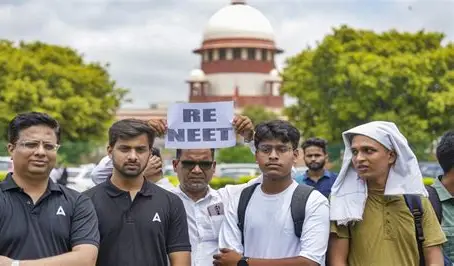
The Supreme Court of India on July 28, 2026 ordered all States to immediately release students below 18 years of age detained during the NEET-UG 2026 paper leak protests, provided they have no criminal antecedents, and barred coercive action against all student protesters.
The bench of Chief Justice of India Surya Kant, Justice Joymalya Bagchi, and Justice V. Mohana further proposed constituting a high-powered SIT for an independent probe into alleged police excesses during the protests, according to LiveLaw.
Background: How We Got Here
The protests began on July 20, 2026 at Jantar Mantar, New Delhi, led by the Cockroach Janta Party (CJP). Students marched toward Parliament demanding the resignation of Union Education Minister Dharmendra Pradhan over alleged irregularities and paper leak in the NEET-UG 2026 examination.
The agitation spread rapidly to Maharashtra, Bihar, Gujarat, Assam, West Bengal, and Kerala. A batch of petitions was filed before the Supreme Court alleging excessive force by police, with the bench composition of CJI Surya Kant, Justice Bagchi, and Justice Mohana formally taking up the matter, as reported by ANI.
- On July 22, 2026, CJI Surya Kant initially declined to urgently hear a plea against police action on the CJP protests; the matter was subsequently formally listed before the bench.
- A CNBC-TV18 video from July 22, 2026 was placed before the Court showing a uniformed police officer threatening to plant 50 grams of contraband on two young protesters, according to Verdictum.
- On July 27, 2026, the Court observed that the right to peaceful protest cannot justify lathi charges and called for uniform protocols across States.
Senior Advocate Shadan Farasat informed the Court that nearly 150 demonstrators — including 13- and 16-year-old minors — remained in illegal detention in Bihar beyond the mandatory 24-hour limit without production before a magistrate, per Verdictum.
Petitioners alleged lathi charges, pellet gun injuries — one protester reportedly losing eyesight — use of nail-embedded lathis causing permanent disabilities, tear gas, electric weapons, assault on journalists and lawyers, and deployment of plainclothes police personnel. These actions were said to violate Articles 14, 19, 20, and 21 of the Constitution of India, according to ANI and Open Magazine.
Simultaneously, families of over 200 injured police personnel filed petitions alleging attacks on officers during the demonstrations, presenting the Court with competing narratives of excess and assault, as reported by The Week.
The Ruling — Key Findings
The Supreme Court bench passed a series of directions on July 28, 2026. The Court ordered all States to release detained students under 18 with no criminal antecedents and barred coercive action in all FIR cases arising from the protests, while permitting investigations to continue, according to LiveLaw.
The Court also directed that the personal digital data of student protesters must not be published, and ordered the preservation of all CCTV footage, drone recordings, wireless communications, and other electronic evidence related to the protests, per LawBeat.
Notices were issued to the Chief Secretaries of Delhi, Maharashtra, Bihar, Kerala, Madhya Pradesh, and Uttar Pradesh, according to LawBeat.
The bench proposed constituting a high-powered committee or SIT to conduct a fair and independent probe covering both allegations of police excesses and attacks on police personnel. As the Court stated: “The allegations prima facie warrant consideration of a fair and independent probe, which must also address the concerns of families of over 200 injured police personnel.”
CJI Surya Kant was direct in his constitutional framing: “Right to peaceful, lawful protest absolutely guaranteed under Constitution.” He also cautioned against agitators being infiltrated, observing: “There are always uninvited guests who enter with their own agendas and then they become the host.”
Critically, CJI Kant signalled that stronger nationwide policing guidelines are forthcoming. Referring to 2018 Supreme Court principles on police response during protests, he stated plainly: “In 2026, they have to be stronger.” This remark, reported by The Week, suggests the Court intends to frame binding, updated guidelines on how police may respond to mass protests across the country.
The Court directed that the bench’s order on coercive action applied immediately across all States, with investigations in FIR cases permitted to proceed unhindered, according to LiveLaw.
Reactions & What’s Next
The Court acknowledged both sets of petitions — those filed by students and those filed on behalf of injured police personnel — and proposed a single probe mechanism to address all competing claims, as reported by The Week.
The proposal to constitute a high-powered SIT or independent committee remains under consideration. The Court indicated it would take up the question of stronger nationwide protest-policing guidelines in subsequent proceedings, per The Week and LiveLaw.
Notices issued to Chief Secretaries of six States signal that state governments will be required to formally respond to the Court’s directions on detentions, electronic evidence preservation, and the treatment of minor protesters, according to LawBeat.
Disclaimer
Disclaimer: This article is for general information only and does not constitute legal advice. Laws may change or vary by case — consult a qualified lawyer before acting. The Courtroom is not liable for any reliance on this content.

