


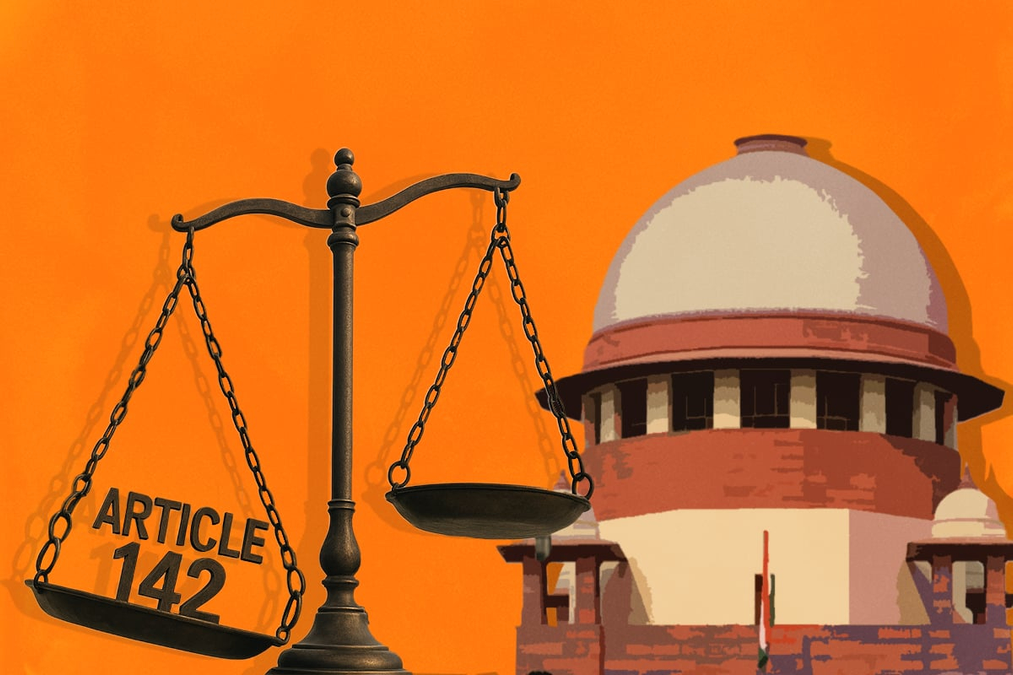
Article 142 Supreme Court powers represent one of the most extraordinary — and debated — provisions in the entire Constitution of India, granting the apex court authority to pass any order necessary for doing complete justice.
Under Article 142(1), this power applies to any cause or matter pending before the Supreme Court, and every decree or order so passed is enforceable throughout the territory of India.
What makes this provision truly unique is its scope: it does not have any counterpart in most of the major written constitutions of the world, and has its origin in the age-old concepts of justice, equity, and good conscience.
Article 142 Supreme Court Powers: The Background
Article 142 sits within Part V of the Constitution of India, the part that establishes the Union’s constitutional machinery — including the Supreme Court itself.
The provision was not always numbered as it is today. Draft Article 118, which eventually became Article 142, was debated in the Constituent Assembly on 27th May 1949. Its adoption reflected a deliberate choice to vest the Supreme Court with residual, equity-based authority.
India Code, the official government legal repository at indiacode.nic.in, lists Article 142 under the heading: “Enforcement of decrees and orders of Supreme Court and orders as to discovery, etc.” That heading captures only part of the provision’s reach.
The full constitutional text reveals two distinct limbs of the power:
- Article 142(1): Empowers the Supreme Court to pass any decree or order necessary for doing complete justice in any cause or matter pending before it — enforceable across all of India.
- Article 142(2): Separately gives the Supreme Court power to secure the attendance of persons, production of documents, or to punish contempt of itself.
- Foundational character: The provision has no direct parallel in most major written constitutions globally, rooted instead in equity, justice, and good conscience.
Read our guide to understanding Indian law for broader context.
Key Developments in Article 142 Supreme Court Powers
The judicial interpretation of Article 142 Supreme Court powers has evolved significantly through landmark constitutional decisions, each sharpening the boundaries of when and how this authority may be invoked.
- Supreme Court Bar Association v. Union of India (1998): The Supreme Court held that powers under Article 142 are “inherent in the Court and are complementary to those powers which are specifically conferred on the Court by various statutes.” The Court described these as “supplementary powers” — a “residual source of power” the Court may draw upon whenever it is just and equitable to do so.
- The two-purpose framework: Over the years, Article 142 has been used primarily for two purposes — firstly, to do complete justice in a given case, and secondly, to fill what the Court perceives as legislative gaps where Parliament has not acted.
- The Constitution Bench limitation: A five-judge Constitution Bench clarified that the jurisdiction under Article 142 should be invoked judiciously and only in extraordinary circumstances to address specific situations requiring immediate attention. The powers conferred by Article 142 are meant to further the cause of justice — not to circumvent the ordinary legal framework.
Source: Supreme Court of India and India Code.
Legal Analysis: What Article 142 Supreme Court Powers Mean
The analytical significance of Article 142 Supreme Court powers lies in their hybrid character. Courts typically exercise judicial functions — but Article 142 enables the Supreme Court to exercise executive and legislative functions in specific scenarios.
This includes issuing guidelines, directives, or orders to governmental bodies where no statutory framework adequately addresses the situation before the Court.
The provision permits the Court to intervene in matters concerning public interest, human rights, constitutional values, or fundamental rights — areas where a strict reading of existing statutes may leave justice incomplete.
Critically, the Supreme Court Bar Association ruling of 1998 framed these powers as supplementary — not superior. Article 142 is not a licence to override the law but a constitutional tool to fill the spaces the law leaves open.
The Constitution Bench’s caution about “extraordinary circumstances” is equally important. The power is meant to be a scalpel, not a sledgehammer — deployed judiciously, not routinely.
Why Article 142 Supreme Court Powers Matter to You
- For citizens: When statutory remedies fail or legislative gaps leave rights unprotected, Article 142 can be the basis for the Supreme Court to step in and deliver enforceable relief across all of India — including on matters of public safety such as road infrastructure.
- For legal practitioners: Understanding that Article 142 is a supplementary, residual power — not an independent cause of action — shapes how petitions are framed before the Supreme Court. Arguments must identify the “cause or matter” pending and the gap that requires the Court’s equity-based intervention.
- For government bodies: Article 142 orders are enforceable throughout India and may carry executive directions to governmental bodies. Non-compliance carries serious constitutional consequences, including contempt under Article 142(2) itself.
- Watch this space: The five-judge Constitution Bench’s guidance that Article 142 jurisdiction must be invoked “judiciously” signals ongoing judicial calibration of this power — and future rulings may further define its outer limits.
What is Article 142 Supreme Court powers?
Article 142 Supreme Court powers refer to the authority granted under Article 142(1) of the Constitution of India, which allows the Supreme Court to pass any decree or order necessary for doing complete justice in any cause or matter pending before it. These orders are enforceable across all of India. Article 142(2) additionally empowers the Court to secure attendance of persons, production of documents, and to punish contempt of itself. The provision sits within Part V of the Constitution and has no direct counterpart in most major written constitutions of the world.
How does Article 142 Supreme Court powers affect me in India?
Article 142 Supreme Court powers can affect Indian citizens directly when the Court uses this provision to issue enforceable directions to governmental bodies on matters involving public interest, human rights, constitutional values, or fundamental rights. In practice, this means the Supreme Court can order action — including on infrastructure, public safety, and policy implementation — that goes beyond what ordinary statutory remedies provide, filling legislative gaps where Parliament has not acted.
What is the legal framework for Article 142 Supreme Court powers?
The legal framework is constitutional: Article 142 is found in Part V of the Constitution of India. India Code (indiacode.nic.in), the official government legal repository, lists it under “Enforcement of decrees and orders of Supreme Court and orders as to discovery, etc.” The provision was derived from Draft Article 118, debated on 27th May 1949 in the Constituent Assembly. Judicial interpretation — including the Supreme Court Bar Association v. Union of India (1998) ruling and subsequent Constitution Bench guidance — has shaped how and when these powers may be exercised.
What should I do if Article 142 Supreme Court powers affects me?
If you believe an Article 142 order of the Supreme Court affects your rights or obligations, the first and most important step is to consult a qualified legal professional. Article 142 orders are constitutionally enforceable across India and carry significant legal weight. A lawyer experienced in constitutional or public law can advise you on your specific situation, including any compliance obligations or avenues for relief that may be available to you.
Conclusion
Article 142 Supreme Court powers occupy a singular place in India’s constitutional architecture — a deliberate grant of equity-based, residual authority that allows the apex court to act wherever justice demands and the law falls short.
From its origins as Draft Article 118 debated in 1949, to its articulation in the Supreme Court Bar Association ruling of 1998, to its calibration by a five-judge Constitution Bench, this provision has been consistently recognised as supplementary and extraordinary — not routine.
Its application to matters of public infrastructure, including India’s highway network, reflects the provision’s core purpose: when the legislative framework leaves a gap and justice requires action, the Supreme Court has the constitutional authority to fill that space — and every decree it passes under Article 142 carries the force of law across the entire territory of India.
Stay ahead of Indian legal developments at The Courtroom — India’s sharpest legal news platform.
Disclaimer: This article is for general informational purposes only and does not constitute legal advice. Laws and regulations are subject to change. Readers are strongly advised to consult a qualified legal professional. The Courtroom makes no warranties regarding the accuracy or completeness of this information.

