


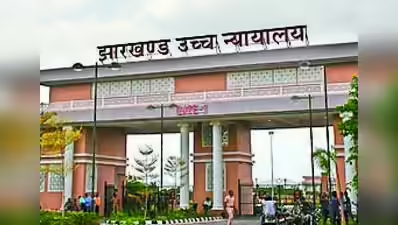
In a significant ruling on June 30, 2026, the Jharkhand High Court held that bhang does not fall within the statutory definition of ‘cannabis (hemp)’ under Section 2(iii) of the NDPS Act, 1985 — and set aside a seven-year rigorous imprisonment sentence against the appellant.
Justice Pradeep Kumar Srivastava, sitting as a Single Bench, allowed the criminal appeal in Sunil Kumar Singh v. State of Jharkhand (Neutral Citation: 2026:JHHC:19082), according to LiveLaw.
Background: How We Got Here
The case traces its origins to October 17, 2000, when a police patrol team intercepted the appellant, Sunil Kumar Singh, near the Chaibasa Bus Stand in Jharkhand. The prosecution alleged that approximately 11 kilograms of ganja were recovered from his possession during that search, as reported by ThePresspad.
The matter came before the Jharkhand High Court as Cr. Appeal (S.J.) No. 726 of 2009, heard by Justice Pradeep Kumar Srivastava of the Single Bench, per Verdictum.
- An FSL report dated November 29, 2002 — issued well after the arrest — concluded that the seized substance was bhang, not ganja, according to ThePresspad.
- Despite this finding, the lower court at Jamshedpur convicted the appellant under Sections 22(B), 20(B), and 11(B) of the NDPS Act and sentenced him to seven years’ rigorous imprisonment along with a fine of Rs. 50,000, per Verdictum.
- The appellant challenged that conviction before the Jharkhand High Court, arguing that bhang — the substance actually recovered — is not a prohibited drug under the NDPS Act.
The Ruling — Key Findings
Justice Srivastava examined Section 2(iii) of the NDPS Act, which defines ‘cannabis (hemp)’ to include charas, ganja (the flowering or fruiting tops of the cannabis plant), and any mixture of these — but expressly excludes seeds and leaves when not accompanied by the tops, according to Verdictum.
The Court found that bhang, which is derived from the leaves of the cannabis plant, falls squarely within that exclusion. As Justice Srivastava observed:
“In the instant case, there is no allegation of cultivation of cannabis plant, rather possession of some substance like Ganja, which was ultimately found to be Bhang, which is specifically excluded from the purview of N.D.P.S.”
The State had argued that because the FSL report noted both bhang and ganja are forms of cannabis, the substance should still attract NDPS liability. The Court rejected this argument outright, per ThePresspad.
Justice Srivastava further held that the State Government had issued no notification under the NDPS Act classifying bhang as a prohibited drug, and no rules had been framed to that effect, as reported by Verdictum.
The Court stated pointedly:
“Since ganja leaves and seeds are excluded from the definition of ganja and nowhere in the NDPS Act the Bhang is referred as a prohibited drink or prohibited drug.”
On these findings, the Court set aside the appellant’s conviction and the sentence of seven years’ rigorous imprisonment with Rs. 50,000 fine under Sections 22(B), 20(B), and 11(B) of the NDPS Act.
The ruling aligns with decisions from other High Courts, including the Karnataka High Court, and earlier judgments in Madhukar v. State of Maharashtra (2002) and Arjun Singh v. State of Haryana (2004), all of which reached the same conclusion that bhang is not covered under the NDPS Act, per LegalServicesIndia.
The Court also noted that bhang may still be subject to state-specific excise regulation — meaning its consumption or sale can be regulated by state governments independently — but its mere possession does not constitute a criminal offence under the central NDPS framework.
Reactions & What’s Next
The sources do not report specific reactions from counsel or the State of Jharkhand following the pronouncement of the verdict on June 30, 2026.
With the conviction now set aside by the Jharkhand High Court, the matter concludes at this stage for the appellant. Whether the State pursues a further challenge before the Supreme Court has not been reported in the available sources.
The judgment adds to a growing body of High Court precedent holding that bhang — long consumed in India in cultural and religious contexts — remains outside the prohibitory net of the NDPS Act absent a specific state notification. Bhang sold at state-licensed shops during festivals such as Holi, for instance, operates under state excise frameworks rather than the NDPS Act.
Disclaimer
Disclaimer: This article is for general information only and does not constitute legal advice. Laws may change or vary by case — consult a qualified lawyer before acting. The Courtroom is not liable for any reliance on this content.

