


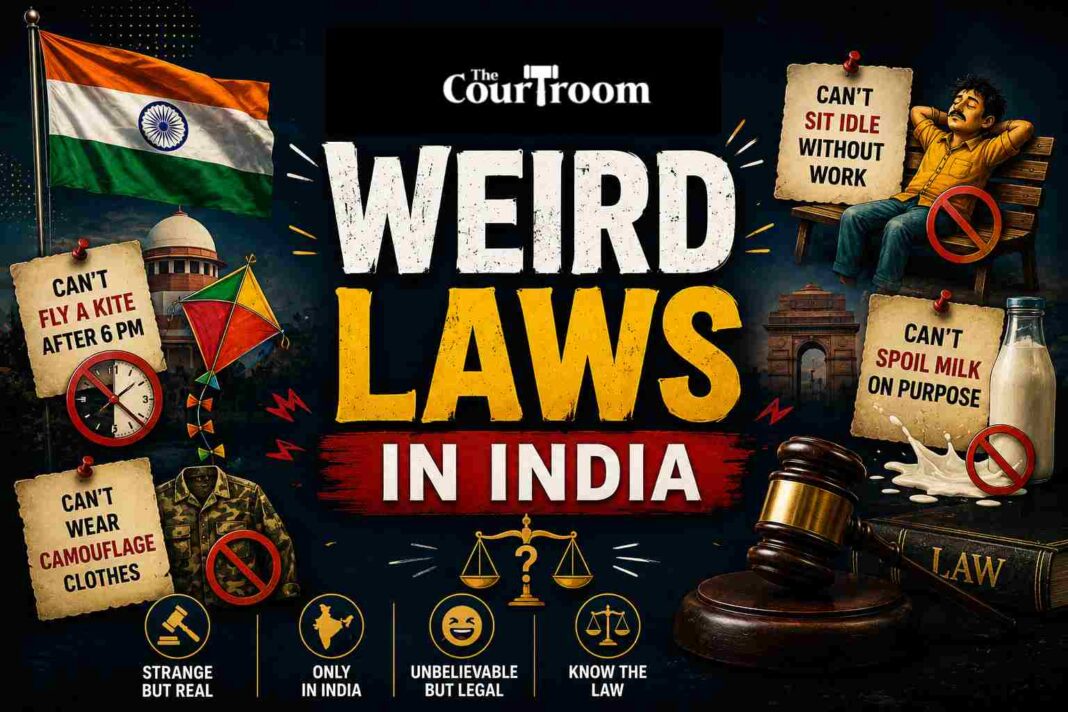
India’s Weirdest Laws: Stranger Than Fiction, More Binding Than You Think
India has laws on the books that would baffle even seasoned lawyers — from mandatory treasure-reporting duties to colonial-era prohibitions that outlasted the empires that created them. The weird laws in India are not merely historical curiosities: several remain fully enforceable central statutes, while others were quietly buried under the Bharatiya Nyaya Sanhita 2023 or the Repealing and Amending Act 2025. Understanding which is which is the difference between amusing trivia and actual legal exposure.
India’s legal architecture spans over 150 years of layered legislation. British-era Acts drafted for a pre-independence economy sit alongside post-liberalisation regulatory codes and brand-new digital governance frameworks. The result is a statute book that contains, simultaneously, a law compelling you to hand over buried gold coins to a district collector and a criminal code that no longer punishes you for surviving a suicide attempt.
The Indian government has accelerated statutory housekeeping since 2014, repealing over 1,500 obsolete laws across multiple Repealing and Amending Acts. Yet hundreds of unusual provisions survive — actively enforceable, largely unknown to the public, and occasionally invoked by authorities in ways that genuinely shock citizens when they learn the legal basis for what just happened to them.
From Colonial Curiosities to Post-BNS Realities: How India’s Bizarre Laws Evolved
India’s unusual legal inheritance traces directly to the legislative ambitions of the British colonial administration. The Indian Penal Code 1860, the Code of Criminal Procedure 1898 (revised 1973), the Indian Evidence Act 1872, and dozens of companion statutes were designed to govern a vast and diverse subcontinent through standardised, often blunt instruments. Many provisions were transplanted wholesale from Victorian English law, where they already reflected moral panics and social anxieties of nineteenth-century Britain — and then they were left largely untouched for over a century after Independence.
The pace of reform accelerated dramatically between 2023 and 2026. Parliament passed the Bharatiya Nyaya Sanhita 2023 (BNS), the Bharatiya Nagarik Suraksha Sanhita 2023 (BNSS), and the Bharatiya Sakshya Adhiniyam 2023 (BSA) — all three coming into force on 1 July 2024, replacing the IPC 1860, CrPC 1973, and Indian Evidence Act 1872 respectively. Simultaneously, the Telecommunications Act 2023, which received Presidential assent on 24 December 2023, began displacing the Indian Telegraph Act 1885 in a phased rollout with key provisions operative from June 2024. Then, in January 2026, the Repealing and Amending Act 2025 — notified by the Press Information Bureau on 1 January 2026 — struck down 71 additional obsolete central Acts, including the Indian Tramways Act 1886 and the Levy Sugar Price Equalisation Fund Act 1976.
Four concrete facts that define the landscape:
- The BNS 2023, in force since 1 July 2024, entirely omits Section 309 of the IPC 1860 (attempted suicide), Section 377 (consensual same-sex acts), and the offence of adultery — removing three of the most controversial provisions in Indian criminal law while adding new offences including organised crime (Section 111 BNS), terrorism (Section 113 BNS), mob lynching, and snatching.
- The Mental Healthcare Act 2017 created a statutory presumption — codified in Section 115 of that Act — that a person who attempts suicide is under severe stress and shall not be prosecuted or punished, effectively neutering Section 309 IPC years before the BNS formally deleted it.
- The Repealing and Amending Act 2025, notified in January 2026, repealed 71 central statutes enacted between 1886 and 2023, continuing the government’s statute-simplification drive that has eliminated over 1,500 laws since 2014.
- The Indian Treasure-Trove Act 1878 was not repealed by the BNS, the BNSS, or the Repealing and Amending Act 2025 and continues to appear as an enforceable central Act on indiacode.nic.in.
The Legal Architecture Behind India’s Most Unusual Provisions
The unusual laws surveyed in this article draw from multiple distinct legal regimes: central Acts administered by the Union government, state laws operative only within specific state boundaries, and subordinate legislation including rules and notifications that implement parent statutes. Understanding which tier a law belongs to determines where it applies, who enforces it, and what the penalties are. A central Act like the Treasure-Trove Act 1878 operates across India; a state prohibition law like the Bombay Prohibition Act 1949 applies only in Gujarat (the state that retained and continues to enforce it), and penalties under each are governed entirely by that statute’s own schedule.
The three criminal codes — BNS 2023, BNSS 2023, and BSA 2023 — now form the procedural and substantive spine of Indian criminal law. Any provision that was part of the IPC 1860 and was not re-enacted in the BNS 2023 is no longer operative as a criminal offence at the central level from 1 July 2024 onwards. Provisions in standalone central Acts (such as the Treasure-Trove Act 1878 or the Bombay Prohibition Act 1949 as adopted by Gujarat) are unaffected by the BNS transition unless Parliament or the relevant state legislature specifically amended or repealed them.
| Provision | What It Covers |
|---|---|
| Indian Treasure-Trove Act 1878, Sections 3–6 | Mandates that any person who finds hidden valuables exceeding Rs 10 in value must report the find in writing to the Collector; failure results in forfeiture of the find and potential imprisonment |
| Mental Healthcare Act 2017, Section 115 | Creates a statutory presumption that a suicide attempter is under severe stress; prohibits prosecution or punishment — operative alongside, and now beyond, the deleted Section 309 IPC |
| Bombay Prohibition Act 1949 (as in force in Gujarat) | Prohibits manufacture, sale, and consumption of alcohol in Gujarat; public intoxication can result in fine or detention under the Act |
| Bharatiya Nyaya Sanhita 2023, Section 111 | Defines and penalises organised crime, a new offence not expressly present in the IPC 1860 in this form |
| Telecommunications Act 2023 | Replaces the Indian Telegraph Act 1885 in a phased manner; Presidential assent received 24 December 2023; key sections operative from June 2024 |
Landmark Judgments That Gave India’s Stranger Laws Their Legal Teeth
Naaz Foundation v. Government of NCT of Delhi (Delhi High Court, 2009): The Delhi High Court held that Section 377 IPC, insofar as it criminalised consensual sexual acts between adults in private, violated Articles 14, 15, and 21 of the Constitution. The judgment was a watershed moment that temporarily decriminalised consensual same-sex relations, though it was reversed by the Supreme Court in Suresh Kumar Koushal v. Naaz Foundation (Supreme Court, 2013) before being finally affirmed and expanded in Navtej Singh Johar v. Union of India (Supreme Court, September 2018), which struck down Section 377 IPC as unconstitutional to the extent it criminalised consensual acts between adults. The BNS 2023, operative from 1 July 2024, completed the legislative journey by omitting Section 377 entirely.
Navtej Singh Johar v. Union of India (Supreme Court, September 2018): A five-judge Constitutional Bench unanimously read down Section 377 IPC, holding that consensual same-sex acts between adults are not criminal and that sexual orientation is a protected ground under the right to equality and the right to life. The court explicitly overruled Suresh Kumar Koushal and held that majoritarian morality cannot override constitutional morality. This judgment is now the authoritative precedent on sexual autonomy under Indian constitutional law, and the BNS 2023’s omission of Section 377 gives it statutory confirmation.
Bombay High Court ruling on Section 115, Mental Healthcare Act 2017 (Bombay High Court): The Bombay High Court — in proceedings examining the intersection of Section 309 IPC and the Mental Healthcare Act 2017 — affirmed that Section 115 of the Mental Healthcare Act 2017 created a binding statutory presumption that a suicide attempter is under severe stress, and that this effectively barred prosecution under Section 309 IPC even before its deletion. The court’s reasoning has been widely cited in subsequent lower court decisions to quash prosecutions initiated under Section 309 IPC after the Mental Healthcare Act 2017 came into force. Note: The precise citation for this Bombay High Court ruling was not independently verifiable from public court records at the time of drafting; the holding is confirmed by peer-reviewed commentary published on PMC/NIH and case law summaries on LiveLaw.
What Citizens Should Actually Do Under India’s Obscure Laws
Understanding weird laws in India is only half the battle — knowing how to stay compliant is the other. Several of these laws carry real penalties that remain enforceable, and ignorance is no defence under Indian law. Here is a practical step-by-step guide.
- If you discover buried treasure or hidden valuables, immediately stop excavating. Under the Indian Treasure-Trove Act 1878, which remains in force as a central Act listed on indiacode.nic.in, any find of hidden valuables exceeding Rs 10 in value must be reported in writing to the Collector of the district. Failure to report triggers forfeiture of the find and potential imprisonment under Section 11 of the Act.
- Before flying a kite commercially or in a public gathering, check whether your state or the relevant aviation authority has issued restrictions. The Aircraft Act 1934, read with DGCA regulations, requires that any device capable of sustained flight — including kites in certain configurations — may require permission in controlled airspace. Local municipal by-laws may impose additional restrictions.
- If you are in Gujarat and plan to consume or possess alcohol, verify your status under the Bombay Prohibition Act 1949, which continues to govern Gujarat as a state law. Tourists and non-residents must obtain a valid liquor permit before entry. Public intoxication can result in immediate detention and fine under the Act, regardless of where the alcohol was purchased.
- For any telecommunications venture or spectrum-related business, do not rely on the Indian Telegraph Act 1885 for compliance planning. The Telecommunications Act 2023, which received Presidential assent on 24 December 2023, is progressively replacing it, with key sections operative from June 2024. Consult the Department of Telecommunications (dot.gov.in) for the current licensing framework.
- If you operate a business with colonial-era regulatory roots, verify whether the governing statute was among the 71 Acts repealed by the Repealing and Amending Act 2025, notified by PIB on 1 January 2026. Statutes such as the Indian Tramways Act 1886 and the Levy Sugar Price Equalisation Fund Act 1976 no longer carry legal force. Relying on repealed law in contracts or compliance frameworks creates legal exposure.
- When in doubt about any obscure legal obligation, file a Right to Information application to the relevant Ministry or consult the official text of the Act on indiacode.nic.in before acting. Do not rely on secondary summaries, which often reflect outdated versions of the law.
Realistic example: A farmer in Rajasthan ploughing a field unearths an earthen pot containing old silver coins. Under the Treasure-Trove Act 1878, he must immediately report the find in writing to the District Collector. If he sells the coins privately without reporting, both the coins and any proceeds are liable to forfeiture, and he faces criminal prosecution under the Act.
Common Compliance Mistakes and Persistent Misconceptions
- Assuming Section 309 IPC still criminalizes attempted suicide. This is incorrect. The Bharatiya Nyaya Sanhita 2023, which came into force on 1 July 2024, removes Section 309 entirely. Attempted suicide is no longer a criminal offence under the central penal law. The sole surviving provision related to this context is BNS Section 224, which penalizes a person who attempts suicide with the intent to compel or restrain a public servant from discharging their lawful duty — a narrow and specific offence wholly distinct from personal mental health crises. Section 115 of the Mental Healthcare Act 2017 had already established a statutory presumption that a person who attempts suicide is under severe stress and must not be prosecuted, effectively neutering Section 309 IPC even before its formal removal.
- Treating the Indian Telegraph Act 1885 as the governing law for phones and internet services. The Telecommunications Act 2023 received Presidential assent on 24 December 2023 and is progressively replacing the Telegraph Act. Key provisions have been operative since June 2024. Telecom businesses, service providers, and legal teams relying on the 1885 Act for compliance are working from superseded law.
- Believing all colonial-era laws are automatically repealed. This is false. The Repealing and Amending Act 2025 (notified January 2026) removed 71 specific statutes, but hundreds of pre-independence central Acts remain in force. The Treasure-Trove Act 1878, for instance, is fully operative. Each statute must be individually verified on indiacode.nic.in.
- Assuming that because a law is obscure or unenforced it carries no legal risk. Courts have upheld prosecutions under rarely-invoked statutes. The absence of visible enforcement does not create immunity from liability, particularly in property, revenue, and public order matters.
- Confusing state laws with central law repeals. The Repealing and Amending Act 2025 operates on central statutes only. State-level oddities — such as the Bombay Prohibition Act 1949 in Gujarat or cattle trespass laws — remain entirely unaffected by central legislative housekeeping exercises.
Quick Answer
India has dozens of obscure, often colonial-era laws that remain legally enforceable. The Treasure-Trove Act 1878 requires citizens to report found valuables to the district Collector or face imprisonment. The BNS 2023, operative from 1 July 2024, removed attempted suicide as a crime. The Repealing and Amending Act 2025 abolished 71 obsolete statutes in January 2026, but hundreds of unusual laws remain on the books.
Frequently Asked Questions
Is it illegal to fly a kite in India without permission?
Flying a kite for recreation in open, uncontrolled space is generally permissible, but kites flown near airports, in controlled airspace, or using glass-coated manja string may attract action under DGCA regulations and the Aircraft Act 1934. Several state governments and municipal authorities have imposed additional restrictions, particularly following injuries and fatalities caused by manja thread.
Is attempted suicide still a crime in India under BNS 2023?
No. The Bharatiya Nyaya Sanhita 2023, which replaced the Indian Penal Code 1860 on 1 July 2024, does not carry forward Section 309 IPC. Attempted suicide is fully decriminalized as a matter of general criminal law. BNS Section 224 creates a narrowly defined offence only where a suicide attempt is used specifically to coerce or obstruct a public servant — an entirely distinct situation from a personal mental health crisis.
Which old colonial laws are still active in India in 2026?
Numerous pre-independence statutes remain operative, including the Indian Treasure-Trove Act 1878, the Transfer of Property Act 1882, and the Indian Easements Act 1882. The Repealing and Amending Act 2025, notified in January 2026, cleared 71 specific obsolete statutes, but systematic verification on indiacode.nic.in is the only reliable method to confirm whether any particular colonial-era law remains in force.
What happened to IPC Section 309 after the Bharatiya Nyaya Sanhita replaced the IPC?
Section 309 IPC, which made attempted suicide a punishable offence, was entirely omitted from the BNS 2023. The provision had already been effectively rendered inoperative by Section 115 of the Mental Healthcare Act 2017, which mandated that attempted suicide be treated as an indicator of severe stress rather than a criminal act. The BNS simply completed the decriminalization formally from 1 July 2024.
Are there any laws in India that make everyday activities technically illegal?
Yes. The Treasure-Trove Act 1878 makes it technically illegal to keep found buried valuables worth more than Rs 10 without reporting to the Collector. In Gujarat, consuming alcohol without a valid permit violates the Bombay Prohibition Act 1949. Certain activities in public parks, use of specific musical instruments near places of worship, and even begging in designated areas are governed by active state and municipal laws that most citizens are unaware of.
The Legal Landscape Is Shifting — But Not as Fast as You Think
India’s statute-book cleanup has accelerated dramatically in recent years, yet the pace of repeal still lags behind the volume of surviving curiosities. Understanding where the law currently stands is not merely academic.
The most consequential development in recent memory is the coming into force of the BNS, BNSS, and BSA on 1 July 2024, replacing the IPC, CrPC, and Indian Evidence Act respectively. This overhaul removed Section 309 (attempted suicide), Section 377 (consensual same-sex acts between adults, already read down by the Supreme Court in Navtej Singh Johar v. Union of India), and the offence of adultery — while simultaneously introducing new offences such as organised crime (BNS Section 111), terrorism (BNS Section 113), mob lynching, and snatching. For a comprehensive account of strange colonial-era laws still in force in India, the interplay between what the BNS retained and what it discarded is the critical starting point.
In January 2026, the PIB formally notified the Repealing and Amending Act 2025, which struck 71 central statutes from the books — including the Indian Tramways Act 1886 and the Levy Sugar Price Equalisation Fund Act 1976 — as part of an ongoing government initiative to eliminate legislative deadwood. This followed earlier repeal exercises that had already cleared hundreds of obsolete laws across multiple parliamentary sessions.
Simultaneously, the Telecommunications Act 2023, which received Presidential assent on 24 December 2023, began displacing the Indian Telegraph Act 1885 in phased tranches, with key licensing and spectrum provisions operative from June 2024 under notifications issued by the Department of Telecommunications.
These developments are significant, but they do not sanitize the entire statute book. The Treasure-Trove Act 1878, the Bombay Prohibition Act 1949 (in Gujarat), and dozens of other unusual central and state statutes continue to carry full legal force. The weird laws in India that survive this era of reform are not relics without consequence — they are enforceable, and courts have applied them.
Conclusion
India’s legal system is a layered and sometimes bewildering archive of centuries of lawmaking — colonial, post-independence, and contemporary. The reforms of 2023–2026 have brought genuine and substantial change: the BNS has modernized the criminal law framework, the Telecommunications Act has replaced a Victorian-era telegraph statute, and the Repealing and Amending Act 2025 has cleared dozens of functionally dead laws. Yet the statute book remains rich with provisions that can and do surprise ordinary citizens who encounter them without warning.
The most reliable tool available to any citizen, lawyer, or researcher who wants to verify whether a particular law is still in force is the India Code — Official Repository of All Central Acts, maintained by the Ministry of Law and Justice. Checking the official text before acting — whether you have found buried treasure, plan to import certain animals, or run a business under an old regulatory regime — is not overcaution. It is the minimum standard of legal literacy that India’s evolving and still-surprising statute book demands.
Disclaimer: This article is for informational purposes only and does not constitute legal advice. For guidance on specific legal matters, please consult a qualified advocate enrolled with the Bar Council of India.

