


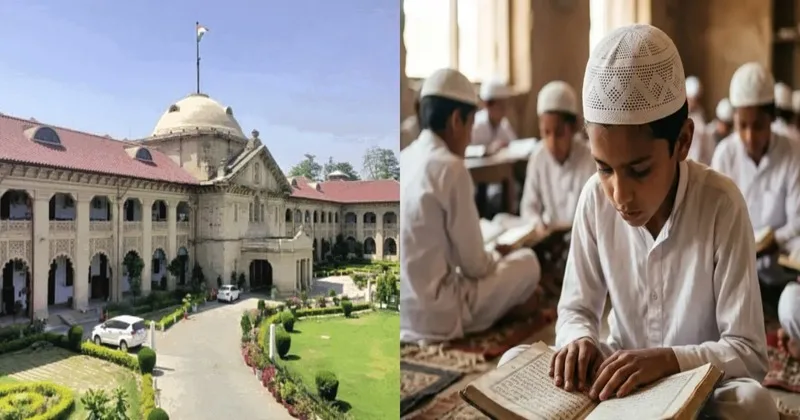
On July 1, 2026, a division bench of the Allahabad High Court dismissed a writ petition seeking to stay the Uttar Pradesh Anti Terrorist Squad’s inquiry into the funding of more than 4,000 unaided madrassas, clearing the way for the investigation to proceed.
The bench of Justice Neeraj Tiwari and Justice Vivek Saran held that the initiation of a fact-finding inquiry cannot be treated as a coercive action against the petitioner institutions, according to LiveLaw.
Background & Case History
The dispute originates from a State Government order dated December 9, 2025, which directed the UP ATS to probe the funding sources of more than 4,000 unaided madrassas operating across Uttar Pradesh.
The inquiry was triggered by intelligence inputs alleging receipt of foreign funding and the construction of large-scale institutions without clear financial documentation or verifiable sources of income, as reported by LiveLaw and LawBeat.
On December 17, 2025, a meeting chaired by the Inspector General of the ATS was convened to determine the three key aspects of the investigation. Subsequently, on January 9, 2026, Ankit Kumar Agarwal, then Director of the Minority Welfare Department, issued instructions to District Minority Officers to verify transactions in bank accounts of madrassa management committees, per the Organiser.
The petitioners — the Madrasa Management Committee and the Teachers’ Association, Madrasas Arabia — filed their writ petition before the Allahabad High Court on February 11, 2026, naming ATS officials as respondents. The case was registered as Committee Of Management And Another vs State of UP and 5 others — 2026 LiveLaw (AB) 348.
- December 9, 2025: State Government issues order initiating ATS inquiry into madrassa funding across Uttar Pradesh.
- December 17, 2025: Meeting chaired by the ATS Inspector General decides on three key aspects of the inquiry.
- January 9, 2026: Director of Minority Welfare Department issues instructions to District Minority Officers to verify madrassa bank account transactions.
- February 11, 2026: Petitioners file writ petition before the Allahabad High Court; court declines interim stay but issues notices to the state and the ATS.
- July 1, 2026: Division bench dismisses the petition, clearing the ATS probe to continue unhindered.
Arguments & Submissions
Senior Counsel VK Singh, assisted by Advocate Mohd. Ali Ausaf, appeared for the petitioners and argued that two earlier inquiries had been conducted on almost the same grounds, and nothing adverse had been found against the madrassas on either occasion, according to LiveLaw.
The petitioners contended that the current probe amounted to harassment of minority educational institutions and sought quashing of the December 9, 2025 State Government order that had set the investigation in motion.
For the State, Additional Advocate General Manish Goel, assisted by Advocate AK Goel, informed the court that the ATS inquiry covered nearly 4,000 institutions and was based on inputs received from different intelligence sources, as reported by LawBeat.
The State submitted that the inquiry was a legitimate fact-finding exercise premised on credible intelligence about alleged foreign funding and unexplained construction of large institutions, and that no punitive action had yet been taken against any institution.
The Ruling: Key Findings
The division bench of Justice Neeraj Tiwari and Justice Vivek Saran dismissed the writ petition on July 1, 2026, declining to exercise the court’s writ jurisdiction at this stage, as reported by LawBeat and LiveLaw.
In its operative observations, the bench held: “the conduct of inquiry cannot be said to be coercive action against the petitioners.”
The bench further declared it was “not inclined to entertain this petition at this stage,” expressly refraining from expressing any opinion on the merits of the allegations or on the likely outcome of the ATS inquiry.
The court directed that if the petitioners file any reply before the Inquiry Committee, that reply shall be duly considered before any further proceedings are taken against the institutions, according to LawBeat.
Legal Analysis & Implications
The court’s reasoning rests on a well-established principle of writ jurisdiction: that a preliminary fact-finding inquiry, standing alone, does not constitute adverse or coercive state action sufficient to attract judicial intervention at the threshold stage.
By declining to stay the inquiry and simultaneously preserving the petitioners’ right to file replies before the Inquiry Committee, the bench struck a procedural balance — allowing the investigation while keeping a future challenge open should concrete adverse orders follow.
The ruling is significant because it affects not just the two petitioner bodies but the broader landscape of more than 4,000 unaided madrassas under the ATS scanner. It signals that courts are unlikely to pre-empt intelligence-driven fact-finding exercises absent a concrete, demonstrable prejudice to the institutions under scrutiny.
The court’s express refusal to comment on the merits of the foreign funding allegations also means the outcome of the ATS inquiry — and any adverse findings — could independently become the subject of fresh legal proceedings by the affected institutions.
Reactions & Stakeholder Response
Following the High Court’s order, the President of the All India Muslim Jamaat, Maulana Shahabuddin Razvi Barelvi, publicly welcomed the ATS probe into madrassa funding, according to reports carried by Prokerala citing IANS on July 4, 2026.
The reaction is notable given that a senior religious figure from within the Muslim community has endorsed the state’s investigative exercise, even as the petitioner management committees and teachers’ associations had sought to halt it through litigation.
What’s Next
With the writ petition dismissed, the UP ATS inquiry into the funding of more than 4,000 unaided madrassas is now free to proceed without any judicial stay. District Minority Officers are expected to continue verifying bank account transactions of madrassa management committees in coordination with local intelligence units.
The petitioners retain the avenue of filing replies before the Inquiry Committee, and the court’s direction ensures those replies must be considered before any adverse action is taken. Should the inquiry result in concrete adverse findings or penal orders, the affected institutions may approach the High Court afresh with a more specific challenge on the merits.
More legal news at The Courtroom.
Disclaimer
Disclaimer: This article is for general information only and does not constitute legal advice. Laws may change or vary by case — consult a qualified lawyer before acting. The Courtroom is not liable for any reliance on this content.

