


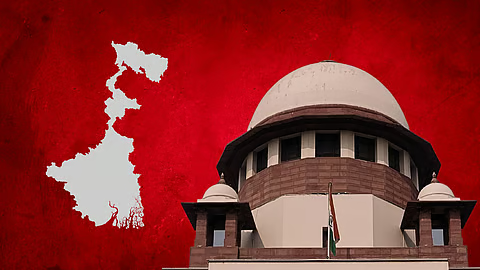
The Supreme Court on June 24, 2026 disposed of a writ petition filed by Paschim Banga Khet Majoor Samity challenging West Bengal’s move to link ration card eligibility under the Public Distribution System to Special Intensive Revision electoral outcomes, granting the agricultural workers’ union liberty to withdraw and approach the Calcutta High Court.
A bench of Justice B.V. Nagarathna and Justice Joymalya Bagchi held that the ration card issue constituted a cause of action distinct from the ongoing SIR electoral rolls proceedings, making it more appropriately suited for adjudication before the High Court, according to LiveLaw.
Background & Case History
The dispute traces to two state government notifications that mechanically linked welfare entitlements to outcomes of the Election Commission of India’s Special Intensive Revision exercise in West Bengal.
On May 19, 2026, the West Bengal Department of Women and Child Development and Social Welfare issued a notification linking Annapurna Yojana benefits to SIR classifications. On June 4, 2026, the West Bengal Food and Supplies Department followed with an order mandating a statewide PDS verification exercise tied to SIR outcomes, as reported by Bar & Bench.
The Food and Supplies Department set June 15, 2026 as the deadline for completion of the verification exercise, according to Tribune India. Beneficiaries who had filed appeals before the SIR tribunal or submitted applications under the Citizenship Amendment Act were to remain active in the ration card database until disposal of their appeals.
- May 19, 2026: WB Department of Women and Child Development issues notification linking Annapurna Yojana to SIR classifications.
- June 4, 2026: WB Food and Supplies Department orders statewide PDS verification linked to SIR outcomes.
- June 15, 2026: Deadline set for completion of the statewide verification exercise.
- June 23, 2026: Matter first mentioned before the Supreme Court bench for urgent listing; bench questioned why the High Court had not been approached first.
- June 24, 2026: Supreme Court formally disposes of the Article 32 petition, granting liberty to approach the Calcutta High Court.
Arguments & Submissions
The petition was filed by Paschim Banga Khet Majoor Samity, a Bengal-based agricultural workers’ union, under Article 32 of the Constitution and was assigned Diary No. 37837/2026 in the matter of Paschim Benga Khet Majoor Samity v. State of West Bengal, according to LiveLaw.
Counsel for the petitioner, Advocate Prasanna Kumar, argued before the bench that the impugned orders affected a massive segment of the state’s population. As reported by Bar & Bench, the petitioner warned that between 35 lakh and 60 lakh ration cards could become inactive if the SIR-PDS linkage were applied mechanically across all categories.
The SIR process categorised voters under scrutiny as absentee, shifted, dead, or duplicate electors — referred to collectively as ASDD — along with those whose applications were rejected and those deleted after adjudication, per Tribune India. Persons falling into any of these categories faced potential deactivation of their ration cards under the impugned orders.
Advocate Prasanna Kumar contended that the issue was pan-India in nature, arguing that other states were also linking SIR outcomes to welfare entitlements. He cited the Supreme Court’s own ruling in Association for Democratic Reforms v. Election Commission of India as the backdrop against which the present challenge arose, according to Bar & Bench.
In the petitioner’s own words, as reported by Bar & Bench: “All those people whose names have been excluded in the SIR are sought to be excluded from the ration list and this has caused a lot of problems.”
The petition alleged violations of Article 14 and Article 21 of the Constitution, as well as the objectives of the National Food Security Act, 2013, which guarantees food entitlements to eligible beneficiaries, per The Statesman and Clarion India.
The Ruling: Key Findings
When the matter was first mentioned on June 23, 2026 for urgent listing, the bench was unreceptive to bypassing the High Court. Justice B.V. Nagarathna asked counsel directly: “Why have you filed this under Article 32?” — a question that signalled the bench’s scepticism about Supreme Court jurisdiction at the first instance, per LiveLaw.
The bench directed the petitioner toward the state forum with pointed clarity: “Please take it to the high court,” Justice Nagarathna told petitioner’s counsel, with the bench adding: “The Calcutta High Court is functioning. Go there.”
Justice Nagarathna specifically noted that the Calcutta High Court had resumed functioning after summer vacation, addressing any procedural concern about availability of the forum, according to Clarion India.
On June 24, 2026, the bench formally disposed of the petition. The court held that the ration card linkage constituted a separate cause of action distinct from the SIR electoral rolls matter and was more appropriately adjudicated by the Calcutta High Court, as reported by LiveLaw.
The operative order permitted withdrawal of the writ petition with liberty to approach the Calcutta High Court, leaving the merits entirely open for determination by the High Court.
Legal Analysis & Implications
The petition engaged multiple constitutional and statutory provisions. Article 32 of the Constitution, under which the petition was filed, confers the right to move the Supreme Court for enforcement of fundamental rights. Articles 14 and 21 — guaranteeing equality before law and the right to life respectively — formed the substantive constitutional backbone of the challenge, per The Statesman.
The National Food Security Act, 2013 was cited as the primary statutory framework violated by the impugned orders, with the petitioner contending that administrative linkage of electoral rolls to PDS eligibility cuts against the Act’s guaranteed food entitlement architecture, per Clarion India.
The bench’s separation of the ration card issue as a distinct cause of action from the SIR electoral rolls proceedings is analytically significant. It suggests that welfare entitlement disputes arising from SIR classifications will be channelled through High Courts rather than consolidated into the Supreme Court’s SIR docket, as reported by Bar & Bench.
The Citizenship Amendment Act carve-out embedded in the impugned orders — preserving active ration card status for CAA applicants pending appeal — adds a further constitutional dimension that the Calcutta High Court will be required to examine, per LawChakra and Tribune India.
Reactions & Stakeholder Response
Advocate Prasanna Kumar, appearing for Paschim Banga Khet Majoor Samity, had pressed the Supreme Court for urgent intervention, arguing the scale of potential ration card deactivations — up to 60 lakh cards — demanded immediate judicial attention at the apex level, according to Bar & Bench.
The petitioner-union also sought to frame the challenge as transcending West Bengal alone, contending that a pan-India trend of states linking SIR outcomes to welfare benefits required Supreme Court-level guidance, per LiveLaw. The bench did not accept this framing as sufficient to invoke Article 32 jurisdiction over the ration-specific dispute.
What’s Next
With the Supreme Court’s disposal, Paschim Banga Khet Majoor Samity is now at liberty to file a fresh petition before the Calcutta High Court challenging the June 4 Food and Supplies Department order and the May 19 Women and Child Development Department notification. The Calcutta High Court is the next forum for the challenge, having resumed sitting after summer vacation, according to Clarion India.
The outcome before the Calcutta High Court will have immediate implications for the PDS entitlements of persons classified as absentee, shifted, dead, duplicate, or otherwise excluded under the SIR process across West Bengal, with the petitioner contending up to 60 lakh ration card holders remain at risk, per Tribune India.
More legal news at The Courtroom.
Disclaimer
Disclaimer: This article is for general information only and does not constitute legal advice. Laws may change or vary by case — consult a qualified lawyer before acting. The Courtroom is not liable for any reliance on this content.

