


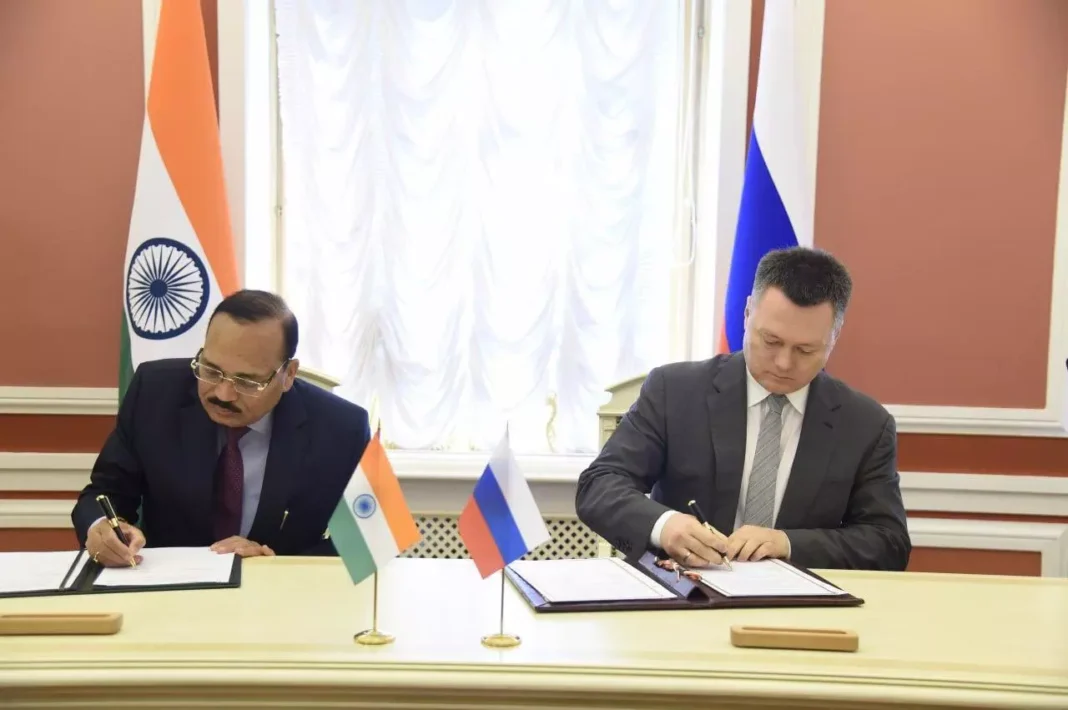
In a landmark diplomatic and institutional development, the Supreme Court of India and the Supreme Court of the Russian Federation signed a first-of-its-kind Memorandum of Understanding in Moscow on June 23, 2026, formalising bilateral judicial cooperation between the two apex courts.
The MoU was signed by Chief Justice of India Surya Kant and Chairman of the Supreme Court of the Russian Federation Igor Krasnov at the Supreme Court of the Russian Federation in Moscow.
Background & Case History
The groundwork for this bilateral engagement was laid during CJI Surya Kant’s earlier visit to Russia in 2024, when he attended the BRICS Chief Justices Conference in Sochi, as reported by ProKerala and IANS.
Justice Surya Kant took oath as the 53rd Chief Justice of India on November 24, 2025. His Moscow visit marks one of the most significant international engagements of his tenure so far.
The two supreme courts serve societies of considerable scale and diversity, but have evolved through distinct legal traditions. Despite those differences, both institutions identified common ground in the modernisation of judicial administration.
- 2024: CJI Surya Kant visits Russia for the BRICS Chief Justices Conference in Sochi, initiating bilateral judicial dialogue.
- November 24, 2025: Justice Surya Kant takes oath as the 53rd Chief Justice of India.
- June 23, 2026: CJI Surya Kant and Chairman Igor Krasnov sign the judicial cooperation MoU at the Supreme Court of the Russian Federation in Moscow.
- June 23, 2026: CJI Surya Kant addresses the Russian delegation, outlining India’s digital judiciary initiatives and AI governance framework.
Arguments & Submissions
During discussions between the two delegations, two key themes dominated, according to LawBeat: the integration of modern and advanced technologies in judicial practice, and investment in judicial education, advanced training, and capacity-building for court personnel.
CJI Surya Kant presented India’s substantial progress under the e-Courts Mission Mode Project, citing digitisation of court records, virtual hearings, video conferencing, and online access to court records, as reported by India Legal and the Daily Pioneer.
CJI Surya Kant also drew attention to AI-driven tools developed by the Indian judiciary — specifically SUVAS (Supreme Court Vidhik Anuvaad Software), which translates judicial documents into regional languages, and the AI-powered chatbot ‘Su Sahy’, designed to assist litigants and lawyers, per LiveLaw.
He additionally referenced the ‘One Case, One Data’ initiative — aimed at creating a standardised digital record for every case across judicial platforms — and the Supreme Court’s recently notified draft regulations governing the use of Artificial Intelligence in the judiciary, according to LiveLaw.
The Ruling: Key Findings
The MoU signed on June 23, 2026, institutionalises cooperation across several pillars: exchange of judicial experiences, sharing of best practices in information technology, and programmes relating to professional training and personnel development, as reported by LawBeat.
CJI Surya Kant, while addressing the Russian delegation, struck a firm note on the limits of artificial intelligence in judicial decision-making. As reported by Bar & Bench and the Daily Excelsior, he stated:
“The administration of justice is, and must remain, fundamentally a human endeavour.”
He further emphasised the forward-looking character of the agreement, saying: “The future of justice will depend upon our ability to combine technological innovation with enduring human values.”
On the scope of institutional collaboration, CJI Surya Kant said: “There is considerable scope for collaboration through exchanges between judicial academies, joint training programmes, research partnerships, and the sharing of best practices between Indian and Russian Judiciaries.”
Legal Analysis & Implications
The MoU represents a first-of-its-kind bilateral agreement between the supreme courts of India and Russia — distinct from multilateral frameworks like BRICS — and signals a move toward structured, institution-to-institution judicial diplomacy.
By covering IT best-practice exchange, the agreement positions India’s judiciary as an active exporter of its digital court architecture. India’s e-Courts project, SUVAS, Su Sahy, and One Case One Data are now formally tabled as reference models for bilateral learning.
The Supreme Court’s recently notified draft AI regulations — referenced by CJI Surya Kant in Moscow — underscore that India is simultaneously deploying AI tools and constructing a governance framework for their responsible use, a dual approach likely to attract attention from other judiciaries.
CJI Surya Kant’s explicit insistence that judicial decision-making must remain a human endeavour also sets a clear normative boundary: technology serves the court; it does not replace the judge. This framing, delivered on an international stage, carries weight as courts globally grapple with AI’s role in adjudication.
Reactions & Stakeholder Response
Bar & Bench, through its official X (formerly Twitter) account, confirmed the meeting and CJI Surya Kant’s address to the Russian delegation, amplifying the significance of his remarks on AI limitations in judicial contexts.
CJI Surya Kant expressed confidence in the durability of the new institutional relationship, stating: “I am confident that continued engagement between the Supreme Court of India and the Supreme Court of the Russian Federation will further strengthen our institutions and enrich the administration of justice in both our countries.”
What’s Next
The MoU now provides a formal institutional framework through which the two supreme courts can operationalise exchanges — including between judicial academies, joint training programmes, and research partnerships — as outlined by CJI Surya Kant during the Moscow visit, per ProKerala and IANS.
The Supreme Court of India’s recently notified draft AI regulations remain an active area of institutional development. Their finalisation will likely shape how India’s judiciary engages with international partners, including Russia, on technology-related judicial cooperation going forward.
More legal news at The Courtroom.
Disclaimer
Disclaimer: This article is for general information only and does not constitute legal advice. Laws may change or vary by case — consult a qualified lawyer before acting. The Courtroom is not liable for any reliance on this content.

