


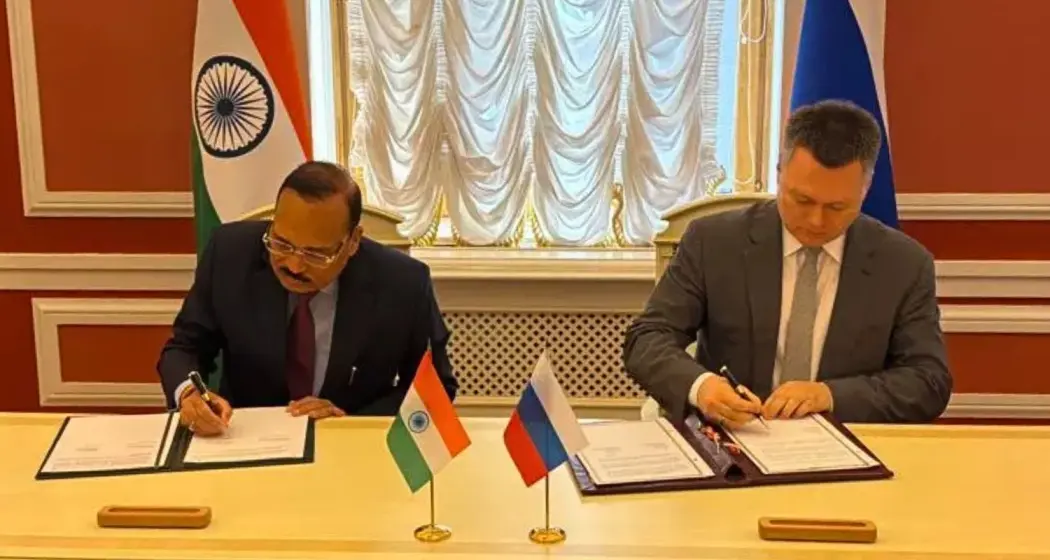
The India Russia judicial MoU, signed on June 23, 2026 in Moscow, represents one of the most consequential institutional agreements between the two countries’ highest courts in recent memory.
Chief Justice of India Justice Surya Kant led a high-level Supreme Court of India delegation to Moscow, where he met with Chief Justice of the Supreme Court of the Russian Federation Igor Krasnov to formalise the agreement.
India Russia Judicial MoU: The Background
The MoU was signed during an official meeting convened in the Marble Hall of the Supreme Court of the Russian Federation in Moscow — a setting that underscored the formal, high-level character of the engagement.
LawBeat described the agreement as a “first-of-its-kind initiative” — the first MoU specifically between the two Supreme Courts focused on technology-driven court administration and professional capacity-building.
- The agreement was signed by CJI Surya Kant and Russian Chief Justice Igor Krasnov during an official bilateral meeting in Moscow.
- The MoU was signed on June 23, 2026, with reports carrying the news through PTI wire dated June 24, 2026.
- The agreement is bilateral between the two apex courts — not a general government-to-government treaty — giving it a distinctly institutional character.
Read our guide to understanding Indian law for broader context.
Key Developments in India Russia Judicial MoU
The MoU lays out a structured framework for cooperation across several domains, with technology and capacity-building at its core. Here are the verified key pillars of the agreement:
- Exchange visits: The MoU affirms the commitment of both Supreme Courts to facilitate regular exchange visits between judicial officials and delegations — enabling direct institutional learning.
- Training programmes: Both short-term and long-term training programmes are envisaged under the MoU, creating structured pathways for judicial and administrative capacity-building between the two systems.
- Joint seminars and conferences: The agreement provides for the organisation of joint seminars and conferences — building a platform for ongoing dialogue on shared challenges in court administration.
- Technology in justice administration: A key area of collaboration is the exchange of experiences and best practices relating to the use of technology in the administration of justice — a domain where both courts have invested significantly in recent years.
Source: Supreme Court of India and India Code.
Legal Analysis: What India Russia Judicial MoU Means
As an MoU between two apex courts — rather than executive branches — this agreement operates within the institutional autonomy of the judiciary. It does not require parliamentary ratification and is not a treaty in the strict international law sense.
Its significance lies in its specificity. By focusing on technology in justice administration and capacity-building, it moves beyond ceremonial diplomacy into actionable reform territory. The establishment of a joint working group on AI and technology — reported by India Legal Live — signals that this MoU is designed to produce measurable outputs, not just diplomatic goodwill.
The “first-of-its-kind” characterisation by LawBeat is analytically significant. It means there is no prior template between these two courts, and both sides are building implementation mechanisms from the ground up. That is both an opportunity and a structural challenge.
India Russia Judicial MoU Matters to You
- For litigants: If technology best practices exchanged under the MoU are absorbed into Indian court administration, the downstream impact could include faster case processing and improved digital access to court services — though implementation timelines remain to be determined.
- For legal practitioners: Joint seminars and conferences envisaged under the agreement may open new professional development avenues — particularly around court technology, case management systems, and comparative procedural law.
- For judicial officers: Short- and long-term training programmes contemplated by the MoU could create structured opportunities for Indian judges and court administrators to study Russian judicial processes, and vice versa.
- What to watch: The reported joint working group on AI and technology in the judiciary is the most concrete deliverable signalled so far. Watch for any formal announcement from the Supreme Court of India on its composition, mandate, and timelines.
Stay ahead of Indian legal developments at The Courtroom — India’s sharpest legal news platform.
Disclaimer: This article is for general informational purposes only and does not constitute legal advice. Laws and regulations are subject to change. Readers are strongly advised to consult a qualified legal professional. The Courtroom makes no warranties regarding the accuracy or completeness of this information.

