


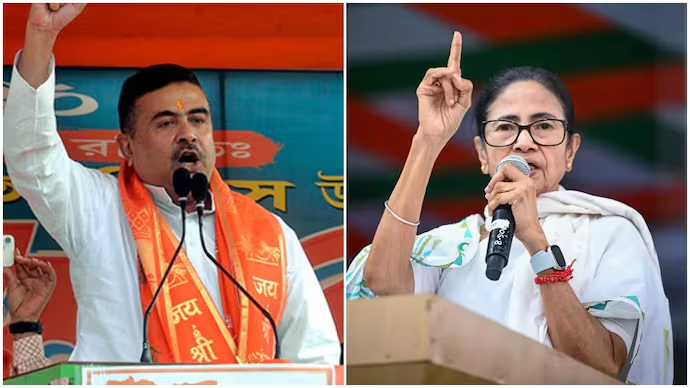
The Bhabanipur election dispute 2026 is now before the Calcutta High Court, after TMC Chairperson Mamata Banerjee formally challenged the return of West Bengal Chief Minister Suvendu Adhikari from the 159-Bhabanipur Assembly Constituency.
Polling in the constituency was held on April 29, 2026, and the result was declared on May 4, 2026. The outcome upended one of West Bengal’s most watched electoral contests, triggering an immediate legal response from the losing candidate.
Bhabanipur Election Dispute 2026: The Background
Bhabanipur has long been regarded as a prestige seat. Mamata Banerjee had won the constituency in three successive elections since 2011, making it her political home ground.
On May 4, 2026, the counting of votes was held at Sakhawat Memorial Government Girls’ High School. Banerjee alleged that the counting process was conducted in an entirely one-sided manner and that she left the counting centre in the evening with several rounds still to be completed.
- Suvendu Adhikari secured 73,917 votes, defeating Mamata Banerjee by a margin of 15,105 votes; Banerjee polled 58,812 votes.
- Banerjee had been publicly raising allegations of irregularities from the day of counting itself, on May 4, 2026.
- The defeat ended her three-consecutive-term run representing Bhabanipur in the West Bengal Legislative Assembly since 2011.
Read our guide to understanding Indian law for broader context.
Key Developments in Bhabanipur Election Dispute 2026
The Bhabanipur election dispute 2026 moved from the counting hall to the courtroom in a matter of weeks. Here is the verified sequence of events as they unfolded.
- April 29, 2026 — Polling Day: Voting was held at the 159-Bhabanipur Assembly Constituency as scheduled.
- May 4, 2026 — Result Declared: Suvendu Adhikari was declared the returned candidate with 73,917 votes. Banerjee alleged her counting agents were excluded from the counting hall and that she and her election agents were assaulted and forced out of the counting centre after 12 rounds of counting.
- June 16, 2026 — Election Petition Filed: Mamata Banerjee filed a petition at the Calcutta High Court on Tuesday, June 16, 2026, at around 1.50 pm. She was accompanied by Beleghata MLA Kunal Ghosh and Rajya Sabha MPs Derek O’Brien and Dola Sen.
Source: Supreme Court of India and India Code.
Legal Analysis: What Bhabanipur Election Dispute 2026 Means
The petition has been filed under Sections 80, 80A and 81 read with Sections 100, 101 and 123 of the Representation of the People Act, 1951 — the primary statutory framework governing election petitions in India.
Three core allegations anchor the petition. First, a substantial number of electors were allegedly unlawfully deleted from the electoral rolls during the Special Intensive Revision (SIR). Second, the Returning Officer was appointed despite an alleged conflict of interest. Third, serious irregularities in the counting process on May 4, 2026, allegedly resulted in the exclusion of the petitioner’s counting agents from the counting hall, causing prejudice to the petitioner.
The High Court has recorded the petitioner’s contention regarding the unlawful deletion of voters during the Special Intensive Revision, signalling that this allegation will form a substantial part of the proceedings ahead.
Under the Representation of the People Act, 1951, an election can be declared void on grounds such as corrupt practices, non-compliance with constitutional or statutory provisions, or the improper reception or rejection of votes. The petitioner’s allegations, if proven, could engage multiple grounds under the Act.
Bhabanipur Election Dispute 2026 Matters to You
- For voters: The allegation that electors were unlawfully deleted from rolls during the Special Intensive Revision raises serious questions about the integrity of electoral roll management — a process that directly affects every registered voter in India.
- For legal practitioners: This case tests the evidentiary threshold required under the Representation of the People Act, 1951, to challenge a returned candidate’s election, especially on grounds of counting irregularities and Returning Officer bias.
- For political observers: The defeat of a three-term MLA by a margin of 15,105 votes in a constituency she had held since 2011, followed by a formal legal challenge, makes this among the most politically consequential election petitions filed before the Calcutta High Court in recent years.
- What to watch: The Calcutta High Court’s treatment of the counting irregularity allegations and the electoral roll deletion claims will be critical milestones as this dispute progresses.
Conclusion
The Bhabanipur election dispute 2026 is a landmark legal challenge that tests the strength of India’s election petition framework at one of its most politically sensitive moments.
From counting hall allegations on May 4 to a formal petition before the Calcutta High Court on June 16, 2026, every development has unfolded swiftly and with significant constitutional weight. The allegations of electoral roll deletions during the Special Intensive Revision, Returning Officer bias, and physical exclusion of counting agents strike at the procedural heart of a free and fair election.
As the Calcutta High Court examines these claims under the Representation of the People Act, 1951, the legal community and the electorate alike will be watching closely. The outcome will reverberate well beyond Bhabanipur.
Stay ahead of Indian legal developments at The Courtroom — India’s sharpest legal news platform.
Disclaimer: This article is for general informational purposes only and does not constitute legal advice. Laws and regulations are subject to change. Readers are strongly advised to consult a qualified legal professional. The Courtroom makes no warranties regarding the accuracy or completeness of this information.

