


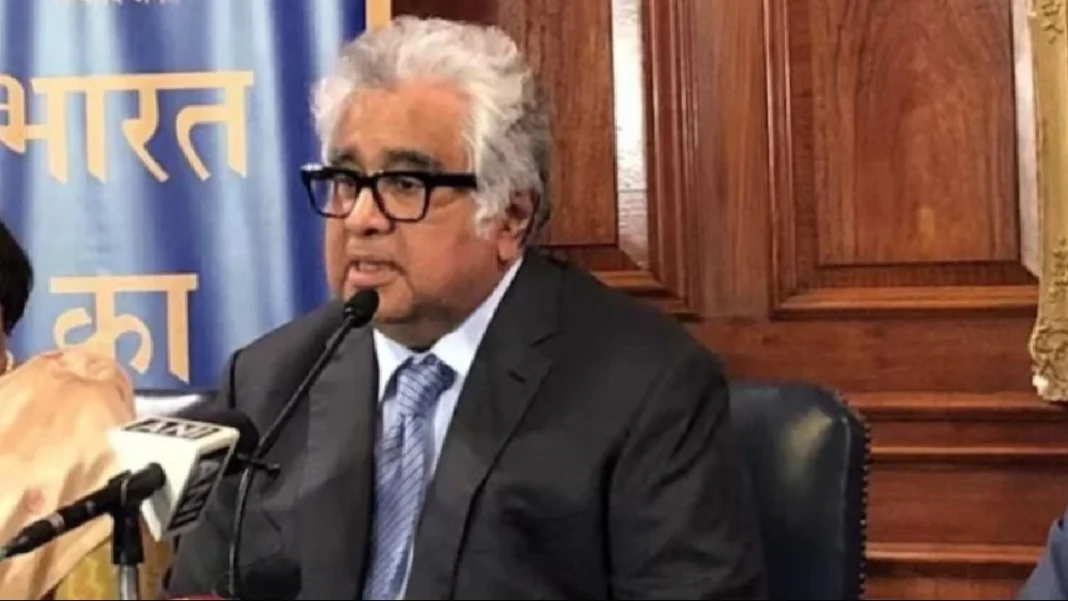
Senior Advocate Harish Salve, former Solicitor General of India and King’s Counsel in England and Wales, has described a United States federal court’s request for a fuller explanation from the Department of Justice as a routine step in American criminal procedure.
Speaking to ANI in an exclusive Zoom interview from London on June 29, 2026, Salve said the American legal system gives the prosecuting agency primary control over whether a case should continue, characterising the court’s move as a “very normal procedure.”
The remarks came after US District Judge Nicholas G. Garaufis of the Eastern District of New York declined on June 27, 2026 to immediately allow the DOJ to drop all criminal charges in United States v. Gautam S. Adani et al., Docket No. 24-CR-433 (NGG).
Background
On November 20, 2024, a five-count criminal indictment was unsealed in Brooklyn charging Gautam S. Adani, Chairman of Adani Green Energy Ltd., his nephew and Executive Director Sagar R. Adani, and Vneet S. Jaain, also an executive at Adani Green Energy Ltd., with conspiracies to commit securities and wire fraud and substantive securities fraud.
The indictment alleged the defendants’ roles in a multi-billion-dollar scheme to obtain funds from US investors and global financial institutions on the basis of false and misleading statements. The indictment also alleged a bribery scheme. The case arose from allegations concerning a 12-gigawatt solar power project.
According to the DOJ press release and the SEC complaint, the defendants allegedly agreed to pay more than $250 million in bribes to Indian government officials to obtain lucrative solar energy supply contracts, projected to generate more than $2 billion in profits after tax over an approximately 20-year period.
A related civil case, SEC v. Adani et al., was filed simultaneously under docket 24-Civ-8080 (VMS). The SEC charged Gautam Adani as Chairman of Adani Green’s Board of Directors and Sagar Adani as its Executive Director.
Verified Details
On May 18, 2026, the DOJ filed a motion to dismiss under Rule 48(a) of the Federal Rules of Criminal Procedure, stating that after reviewing the case it had decided not to devote further resources to the criminal charges against the individual defendants.
Judge Garaufis declined to grant immediate dismissal on June 27, 2026, characterising the government’s initial explanation as “terse, bland, and conclusory.” He noted that Rule 48(a) requires the government to provide the basis for a motion to dismiss.
In his order, Judge Garaufis wrote: “Thus, the Government has failed to meet its obligation to supply adequate reasoning and sufficient facts to support dismissal of the Indictment. And, without this additional information, the court cannot fulfill its own obligation to exercise ‘sound judicial discretion’ in considering the Government’s request for dismissal.”
The court directed the DOJ to submit a detailed explanation by July 13, 2026.
On June 24, 2026, Sullivan & Cromwell LLP wrote to Judge Garaufis on behalf of Gautam Adani, Sagar Adani, and Vneet Jaain urging formal dismissal of the indictment.
Statements from Law Firms
Gautam Adani, Sagar Adani, and Vneet Jaain are represented by Sullivan & Cromwell LLP, led by co-chair Robert J. Giuffra Jr. and partner James McDonald. Sullivan & Cromwell filed the June 24, 2026 letter to the court urging formal dismissal on behalf of all three defendants.
Giuffra is also described by multiple secondary sources citing The New York Times as one of US President Donald Trump’s personal lawyers. Salve’s own role in the proceedings beyond his public commentary to ANI is information not publicly available in the verified fact sheet.
Strategic Significance
The DOJ’s May 18, 2026 motion to dismiss came alongside an announcement that Adani Enterprises Limited had agreed to a $275 million settlement with the US Treasury’s Office of Foreign Assets Control related to US Iran-related OFAC sanctions. These are separate proceedings from the criminal indictment.
Around May 15, 2026, civil settlements were also agreed with the SEC: Gautam Adani for $6 million and Sagar Adani for $12 million, according to the verified fact sheet. These figures relate to the civil case and are separate from the criminal matter.
The hiring of Sullivan & Cromwell, whose co-chair Robert J. Giuffra Jr. is described as a personal lawyer to President Trump, attracted commentary in secondary media regarding the broader political and legal context. The verified fact sheet does not establish any direct causal link between that representation and the DOJ’s decision.
Industry Context
The original indictment centred on allegations relating to a 12-gigawatt solar power project and the role of the Solar Energy Corporation of India, a government entity, in awarding supply contracts. Co-accused in the indictment include former executives of Azure Power Global Ltd., a US-listed Indian renewable energy company, and former employees of a Canadian institutional investor.
The former EDNY US Attorney Breon Peace announced the original charges; he has since departed the office.
Regulatory or Legal Context
Rule 48(a) of the Federal Rules of Criminal Procedure governs government motions to dismiss criminal indictments. The rule requires leave of court, giving judges oversight authority even where the executive branch seeks to withdraw charges.
Judge Garaufis’s order reflects the court’s obligation to exercise what it termed “sound judicial discretion” before granting such leave. The DOJ must now file its substantive explanation by July 13, 2026.
Chris Man, a partner at Steptoe LLP and a US-based white-collar defence lawyer, commented on the procedural issue, though the specific content of his comment is not reproduced in the verified fact sheet beyond his identification as a source on the procedural question.
John C. Coffee, the Adolf A. Berle Professor of Law at Columbia Law School, is cited in the fact sheet in connection with the case. The specific content of any statement he made is information not publicly available in the verified fact sheet.
Why It Matters
The court’s refusal to grant immediate dismissal introduces a measure of judicial scrutiny over what is typically a prosecutorial decision, and sets a formal legal record requirement before charges against Gautam Adani, Sagar Adani, and Vneet Jaain can be dropped.
Salve’s framing of the order as a “very normal procedure” offers a counterweight to coverage that has portrayed the court’s intervention as unusually significant. His characterisation reflects the view that US courts routinely review the adequacy of government reasoning under Rule 48(a).
The July 13, 2026 deadline will be a key marker for whether the DOJ provides reasoning the court deems sufficient to exercise its discretion in favour of dismissal.

