


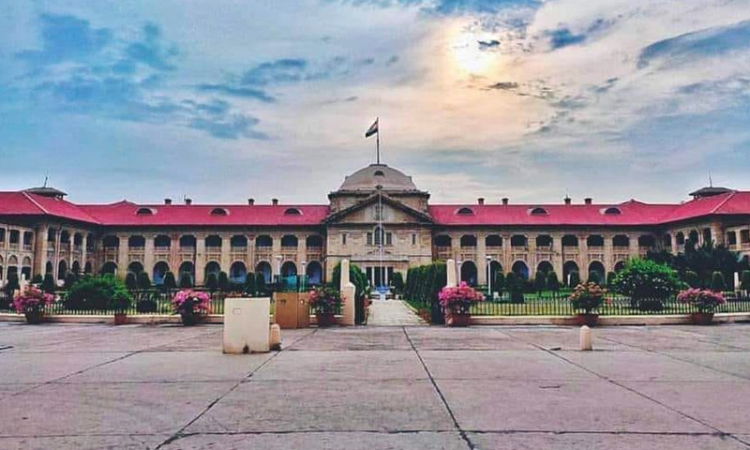
The Allahabad High Court ruled on June 26, 2026, that the constitutional guarantee of freedom of religion under Article 25 does not entitle any community to use a particular road for the performance of religious rites.
The bench of Justice JJ Munir and Justice Arun Kumar dismissed a Public Interest Litigation seeking permission to use a specific route for a Muharram procession in Sambhal, Uttar Pradesh, according to LiveLaw.
Background & Case History
The petition arose from a dispute over the route to be taken by a Muharram procession in Sambhal district, Uttar Pradesh — a district that has faced heightened judicial scrutiny over communal tensions and religious observances in recent years.
The case, cited as 2026 LiveLaw (AB) 333, was filed by Sharif Ahmad and others against the State of Uttar Pradesh and others, per LiveLaw.
The matter came before the division bench of Justice JJ Munir and Justice Arun Kumar of the Allahabad High Court, which ultimately dismissed the petition on law and order grounds.
- Petition filed by Sharif Ahmad and others seeking a specific road route for the Muharram procession in Sambhal, UP.
- The case was registered and listed before the division bench of Justice JJ Munir and Justice Arun Kumar.
- The petition was dismissed by the bench on June 26, 2026, citing law and order concerns related to the proposed new route.
- The ruling was reported by LiveLaw under case citation 2026 LiveLaw (AB) 333, covered by Associate Editor Sparsh Upadhyay.
Arguments & Submissions
The petitioners, led by Sharif Ahmad, approached the High Court seeking a judicial direction compelling the administration to permit a specific road to be used for the Muharram procession in Sambhal, according to LiveLaw.
The case for the petitioners rested, at least in part, on the fundamental right to freedom of religion guaranteed under Article 25 of the Constitution of India — the argument being that the right to practice religion included the right to conduct religious processions along a chosen route.
The State of Uttar Pradesh and other respondents opposed the plea. The civil and police administration flagged law and order concerns arising from the proposed new procession route as a key ground for refusing permission, as reported by LiveLaw.
The Ruling: Key Findings
The bench of Justice JJ Munir and Justice Arun Kumar squarely rejected the petitioners’ constitutional argument, holding that freedom of religion under Article 25 has a defined scope that does not stretch to a claim over any particular road, per LiveLaw.
In its ruling, the court held that Article 25 “doesn’t entitle a community to use a particular road for the performance of religious rites.”
The court further held that decisions regarding procession routes fall within the exclusive domain of the civil and police administration — not the courts.
The PIL was accordingly dismissed, with the bench affirming that law and order considerations raised by the administration in relation to the proposed new Muharram procession route in Sambhal provided sufficient justification for the refusal, according to LiveLaw.
Legal Analysis & Implications
Article 25 of the Constitution of India guarantees to all persons the freedom of conscience and the right freely to profess, practise, and propagate religion, subject to public order, morality, and health.
The Allahabad High Court’s ruling draws an important distinction: the freedom of religion protected under Article 25 covers the substance of religious practice, but does not create an ancillary right to demand a specific physical route for a religious procession.
By affirming that route decisions belong to the civil and police administration — not to courts — the bench reinforces the principle that the executive retains primary authority over public order matters, even where religious processions are involved.
The ruling sits within a broader pattern of Allahabad High Court decisions from Sambhal in 2025–2026. Notably, a separate bench of Justices Atul Sreedharan and Siddharth Nandan in March 2026 struck down a Sambhal administration cap of 20 worshippers for Namaz during Ramzan, holding that the state cannot restrict fundamental religious rights purely on law and order grounds, per LiveLaw’s monthly digest.
Taken together, the two rulings reflect a nuanced judicial position: the state cannot arbitrarily restrict the exercise of religion, but a community cannot claim a constitutional right to a particular public road as the venue for that exercise.
Reactions & Stakeholder Response
No formal reactions from the petitioners, Bar Associations, or civil society organisations have been reported in the sources available at the time of publication.
The ruling was covered by LiveLaw’s Associate Editor Sparsh Upadhyay, whose report notes the court’s firm delineation of administrative authority over procession routes in sensitive districts such as Sambhal.
What’s Next
With the PIL dismissed by the Allahabad High Court, the petitioners would need to approach the Supreme Court of India if they wish to challenge the ruling further — no such appeal has been reported as yet.
On the same day, the same bench of Justice JJ Munir and Justice Arun Kumar also decided a related Sambhal matter — 2026 LiveLaw (AB) 331 — concerning the 24 Kosi Parikrama Marg project, signalling continued judicial engagement with religious and communal issues in the district, according to LiveLaw.
More legal news at The Courtroom.
Disclaimer
Disclaimer: This article is for general information only and does not constitute legal advice. Laws may change or vary by case — consult a qualified lawyer before acting. The Courtroom is not liable for any reliance on this content.

