


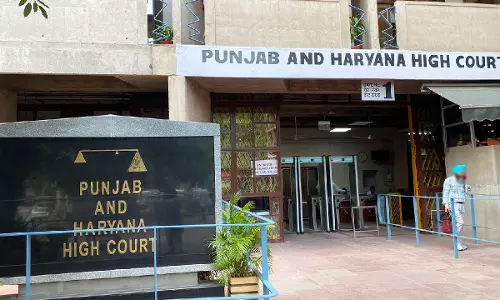
Adverse Possession: State Cannot Use Doctrine Against Private Landowners, Holds P&H High Court
The Punjab and Haryana High Court has held that the State cannot invoke the doctrine of adverse possession to claim ownership over private land, ruling that such a plea is fundamentally incompatible with a welfare State’s constitutional obligations.
Justice Ramesh Kumari delivered the ruling, cited as [2026 LiveLaw (PH) 209], and directed the Haryana Government to pay compensation for private land that was used for a distributary without following any formal land acquisition procedure, according to LiveLaw.
Background & Case History
The dispute arose when the Haryana Government used a private landowner’s parcel for a distributary — an irrigation channel — without initiating any proceedings under land acquisition law, leaving the owner without compensation or legal remedy through administrative channels.
Aggrieved, the landowner approached the Punjab and Haryana High Court seeking compensation. The case was placed before Justice Ramesh Kumari, whose ruling has now been reported as [2026 LiveLaw (PH) 209], according to LiveLaw. Full case number and party names were not independently disclosed in the available reporting.
The ruling was reported by LiveLaw on June 26, 2026, approximately seven hours after it was delivered, based on LiveLaw’s publication metadata. The judgment adds to a growing body of Indian jurisprudence firmly rejecting State claims of adverse possession over private property.
- Haryana Government uses private land for a distributary without initiating acquisition proceedings, depriving the landowner of compensation.
- Landowner moves the Punjab and Haryana High Court seeking compensation for the unauthorised use of private property.
- November 19, 2024: Supreme Court of India decides State of Haryana v. Amin Lal (2024 INSC 875), reaffirming that the State cannot claim adverse possession over private citizens’ property.
- June 26, 2026: Justice Ramesh Kumari of the Punjab and Haryana High Court rules in favour of the landowner, directing the Haryana Government to pay compensation; ruling cited as [2026 LiveLaw (PH) 209].
Arguments & Submissions
The petitioner’s central submission was that the Haryana Government had occupied and used the private land for a public irrigation distributary without ever initiating the statutory land acquisition process, thereby depriving the owner of both title security and financial compensation.
The State of Haryana, in defence, appears to have invoked the doctrine of adverse possession — the legal principle that long, open, and uninterrupted possession of land can, in certain circumstances, extinguish the original owner’s title. The court squarely rejected this argument, according to LiveLaw’s reporting on the judgment.
The government’s reliance on adverse possession in a case of its own administrative omission drew sharp scrutiny from the court, which framed the issue as a question of the State’s fundamental constitutional role and its obligations toward citizens whose property rights are guaranteed by law.
The Ruling: Key Findings
Justice Ramesh Kumari held without qualification that “the State cannot invoke the doctrine of adverse possession to claim ownership over private land,” as reported by LiveLaw in its coverage of [2026 LiveLaw (PH) 209].
The court went further, holding that invoking adverse possession is incompatible with the State’s role as a welfare State — a finding that situates the ruling squarely within the constitutional framework governing State conduct toward citizens.
In its operative directions, the court ordered the Haryana Government to pay compensation to the private landowner for the land that had been used for the distributary — effectively treating the State’s unauthorised occupation as a compulsory acquisition that triggers a compensation obligation.
The ruling affirms that when the State takes or uses private property without following due process under land acquisition law, it cannot subsequently defeat a citizen’s compensation claim by pleading long possession as a shield.
Legal Analysis & Implications
The judgment is grounded in Article 300A of the Constitution of India, which provides that no person shall be deprived of their property except by authority of law. The court’s reasoning treats adverse possession — a common law doctrine — as legally insufficient to satisfy this constitutional standard when wielded by the State against a private citizen.
The ruling follows closely from the Supreme Court’s November 2024 decision in State of Haryana v. Amin Lal (2024 INSC 875), where the apex court held that “allowing the State to appropriate private property through adverse possession would undermine the constitutional rights of citizens and erode public trust in the government,” per Verdictum’s reporting of that decision.
The Supreme Court had also taken the same position in State of Haryana v. Mukesh Kumar [(2011) 10 SCC 404], establishing that this is not a novel principle but a settled feature of Indian constitutional law. The P&H High Court’s 2026 ruling reinforces this line of authority at the High Court level, making it harder for State governments to rely on passive occupation as a substitute for formal acquisition.
The practical implication is significant: State agencies and departments that have historically occupied private land for infrastructure — canals, roads, public utilities — without completing acquisition procedures now face a clearly articulated legal obligation to compensate landowners, and cannot use the passage of time as a defence.
Reactions & Stakeholder Response
No formal reactions from the Bar, civil society organisations, or the Haryana Government were reported in the available sources at the time of publication. The case details, including the identities of counsel on both sides, were not disclosed in the publicly accessible portions of LiveLaw’s reporting, as the full judgment text remains behind a paywall.
The ruling is nonetheless likely to be closely watched by property law practitioners and landowners across Haryana and Punjab, given the frequency with which State irrigation and public works departments have occupied agricultural land through administrative action rather than formal acquisition proceedings.
What’s Next
The immediate consequence of the ruling is that the Haryana Government is now directed to pay compensation to the landowner. Whether the State will challenge the ruling before a division bench of the Punjab and Haryana High Court or before the Supreme Court has not been reported in available sources.
The ruling may also prompt similar compensation claims from other landowners whose property has been used by Haryana’s irrigation or public works departments without formal acquisition — a category of disputes that has historically been litigated across multiple High Courts in India.
More legal news at The Courtroom.
Disclaimer
Disclaimer: This article is for general information only and does not constitute legal advice. Laws may change or vary by case — consult a qualified lawyer before acting. The Courtroom is not liable for any reliance on this content.

