


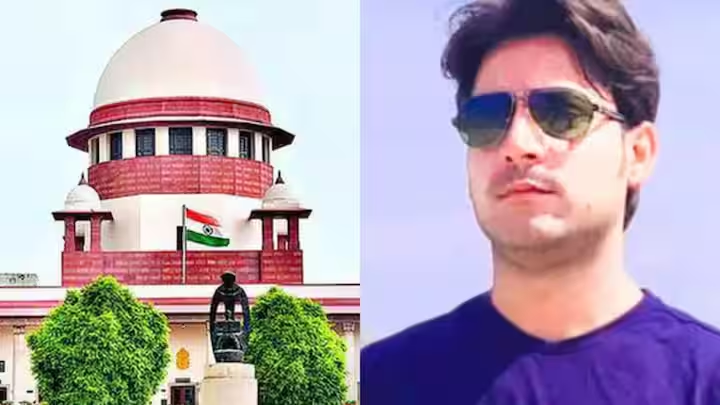
The Supreme Court of India on June 30, 2026, refused to entertain a PIL seeking a CBI investigation into the alleged extra-judicial killing of 28-year-old Bharat Bhushan Tiwari in Bhojpur, Bihar, directing petitioner Advocate Vishal Tiwari to approach the Patna High Court.
A bench of Justices MM Sundresh and Sheel Nagu delivered the terse rebuff, questioning both the petitioner’s locus standi and the maintainability of the petition under Article 32 of the Constitution, according to LiveLaw.
Background & Case History
Bharat Bhushan Tiwari, a 28-year-old local activist and social media commentator from Bilauti village in Bihar’s Bhojpur district, was killed in a police encounter on June 17, 2026, according to ANI and BizzBuzz.
Tiwari had approximately 1.6 lakh Facebook followers and had posted Facebook Live videos showing himself with an illegal weapon, expressing frustration over government inaction on flood rehabilitation and threatening local administrative officers.
Hours before his death, he went live on Facebook expressing willingness to surrender and lay down his weapon if certain demands were met, as reported by LawBeat and ProKerala.
- June 16, 2026: Bhojpur Police issued an official statement describing Tiwari as “mentally unstable” and claiming they were working to take him into safe custody for medical treatment — less than 24 hours before the encounter.
- June 17, 2026: Bharat Bhushan Tiwari was killed in the alleged police encounter in Bilauti village, Bhojpur district, Bihar; he died while being taken to Patna Medical College and Hospital.
- June 20, 2026: Bihar Chief Minister Samrat Choudhary announced a high-level judicial inquiry to be led by a retired High Court judge; six police personnel including the local Station House Officer were suspended.
- June 30, 2026: The Supreme Court bench of Justices MM Sundresh and Sheel Nagu refused to entertain the PIL and directed the petitioner to Patna High Court.
The killing triggered widespread protests, highway blockades, and political controversy in Bihar, with independent MP Pappu Yadav and former Union Minister Ashwini Choubey publicly questioning the encounter’s legitimacy, per BizzBuzz.
Before the matter reached the bench of Justices Sundresh and Nagu, Justice BV Nagarathna had declined an urgent hearing and directed the petitioner to approach the apex court registry for listing, according to India Legal Live and ProKerala.
Arguments & Submissions
Advocate Vishal Tiwari filed the writ petition under Article 32 of the Constitution as petitioner-in-person, arraying the Union of India, the State of Bihar, the Director General of Police, and the CBI as respondents, according to ProKerala.
The petition argued that the encounter was staged and extra-judicial in nature. It invoked Article 21 of the Constitution — the right to life and liberty — and urged compliance with the Supreme Court’s PUCL judgment guidelines governing police encounter investigations, per ProKerala and LawBeat.
The petition also sought the constitution of an independent expert committee to conduct a parallel inquiry into the circumstances of the killing.
On the question of police power, the petition stated: “The police cannot be allowed to become a mode of delivering final justice or to become a punishing authority,” adding that “the power of punishment is only vested in the judiciary.”
The family of Bharat Bhushan Tiwari, relying on statements from his father Kashinath Tiwari, alleged that the deceased had no criminal antecedents, no FIRs or chargesheets against him, and had thrown away his pistol before being shot, as reported by LawBeat and ANI.
The Ruling: Key Findings
The bench of Justices MM Sundresh and Sheel Nagu declined to admit the PIL at threshold, according to LiveLaw and ANI.
Justice MM Sundresh first questioned the petitioner’s standing with the pointed query: “Who are you?” — upon learning that Advocate Vishal Tiwari was a PIL petitioner rather than a party directly affected, the bench refused to entertain the plea, as reported by LawBeat.
The bench then stated plainly: “We will not entertain.”
Beyond locus, the bench also questioned the maintainability of the petition under Article 32 of the Constitution, per ProKerala. The court’s position was that such a matter ought to be examined first by the jurisdictional High Court.
The petitioner was granted liberty to file a fresh petition before the Patna High Court, the appropriate forum for the relief sought.
Legal Analysis & Implications
The bench’s dual challenge — to locus standi and Article 32 maintainability — reflects a recurring judicial concern about the misuse of direct Supreme Court access in matters that belong at the High Court level first.
Article 32 of the Constitution grants the right to move the Supreme Court for enforcement of fundamental rights. However, the court has consistently held that where an adequate alternative remedy exists, petitioners should exhaust that remedy before approaching the apex court directly.
The petition cited the PUCL judgment, the Supreme Court’s seminal ruling that lays down mandatory guidelines for investigating encounter deaths — including magisterial inquiries, FIR registration, and magisterial oversight. The court did not rule on those merits, leaving the PUCL compliance question open for the High Court.
The case also raises broader concerns flagged in the petition itself about what it described as a growing “encounter culture” across Bihar and Uttar Pradesh, a political and legal debate that is now expected to shift to the Patna High Court’s docket.
Bihar Police’s own narrative was internally contradictory: the force declared Tiwari “mentally unstable” requiring medical care on June 16, then reported that he fired eight to ten rounds from an illegal pistol at STF personnel the following day, per ANI and BizzBuzz.
Reactions & Stakeholder Response
The state government’s pre-emptive response included the suspension of six police personnel and an announcement by Chief Minister Samrat Choudhary of a high-level judicial inquiry headed by a retired High Court judge, as reported by BizzBuzz.
Political reactions were swift. Independent MP Pappu Yadav and former Union Minister Ashwini Choubey both questioned the legitimacy of the encounter, adding parliamentary weight to the demands for an independent probe, per BizzBuzz.
The petitioner’s invocation of Article 21 and the PUCL framework signals that civil society concerns about accountability in alleged fake encounters remain unresolved, regardless of the Supreme Court’s refusal to intervene at this stage.
With the Supreme Court directing the petitioner to the Patna High Court, Advocate Vishal Tiwari is expected to file a fresh writ petition before the jurisdictional High Court seeking a CBI probe and directions for PUCL guideline compliance.
The state government’s judicial inquiry — announced by Chief Minister Samrat Choudhary on June 20 — remains ongoing, with a retired High Court judge at its helm. Its findings could influence the scope and direction of any High Court proceedings.
Full coverage: LiveLaw. More legal news at The Courtroom.
Disclaimer
Disclaimer: This article is for general information only and does not constitute legal advice. Laws may change or vary by case — consult a qualified lawyer before acting. The Courtroom is not liable for any reliance on this content.

