


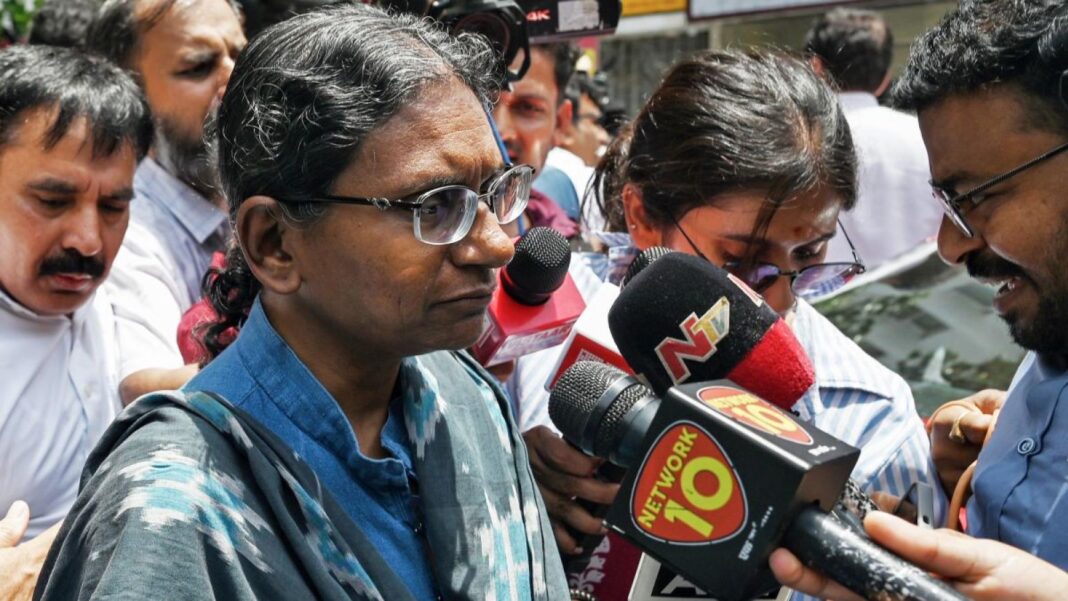
The Rajya Sabha nomination rejection of Congress leader Meenakshi Natarajan has landed before the Supreme Court of India, setting up a high-stakes constitutional clash just days before polling.
According to LiveLaw, Natarajan filed a writ petition on June 11, 2026 — the same day it was the last date for withdrawal of nominations — challenging the rejection of her candidature from Madhya Pradesh. The case is docketed as Meenakshi Natarajan v. Election Commission of India, Diary No. 36330/2026.
Background: The Rajya Sabha Nomination Rejection of Meenakshi Natarajan
Natarajan is a former Lok Sabha MP from Mandsaur and currently serves as the AICC in-charge for Telangana. She was the Congress party’s sole Rajya Sabha candidate from Madhya Pradesh for the June 18, 2026 biennial elections.
Her nomination was rejected on June 9, 2026 by Returning Officer Arvind Sharma, the Principal Secretary of the Madhya Pradesh Legislative Assembly, according to Bar & Bench and LawBeat.
The core facts of the dispute are as follows:
- The Returning Officer held that Natarajan failed to disclose private complaint No. 4472/2025, pending before the IV Additional Judicial Magistrate, Hyderabad, in Form 26 of her nomination affidavit. She is arrayed as Respondent No. 4 in that complaint, filed by former Congress worker A. Srilatha.
- Congress countered that the Magistrate had only issued a pre-cognisance notice under Section 223 of the Bharatiya Nagarik Suraksha Sanhita (BNSS) on September 17, 2025 — not a summons — meaning no court had yet taken cognisance of the complaint. The party argued that mandatory disclosure under Section 33A of the Representation of the People Act is triggered only post-cognisance and for offences carrying a minimum sentence of more than two years.
- Objections to Natarajan’s nomination were originally raised by BJP Rajya Sabha candidate Mahesh Kewat and BJP state general secretary Rahul Kothari, as reported by Bar & Bench and LawBeat.
On June 10, 2026, a high-powered Congress delegation — comprising KC Venugopal, Randeep Surjewala, Jairam Ramesh, Vivek Tankha, and Senior Advocate Abhishek Manu Singhvi — met the Election Commission seeking a reversal of the decision, per Business Standard and India TV News. The Commission did not oblige, prompting the legal challenge.
Natarajan described the Returning Officer’s order as “arbitrary, biased and contrary to law.” Singhvi was equally pointed, stating on X: “the decision of the Returning Officer is indeed poor and absolutely partisan.”
What the Court Said
On June 11, 2026, a Supreme Court bench of Justice Prashant Kumar Mishra and Justice Atul S. Chandurkar agreed to list the writ petition after an urgent oral mentioning by Senior Advocate Abhishek Manu Singhvi, according to LiveLaw and LawBeat.
The bench was not without reservations. Justice Mishra questioned the maintainability of the writ petition, noting that the established recourse in election matters is to file an election petition — not a writ — during an ongoing electoral process.
The Election Commission of India’s counsel, Senior Advocate DS Naidu, informed the bench that the petition copy had not yet been served on the poll body. The court accordingly directed: “List it tomorrow subject to clearing of defects.” The matter was scheduled for hearing on June 12, 2026.
Critically, the bench did not grant any interim stay on the declaration of results or the electoral process at this stage. With polling for the three Madhya Pradesh Rajya Sabha seats scheduled for June 18, 2026, the timeline is extremely tight.
Natarajan, in a public statement, struck a resolute note: “We still have full faith in constitutional institutions. That is why we are fighting this battle.”
What It Means for You
The case strikes at a fundamental question: when must a candidate disclose a pending complaint in their nomination affidavit? Under Section 33A of the Representation of the People Act, the disclosure obligation is linked to criminal cases — but whether a pre-cognisance BNSS notice creates that obligation remains contested.
If the Supreme Court ultimately rules that the rejection under Section 36 of the Representation of the People Act, 1951 was improper, Section 100(1)(c) of the same Act provides that improper rejection of a nomination can void an election — a remedy that would arrive long after June 18 if no interim relief is granted now.
The political consequence is already stark. With Natarajan out of the race, the BJP’s three candidates — Tarun Chugh, Rajneesh Agrawal, and Mahesh Kewat — are poised to sweep all three Madhya Pradesh Rajya Sabha seats, per India TV News.
Read more at The Courtroom.
Why was Meenakshi Natarajan’s Rajya Sabha nomination rejected?
Returning Officer Arvind Sharma rejected her nomination on June 9, 2026, on the ground that she did not disclose private complaint No. 4472/2025 — filed before the IV Additional Judicial Magistrate, Hyderabad, where she is Respondent No. 4 — in Form 26 of her nomination affidavit, as reported by Bar & Bench and LiveLaw.
What is Congress’s legal argument against the nomination rejection?
Congress argues that the Magistrate only issued a pre-cognisance notice under Section 223 BNSS on September 17, 2025 — not a summons — meaning no court had taken cognisance. The party contends that mandatory disclosure under Section 33A of the Representation of the People Act is triggered only after cognisance is taken, and only for offences with a minimum sentence of more than two years, according to LiveLaw and The Federal.
What did the Supreme Court decide on June 11, 2026?
The bench of Justice Prashant Kumar Mishra and Justice Atul S. Chandurkar agreed to list Natarajan’s writ petition (Diary No. 36330/2026) for hearing on June 12, 2026, subject to the clearing of defects. The court questioned the writ petition’s maintainability during an ongoing election and did not grant any interim stay, per LiveLaw and Bar & Bench.
Final Thoughts on the Rajya Sabha Nomination Rejection
Meenakshi Natarajan’s Supreme Court challenge places the spotlight on the precise scope of disclosure obligations under the Representation of the People Act — a question with far-reaching implications for future candidates served with pre-cognisance notices.
With Rajya Sabha polling in Madhya Pradesh on June 18, 2026 and no interim relief granted yet, the clock is running out for a judicial remedy that could change the electoral outcome in time.
Stay updated at The Courtroom.
Disclaimer
Disclaimer: This article is for general information only and does not constitute legal advice. Laws may change or vary by case — consult a qualified lawyer before acting. The Courtroom is not liable for any reliance on this content.

