


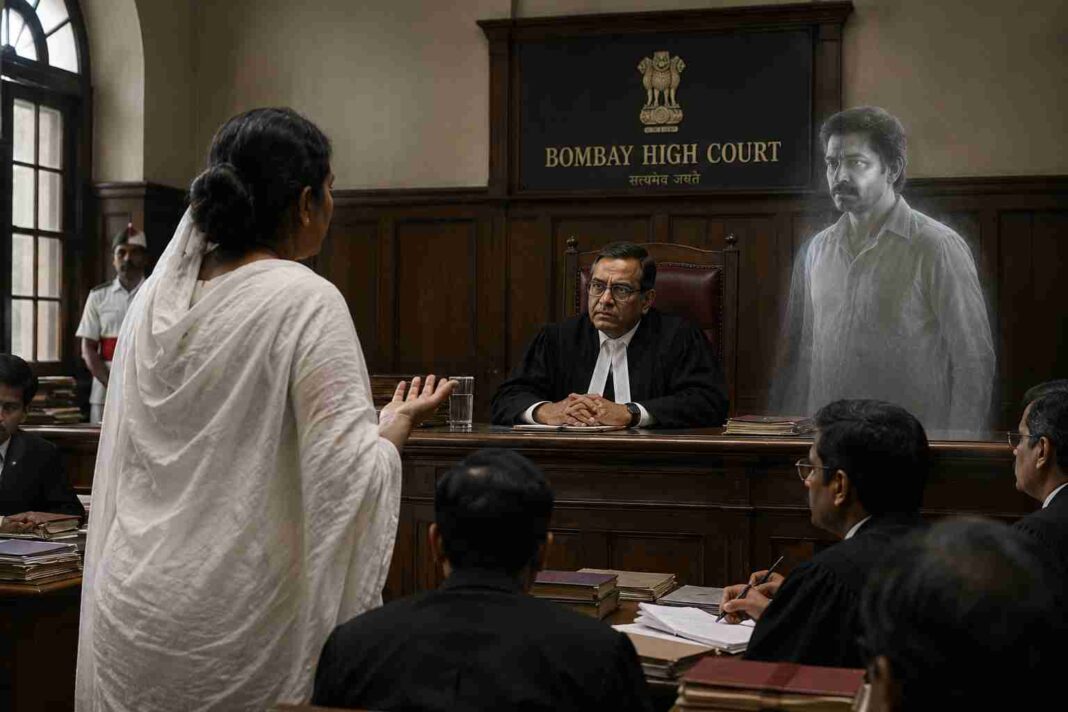
A widow walked into a Bombay court in 1988 and told the judge her dead husband’s ghost was sexually harassing her — and the court actually took it seriously.
No, this isn’t a horror film plot. This is the Bombay HC ghost harassment case, a real legal episode from Maharashtra that still makes lawyers do a double-take when they hear it.
So pull up a chair. This one’s strange from start to finish.
—
The Bombay HC Ghost Harassment Case: What Actually Happened
The year is 1988. A widow — her name has not been widely reported in accessible records [Unverified as to full name] — files a petition in the Bombay High Court. Her claim? The ghost (atma) of her deceased husband is visiting her at night and sexually harassing her.
She wants the court to make it stop.
Now, before you laugh — think about what this actually required the court to do. A judge had to sit down, read this petition, and decide: do we admit this? Do we send notice to… a ghost?
The answer, reportedly, was yes — the petition was admitted for hearing [Unverified as to precise admission order details; widely cited in Indian legal folklore].
—
Wait — Can Indian Courts Even Jurisdiction Over a Ghost?
This is where it gets philosophically wild.
Indian courts operate under the Code of Civil Procedure, 1908, and the Constitution of India. Jurisdiction means the court has power over persons or property within its territory. A ghost is neither a legal person nor holds property (that we know of).
So technically? No jurisdiction. Full stop.
But here’s the counter-intuitive insight that most people miss: the court’s real job wasn’t to summon a ghost. It was to assess whether the living petitioner had a genuine grievance — potentially rooted in psychological distress, family property disputes, or coercion by living relatives using fear of the supernatural as a weapon.
That reframing? That’s actually smart jurisprudence.
Cases involving supernatural claims in India often mask very real, earthly problems:
- Land disputes dressed up as “cursed property”
- Family members using ghost threats to control widows
- Mental health crises that need medical intervention, not legal remedy
- Genuine fear and trauma, regardless of the cause’s origin
—
The Lawyers Who Had to Keep a Straight Face
Imagine being the advocate on record for this petition.
You draft the vakalatnama (that’s the document authorising you to appear for someone). You write the cause title. You list the respondent.
What do you write?
“The Ghost of [Name], deceased”?
Indian legal history has a few cases where courts have had to grapple with non-human respondents — temples as legal persons, rivers as entities (the Uttarakhand High Court gave the Ganga and Yamuna legal personhood in 2017, though the Supreme Court of India stayed that order the same year in Mohd. Salim v. State of Uttarakhand). But a ghost? That’s a category entirely its own.
The numbered steps the court would theoretically need to follow:
- Identify and name the respondent with legal precision
- Determine a valid mode of service of notice (how do you serve a ghost?)
- Wait for appearance or proceed ex-parte
- Frame the issues
- Hear evidence — which would include the petitioner’s testimony about paranormal events
- Pass an enforceable order
Step 2 alone is an impossible riddle.
—
How Did It End? (Spoiler: Not With an Exorcism Order)
The case does not appear to have resulted in a substantive judgment on the merits [Unverified as to final disposal]. Most sources in Indian legal commentary treat it as a curio — a petition that was filed, caused raised eyebrows, and faded without a reported order.
But the filing itself tells you something important about Indian courts: they are, by design, accessible to everyone. A semi-literate widow with a supernatural fear could walk into the Bombay High Court and have her petition read by a judge. That’s not a flaw in the system. In its own strange way, that’s the system working.
—
The Question This Case Leaves You With
Does a court that takes a ghost petition seriously look foolish — or does it look humane?
Because somewhere in Maharashtra in 1988, a woman was scared enough to walk into one of India’s highest courts and ask for help. Whatever she was afraid of — ghost, relative, memory, grief — she believed the law could protect her.
That’s either the most absurd thing you’ve heard this week, or the most human.
You decide.
—
This article is for informational and entertainment purposes only and does not constitute legal advice; consult a qualified advocate for any legal matter.

