


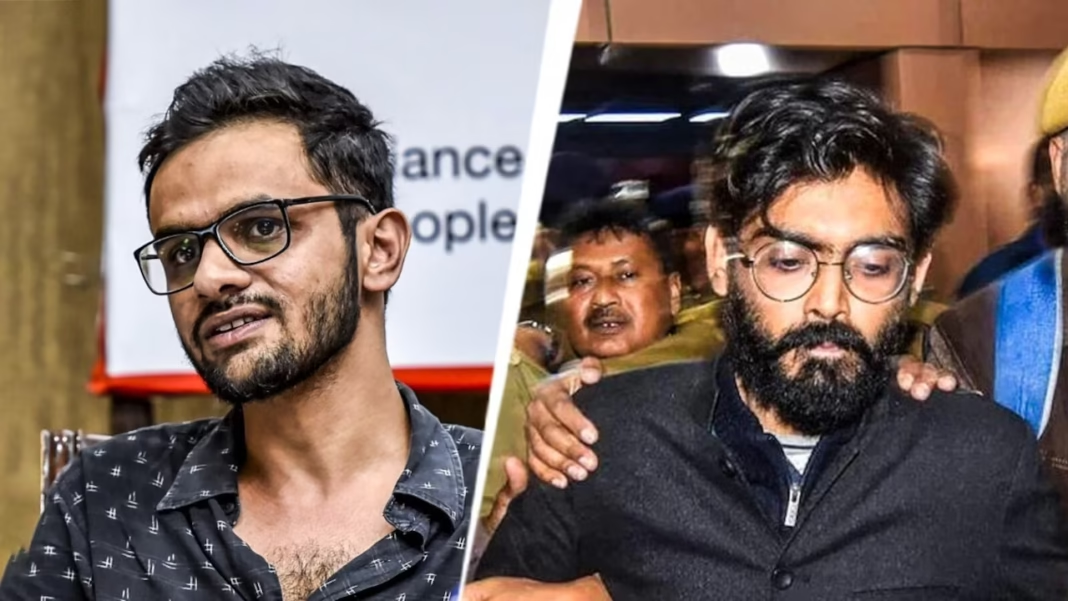
On July 4, 2026, Additional Sessions Judge Sameer Bajpai of the Karkardooma Sessions Court, Delhi, dismissed the fresh regular bail applications of Umar Khalid and Sharjeel Imam in the Delhi riots larger conspiracy case — finding them not maintainable in light of a binding Supreme Court order.
The court held it had no option but to follow the Supreme Court’s January 5, 2026 judgment, which had expressly denied bail to both accused, according to Bar & Bench. Both men remain in judicial custody, having been incarcerated since 2020 without trial commencing.
Background & Case History
The case arises from FIR No. 59/2020, registered by the Delhi Police Special Cell in connection with communal violence that erupted in North East Delhi in February 2020. The riots left 53 people dead and are alleged by the prosecution to have been the product of a larger, pre-planned conspiracy.
The accused were charged under multiple provisions of the Unlawful Activities (Prevention) Act, 1967 (UAPA), including Section 15, and under several sections of the Indian Penal Code, 1860. Umar Khalid and Sharjeel Imam were among a group of activists and students arrested in connection with the case, per LawBeat.
Multiple bail applications have been filed and rejected across different forums over the course of the proceedings. The Delhi High Court, in October 2022, had rejected Umar Khalid’s bail plea (Justices Siddharth Mridul and Rajnesh Bhatnagar presiding). The matter then travelled to the Supreme Court.
- February 2020: Communal violence erupts in North East Delhi; 53 people killed and FIR No. 59/2020 registered by Delhi Police Special Cell.
- 2020 (January–September): Umar Khalid, Sharjeel Imam, and other activists arrested in connection with the larger conspiracy case.
- October 18, 2022: Delhi High Court rejects Umar Khalid’s bail plea.
- January 5, 2026: Supreme Court bench of Justices Aravind Kumar and NV Anjaria denies bail to Khalid and Imam; grants bail to five co-accused — Gulfisha Fatima, Meera Haider, Shifa Ur Rehman, Mohd. Saleem Khan, and Shadab Ahmed.
- April 2026: Supreme Court dismisses Umar Khalid’s review petition against the January 5 order.
- May 18, 2026: A coordinate bench of the Supreme Court criticises the January 5 order, observing “bail is the rule and jail is an exception” even under UAPA, and refers related UAPA bail jurisprudence questions to a larger bench.
- June 2026: Khalid and Imam file fresh regular bail pleas before Karkardooma Court.
- July 4, 2026: ASJ Sameer Bajpai dismisses both applications as not maintainable.
Arguments & Submissions
Senior Advocate Trideep Pais, appearing for Umar Khalid, contended that there was no recovery from his client, no statement leading to any discovery, and no allegation that Khalid was present at the site of violence, according to Republic World and LiveLaw. The defence emphasised that nearly six years of incarceration without commencement of trial constituted a grave violation of the fundamental right to personal liberty guaranteed under Article 21 of the Constitution of India.
Advocate Talib Mustafa, appearing for Sharjeel Imam, raised a distinct procedural argument: that the Supreme Court’s imposition of a one-year embargo on filing bail applications was itself a matter referred to a larger bench, and therefore that embargo could not operate as a bar to the fresh applications, as reported by Bar & Bench.
The defence further pointed to intervening developments as constituting a material change in circumstances. These included a Supreme Court order granting six-month interim bail to co-accused Tasleem Ahmed and Khalid Saifi, as well as a Delhi High Court order granting bail to co-accused Khurram Parvez, per Prokerala and LiveLaw.
Special Public Prosecutors Madhukar Pandey and Anirudh Mishra appeared for the State. The prosecution countered that the Supreme Court had already rejected the bail petitions and had also dismissed Umar Khalid’s review petition as recently as April 2026, according to Prokerala.
The Ruling: Key Findings
ASJ Sameer Bajpai rejected both applications in unambiguous terms, holding that the trial court was bound by the January 5, 2026 Supreme Court judgment and had no jurisdiction to entertain the fresh pleas.
The judge stated directly: “This Court has no option but to follow the judgment dated 05.01.2026, as passed by the Hon’ble Supreme Court, whereby the petitions of both the applicants were dismissed.”
The court went further, declaring the applications wholly non-maintainable. In its operative findings, the judge held: “Thus, following the said order of the Hon’ble Supreme Court, this Court cannot entertain the applications and grant bail to the applicants. In fact the applications are not maintainable and they are hereby dismissed.”
The court additionally noted that the Gulfisha Fatima and Syed Iftikhar Andrabi judgment had already been referred to a larger Supreme Court bench. Until that issue is resolved, it held, the bail applications of Khalid and Imam could not be considered on any ground, per LiveLaw.
Legal Analysis & Implications
The bail applications were filed under Section 483 of the Bharatiya Nagarik Suraksha Sanhita (BNSS) read with Section 43D(5) of the UAPA. Section 43D(5) imposes a stringent threshold on courts, prohibiting bail where the court, on a perusal of the case diary or report, is of the opinion that there are reasonable grounds for believing the accusation against such a person is prima facie true.
The Supreme Court’s January 5, 2026 bench had found this threshold satisfied in the cases of Khalid and Imam, holding that “threshold under Section 43D(5) stands attracted…continued detention has not crossed constitutional impermissibility to override the statutory embargo as against them.” It simultaneously permitted renewal of applications only after examination of protected witnesses or after one year from that date, whichever is earlier.
The May 2026 coordinate bench’s reservations about the January 5 ruling — including its invocation of the long-established principle that “bail is the rule and jail is an exception” even under UAPA — have added a layer of jurisprudential uncertainty to the case. However, until the larger bench settles the referred questions, trial courts remain bound by the January 5 order, as Karkardooma Court made explicit on July 4, 2026.
Reactions & Stakeholder Response
The legal teams for both accused are expected to consider their next steps in light of the July 4 dismissal. The defence had anchored its fresh applications in the argument that co-accused receiving bail elsewhere constituted a change in circumstances sufficient to reopen the question — a contention the sessions court declined to accept as a basis for entertaining the pleas at all.
No formal statements from civil society organisations had been publicly reported at the time of publication. The case has historically attracted significant attention from legal commentators and civil liberties groups, given its implications for the application of UAPA bail jurisprudence to prolonged pre-trial detention.
What’s Next
Both Umar Khalid and Sharjeel Imam remain in judicial custody following the July 4 dismissal. The conditions set by the Supreme Court — completion of examination of protected witnesses, or expiry of one year from January 5, 2026 — remain the operative framework governing when fresh bail applications may be considered.
The larger Supreme Court bench to which UAPA bail jurisprudence questions have been referred will be a critical forum to watch. A ruling from that bench could materially alter the legal landscape for both accused and for future UAPA bail applicants across the country.
More legal news at The Courtroom.
Disclaimer
Disclaimer: This article is for general information only and does not constitute legal advice. Laws may change or vary by case — consult a qualified lawyer before acting. The Courtroom is not liable for any reliance on this content.

