


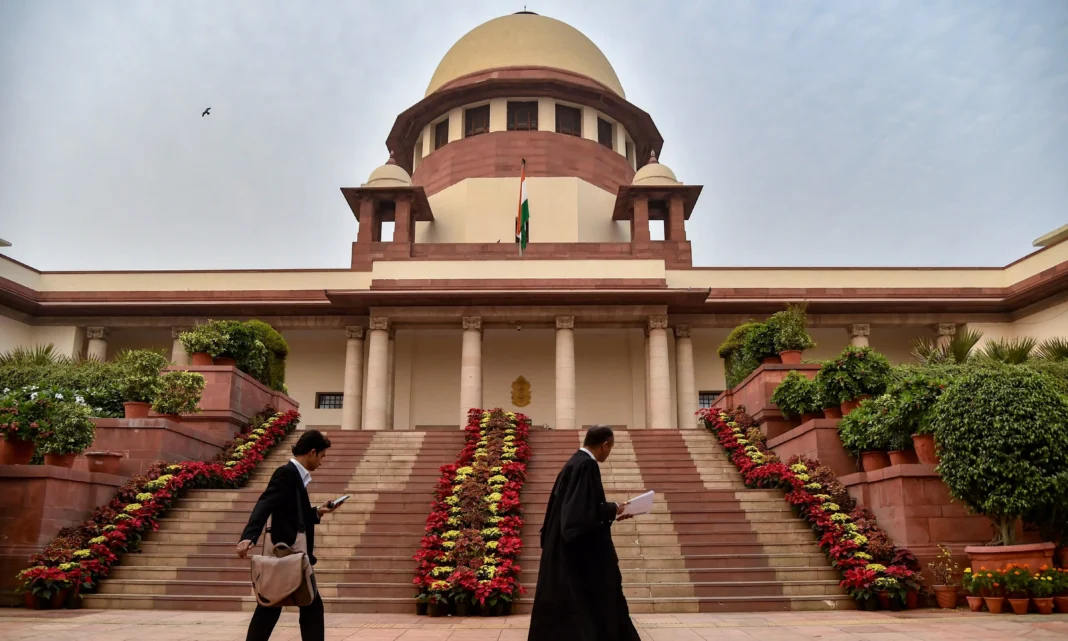
On June 23, 2026, a Supreme Court bench of Justice Prashant Kumar Mishra and Justice NV Anjaria upheld the conviction of Israfil @ Pappu @ Naimuddin Khan under Sections 420, 467, 468, and 471 IPC, but reduced his five-year rigorous imprisonment sentence to the period already undergone.
The bench held that sentencing proportionality demands consideration of the long lapse of time without repetition of criminal conduct, according to LiveLaw.
Background & Case History
The case arose from the use of a forged revenue document — a Bhu Adhikar Rin Pustika (a land rights and loan record) — as surety in judicial proceedings, as reported by AskJunior.
Criminal proceedings were initiated in 2014. The trial court convicted the appellant on all four counts and imposed five years’ rigorous imprisonment on each count along with a fine of Rs. 1,000 under each head, with substantive sentences to run concurrently.
The Madhya Pradesh High Court affirmed both conviction and sentence before the matter was carried in appeal to the Supreme Court, according to LiveLaw. The Supreme Court registered the matter as Crl.A. No. 3081/2026, Diary Number 36363/2025, per records on the Supreme Court of India website.
- 2014: Criminal proceedings commenced against the appellant for using a forged Bhu Adhikar Rin Pustika as surety in judicial proceedings.
- Trial court convicted the appellant under Sections 420, 467, 468, and 471 IPC and sentenced him to five years’ rigorous imprisonment on each count with concurrent running of sentences.
- Madhya Pradesh High Court affirmed the conviction and the sentence in its entirety on appeal.
- June 23, 2026: Supreme Court upheld conviction but modified sentence to the period already undergone.
Arguments & Submissions
Before the Supreme Court, the appellant urged that he was not a habitual offender and that no subsequent criminal antecedents had been brought to the notice of the Court, according to LiveLaw.
The appellant further relied on the fact that criminal proceedings had been pending for approximately a decade since 2014, placing considerable strain on the accused over a prolonged period.
The appellant also submitted that the forged document was detected at the threshold stage, meaning that no irreversible pecuniary or proprietary consequences had flowed from the commission of the offence, per AskJunior.
The Ruling: Key Findings
The bench allowed the appeal in part, upholding the conviction under all four counts while modifying the sentence to the period already undergone by the appellant, according to LiveLaw.
The Court observed: “The long lapse of time without any material indicating repetition of similar criminal conduct is also a relevant consideration while moulding sentence.”
The bench further held: “Sentencing cannot be reduced to a purely retributive exercise divorced from the factual matrix of the case and the overall circumstances of the offender.”
The Court also reiterated that “the principle of proportionality remains central to the sentencing process,” per LiveLaw.
The decisive mitigating factors were the decade-long pendency of criminal proceedings since 2014 and the fact that the forged document was detected at the threshold stage, preventing any irreversible harm, as reported by AskJunior.
Legal Analysis & Implications
The conviction was sustained under four provisions of the Indian Penal Code, 1860: Section 420 (cheating), Section 467 (forgery of valuable security), Section 468 (forgery for purpose of cheating), and Section 471 (using as genuine a forged document).
The Court relied on the precedent Padum Kumar vs. State of Uttar Pradesh, (2020) 3 SCC 35, which affirmed that the long passage of time, absence of criminal antecedents, and the period of incarceration already undergone are all relevant sentencing considerations, according to LiveLaw and AskJunior.
The ruling reinforces the principle that sentencing proportionality demands a contextual inquiry — courts must weigh the nature of the offence against the offender’s conduct over time and the actual harm caused.
Critically, the judgment signals that where a forgery is detected before it produces material harm, and where the accused demonstrates no pattern of recidivism over a prolonged period, a reduced sentence may be warranted even as the conviction stands.
The decision also underscores the relevance of protracted litigation itself as a mitigating factor: a decade of criminal proceedings carries its own punitive weight, which courts are entitled to acknowledge at the sentencing stage.
Reactions & Stakeholder Response
No specific reactions from Bar associations, civil society organisations, or counsel on record have been reported in the pre-verified sources at the time of publication.
The ruling is, however, expected to be cited in analogous cases where conviction is uncontested but the proportionality of the sentence — particularly after long periods of pendency — remains in dispute.
What’s Next
With the Supreme Court having modified the sentence to the period already undergone, the operative effect of the order is that the appellant stands released from the custodial portion of the sentence, subject to compliance with any fine-related directions.
The conviction itself stands affirmed across all four counts under the IPC, leaving no further appellate remedy on the question of guilt in this matter.
Full coverage: LiveLaw. More legal news at The Courtroom.
Disclaimer
Disclaimer: This article is for general information only and does not constitute legal advice. Laws may change or vary by case — consult a qualified lawyer before acting. The Courtroom is not liable for any reliance on this content.

