


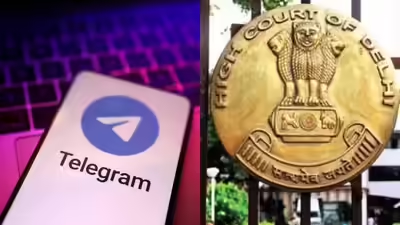
Telegram filed a writ petition before the Delhi High Court on June 17, 2026, challenging the Central government’s decision to temporarily block its operations in India — a ban imposed just days before the NEET-UG 2026 re-examination scheduled for June 21.
Advocate Madhav Khosla mentioned the matter on an urgent basis before a vacation bench of Justice Tejas Karia, who agreed to list the petition for hearing the same day, according to Bar & Bench.
Background: How We Got Here
The original NEET-UG 2026 examination was held on May 3, 2026, and was subsequently cancelled following widespread allegations of question paper leaks and irregularities, per Business Standard and Tribune India.
A fresh re-examination was scheduled for June 21, 2026. In the run-up to that test, the Ministry of Electronics and Information Technology (MeitY) issued directions under Section 69A of the Information Technology Act, 2000, blocking access to Telegram in India until June 22, 2026.
- The blocking order was issued on June 16, 2026, on the recommendation of the National Testing Agency (NTA) and the Department of Higher Education, Ministry of Education, as reported by LiveLaw and Siasat.
- A separate government order directed Telegram to disable its message-editing feature for messages already posted in India until June 30, 2026 — a feature authorities say was exploited by cheating syndicates to fabricate backdated evidence of paper leaks, according to Bar & Bench and Tribune India.
- Following the MeitY directions, both Google and Apple delisted the Telegram app from their respective app stores until June 22, per Siasat.
Before the platform-wide block was ordered, the Indian Cyber Crime Coordination Centre (I4C) under the Ministry of Home Affairs had reportedly attempted coordinated channel-by-channel takedowns that failed to contain the spread of leaked content.
Telegram stated it had received specific URLs from Indian authorities on June 9, 2026, and removed all flagged content within one hour, according to Bar & Bench. The company also claimed to have taken down more than 900 links related to unlawful NEET content, deploying AI, machine learning tools, and manual moderation.
The Ruling — Key Findings
As of June 17, 2026, the Delhi High Court had not yet issued a ruling on the merits of Telegram’s petition. Justice Tejas Karia’s vacation bench agreed to hear the matter on an urgent basis, but the substantive decision on the Section 69A blocking order remained pending, per Bar & Bench and LiveLaw.
In its writ petition, Telegram argued that the government’s blocking order was constitutionally infirm on multiple grounds. The petition stated:
“The impugned Order proceeds on the impermissible premise that misuse by a subset of users justifies blocking of an entire platform.”
The petition also raised a pointed Article 14 challenge, arguing: “The Order further singles out the Petitioner No.1 while similarly situated intermediaries continue to operate without restriction, without any rational basis or comparative analysis, thereby violating Article 14 of the Constitution of India.”
Telegram further warned of the broader constitutional implications, submitting: “Such an approach, if upheld, would enable indiscriminate suspension of digital platforms, severely undermining constitutional protections of free speech and access to information.”
Advocate Khosla submitted before the court that over 150 million Telegram users in India were directly affected by the government ban, according to Bar & Bench and Business Standard.
Reactions & What’s Next
The NTA defended the restrictions in an official statement, with NTA Director General Abhishek Singh stating: “Both measures have been taken in the interest of public order, in response to the organised use of the platform by cheating rackets to defraud candidates appearing for the NEET (UG) 2026 re-examination scheduled on 21 June 2026.”
Telegram founder and CEO Pavel Durov publicly opposed the ban on X on June 16, 2026, writing: “Telegram is a force for good. Banning it, even temporarily, is a mistake.”
The Internet Freedom Foundation (IFF) weighed in publicly, describing the restrictions as a “band-aid solution” and calling them “disproportionate,” according to The Federal.
The Section 69A access restriction is set to lapse on June 22, 2026 — one day after the NEET-UG re-examination — while the separate order requiring Telegram to disable its message-editing feature runs until June 30, 2026.
The court’s decision on the merits of Telegram’s challenge was awaited as of the date of filing. More legal news at The Courtroom.
Why did MeitY block Telegram ahead of the NEET-UG 2026 re-exam?
MeitY issued a Section 69A order on June 16, 2026, on the recommendation of the NTA and the Department of Higher Education. The NTA stated the measures were taken in response to organised use of the platform by cheating rackets to defraud candidates appearing in the re-examination scheduled for June 21, 2026.
How long does the Telegram ban in India last?
The Section 69A blocking order restricting access to Telegram in India is set to lapse on June 22, 2026. A separate order requiring Telegram to disable its message-editing feature for previously posted content runs until June 30, 2026, according to Bar & Bench and Tribune India.
What legal grounds did Telegram raise in its Delhi High Court petition?
Telegram’s writ petition argued that the blocking order violated Article 14 of the Constitution of India by singling out Telegram while other similarly situated social media intermediaries continued to operate without restriction. It also contended that penalising an entire platform for the misuse of a subset of users is constitutionally impermissible, per LiveLaw and Bar & Bench.
Disclaimer
Disclaimer: This article is for general information only and does not constitute legal advice. Laws may change or vary by case — consult a qualified lawyer before acting. The Courtroom is not liable for any reliance on this content.

