


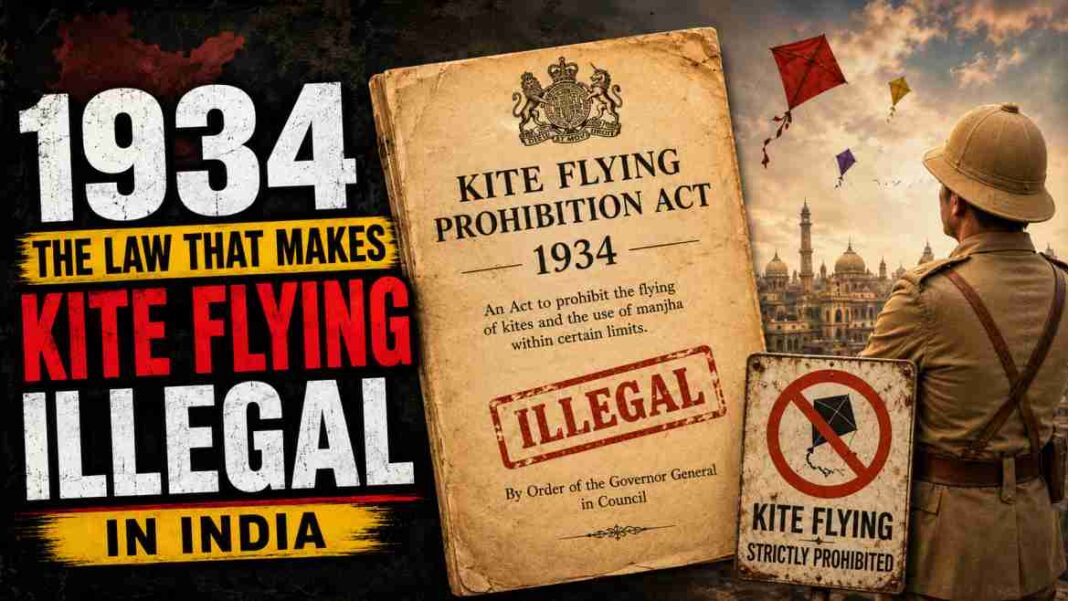
Every time you fly a kite in India, you are technically operating an aircraft — and you don’t have a licence.
That’s not a joke. That’s the Aircraft Act, 1934.
And if you think this is some forgotten footnote that nobody cares about, wait till you hear what happened in the Delhi High Court in 2022.
—
The 1934 Law That Made Kite Flying Illegal India Never Talks About
Picture colonial British India. The year is 1934. The British government wants to regulate the skies — airships, balloons, flying machines, the works. So they pass the Aircraft Act, 1934, Act No. 22 of 1934.
And right there in Section 2(1), they drop a definition that would haunt every Makar Sankranti celebration for the next ninety years.
An “aircraft” means “any machine which can derive support in the atmosphere from reactions of the air.”
The list of examples? Balloons, airships, gliders, flying machines.
And kites.
Your kite — the one made of tissue paper and a bamboo stick — is legally an aircraft under Indian law.
—
So What Happens If You Actually Get Caught?
Here’s where it gets real. Section 11 of the Aircraft Act lays down the penalty for unsafe or unlicensed flying practices.
Two years in prison. A fine of ten lakh rupees. Or both.
Ten. Lakh. Rupees. For flying a kite.
Now, here’s the counter-intuitive part that most people miss: no verified case has ever been found where someone was prosecuted and convicted under the Aircraft Act solely for recreational kite flying. [The exact sub-section of Section 11 that would apply specifically to kite flying also could not be independently confirmed from primary source text alone — see the gaps in public legal databases.] So the law exists on paper, but it has never — as far as public records show — put a kite flyer in handcuffs for the kite itself.
But “never enforced yet” is very different from “not a law.”
—
The Day a Lawyer Filed a PIL to Ban Kites Completely
Here’s where the story gets genuinely wild.
On August 5, 2022, the Delhi High Court decided a case called Sanser Pal Singh v. Union of India (2022 SCC OnLine Del 2418, also reported as 2022 LiveLaw (Del) 770).
Sanser Pal Singh, a practising advocate, had filed a PIL asking for a complete ban — not just on Chinese manjha, but on flying, making, selling, buying, storing and transporting kites and everything used to make them.
A Division Bench of Chief Justice Satish Chandra Sharma and Justice Subramonium Prasad heard the case.
And their response? The Court said kite flying is “a part of our culture and heritage” and refused to pass a blanket ban.
But — and this is the cliffhanger — the Court did NOT rule on whether the Aircraft Act, 1934 permits or prohibits kite flying. That specific question was left entirely untouched. Which means the 1934 definition is still sitting there, fully alive, fully unanswered.
—
The Manjha Problem Nobody Can Solve
So if the Court didn’t ban kites, what did it do?
The real concern the judges addressed was Chinese manjha — the synthetic, nylon-coated, often metal-dusted thread that has killed motorcyclists, injured children, and slashed birds across India for years.
Here’s exactly where the law currently stands:
- The National Green Tribunal passed an order on August 10, 2020, banning the manufacture, sale, storage, purchase and use of non-biodegradable synthetic thread for kite flying.
- The Delhi government issued a notification on January 10, 2017, imposing a complete ban on Chinese manjha and setting up a Monitoring Committee.
- The Delhi Police Act, 1978, under Section 94, separately prohibits flying kites “so as to cause danger, injury or alarm to persons, animals or property.”
And yet every year, the injuries keep coming. The Bombay High Court separately questioned authorities over their failure to curb nylon manjha — because orders on paper and enforcement on the street are two very different things.
The 2022 Delhi High Court judgment directed the Delhi government to ensure strict compliance with all existing bans. Cotton thread only. No metallic components. No glass coating. You can read the full LiveLaw report on the 2022 judgment for the complete picture.
—
Three Laws That Govern Your Kite Right Now
If you are flying a kite today, here is the legal universe sitting above your head:
- Aircraft Act, 1934, Section 2(1) — your kite is an aircraft. Section 11 prescribes imprisonment up to two years and/or a fine of up to ten lakh rupees for violations.
- NGT Order, August 10, 2020 — synthetic and nylon thread is banned.
- Delhi Police Act, 1978, Section 94 — flying in a way that causes danger or alarm is prohibited.
For more legal curiosities on thecourtroom.in that will make you question everything you thought was normal, this is the place to start.
—
Did India Ever Actually Fix This Law?
Have you ever wondered why nobody in Parliament has bothered to amend the definition and take kites out of the aircraft category?
It would take one line. Literally one line.
Instead, the Aircraft Act has been sitting there since 1934 — through Independence, through the Emergency, through every Makar Sankranti — silently classifying your hundred-rupee kite as aviation equipment.
So the next time you stand on a rooftop in Ahmedabad or Jaipur, feeding out thread into the January sky, just know: somewhere in the India Code, you are a pilot.
And you never even got your licence.
—
This article is intended for general informational purposes only and does not constitute legal advice; please consult a qualified legal professional for advice specific to your situation.

