


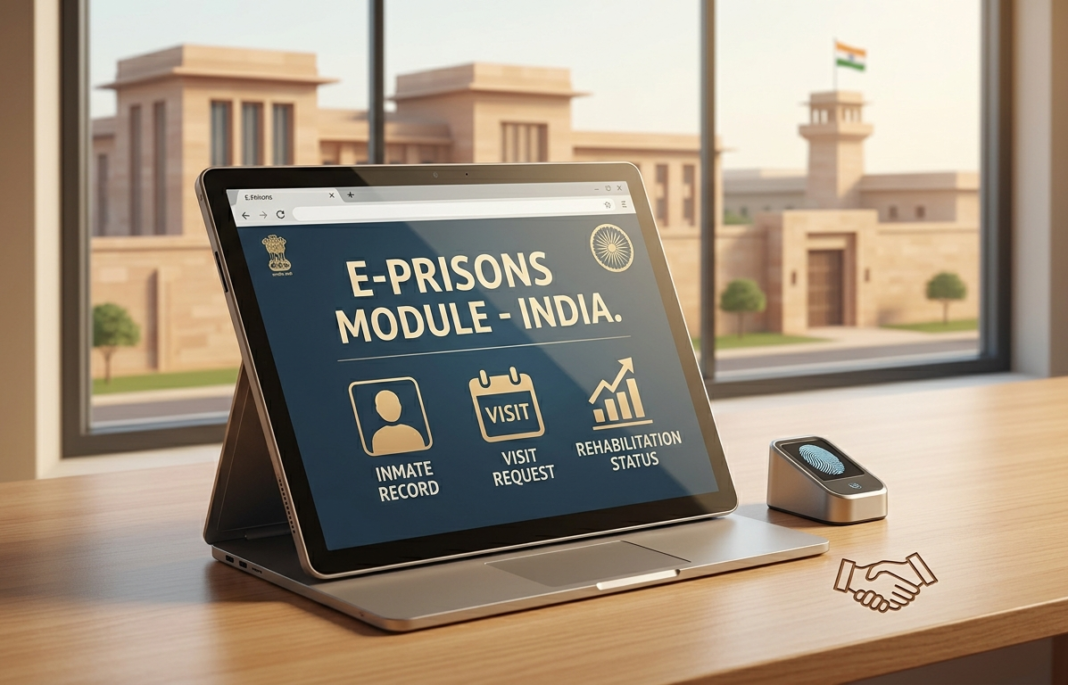
The e-prisons premature release module is now live across India, marking a watershed moment in prison administration and judicial oversight of remission rights.
According to LiveLaw, the Supreme Court of India formally closed proceedings on May 29, 2026 in Criminal Appeal No. 2217 of 2026 — Surendra @ Sunda v. State of Uttar Pradesh — after noting that the module had been successfully launched pan-India on May 27, 2026.
The development is one of the most significant digital interventions in India’s prison administration in recent memory, directly addressing systemic backlogs that kept eligible prisoners behind bars long past their due date for consideration.
Background: E-Prisons Premature Release Module
The case began as a criminal appeal by Surendra alias Sunda, a life convict from Uttar Pradesh convicted under Sections 302, 148, and 149 of the Indian Penal Code — charges of murder, rioting with deadly weapons, and unlawful assembly.
As proceedings developed, the Supreme Court expanded its inquiry into a systemic examination of how UP’s prisons handled premature release and remission applications. What emerged was deeply troubling.
Per The Legal Affair, the Court uncovered a substantial backlog: thousands of eligible prisoners in Uttar Pradesh had completed the requisite period of incarceration but remained imprisoned due to administrative delays, missing records, and a failure of coordination between authorities.
In a separate but related irregularity, 21 of 158 convicts released pursuant to earlier court directions had not completed the minimum 14-year period ordinarily required before a life convict becomes eligible for premature release consideration — a serious lapse that underscored the need for automated oversight.
On April 13, 2026, a bench of Justice JK Maheshwari and Justice Atul S. Chandurkar delivered a judgment directing the National Informatics Centre (NIC) to develop an automated, uniform system for premature release of life convicts across India. Key milestones in this case include:
- April 13, 2026: Supreme Court directs NIC to build the automated premature release software within the existing e-Prisons platform.
- May 27, 2026: NALSA launches the ‘E-Prisons Early Release Processing Module’ in virtual mode across India, presided over by CJI Surya Kant.
- May 29, 2026: A five-judge Supreme Court bench led by CJI Surya Kant formally disposes of Criminal Appeal No. 2217 of 2026, noting the successful pan-India rollout.
Before the national rollout, the module was first piloted at Central Jail, Agra, and District Jail, Lucknow, according to NewKerala and the420.in. Amicus curiae Senior Advocate K. Parameshwar and Advocate Ravi Raghunath were credited by the Court with prompting NIC to undertake those pilot projects.
The e-Prisons platform already connects approximately 1,318 prisons nationwide, making it a ready infrastructure base for this new module.
What the Court Said
In its May 29, 2026 order disposing of the appeal, the Supreme Court recorded: “In furtherance thereto, and in collaboration with all relevant stakeholders, software known as ‘E-Prisons Early Release Processing Module’ has now been launched by the NIC.”
The Court assigned ongoing implementation responsibility to State Legal Services Authorities, to work in coordination with prison authorities and other prescribed government authorities, as reported by LiveLaw.
The five-judge bench that closed the case comprised CJI Surya Kant, Justice JK Maheshwari, Justice Pankaj Mithal, Justice Joymalya Bagchi, and Justice Vipul M. Pancholi.
Two days earlier, at the pan-India virtual launch on May 27, 2026, CJI Surya Kant — serving also as Patron-in-Chief of NALSA — sounded a pointed warning about bureaucratic inertia: “Administrative delay, if left unattended, risks diminishing the very fairness that the process is intended to secure.”
Justice Vikram Nath, Executive Chairman of NALSA, and Justice JK Maheshwari, Chairman of the Supreme Court Legal Services Committee (SCLSC), were also present at the launch. Bharat Parashar, Secretary General of the Supreme Court of India; Sanjiv Pandey, Member Secretary of NALSA; and Shashikant Sharma, Scientist-G at NIC, were among senior officials in attendance, according to India Legal.
The Madras High Court moved swiftly as well. According to LiveLaw’s Madras HC report, Justices Anita Sumanth and Sunder Mohan took suo motu note of the module’s launch and recorded: “The Hon’ble Chief Justice of India has, in an event convened on 27.05.2026, also launched the ‘E-Prisons Early Release Processing Module’.” The court directed a pilot implementation at Puzhal Central Prison in Tamil Nadu.
What It Means for You
For prisoners and their families, the module promises to end the silent injustice of administrative limbo. Eligible prisoners will now be automatically identified before their eligibility date, with proposals processed online and stakeholders alerted in real time via SMS and WhatsApp.
Colour-coded alerts with grace period monitoring and centralised dashboards will give authorities — and eventually oversight bodies — a live picture of where each case stands. The module directly engages Article 21 of the Constitution, which guarantees the right to life and personal liberty, in the context of a prisoner’s entitlement to timely remission consideration.
For legal practitioners, the introduction of digital accountability mechanisms signals that courts will hold states to a higher standard of prison administration going forward. Implementation through State Legal Services Authorities ensures ground-level accountability.
Read more at The Courtroom. Original report: LiveLaw.
What is the E-Prisons Early Release Processing Module?
It is a digital module developed by the National Informatics Centre (NIC) within the existing e-Prisons platform. It automates identification of eligible prisoners, processes premature release proposals online, and sends real-time SMS and WhatsApp alerts to concerned authorities, according to LiveLaw and NewKerala.
Which Supreme Court case led to the creation of this module?
The module was directed by the Supreme Court in Criminal Appeal No. 2217 of 2026 — Surendra @ Sunda v. State of Uttar Pradesh (also cited as 2026 INSC 414). A bench of Justice JK Maheshwari and Justice Atul S. Chandurkar issued the directions on April 13, 2026, per LiveLaw.
Who is responsible for implementing the module across states?
The Supreme Court assigned implementation responsibility to State Legal Services Authorities, who are required to coordinate with prison authorities and other prescribed government authorities, as reported by LiveLaw in its coverage of the May 29, 2026 order.
Final Thoughts on the E-Prisons Premature Release Module
The pan-India launch of the e-prisons premature release module on May 27, 2026, followed by the Supreme Court’s formal closure of the landmark case on May 29, 2026, signals a decisive shift toward technology-driven, rights-respecting prison governance in India.
With NALSA, NIC, State Legal Services Authorities, and High Courts like Madras all aligned behind the initiative, the groundwork for ending remission backlogs — and the silent deprivation of liberty they cause — is now firmly in place.
Stay updated at The Courtroom.
Disclaimer
Disclaimer: This article is for general information only and does not constitute legal advice. Laws may change or vary by case — consult a qualified lawyer before acting. The Courtroom is not liable for any reliance on this content.

