


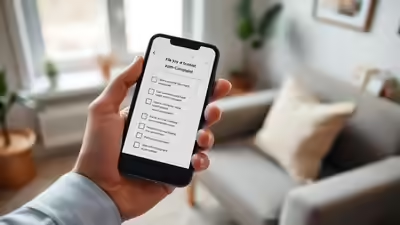
In short: Filing a consumer complaint India online is now possible through the government’s e-Daakhil portal, which lets you choose between a District Commission, State Commission, or the National Commission (NCDRC) based on the value of your claim. The Consumer Protection Act 2019 governs the entire process.
Key points
- The Consumer Protection Act 2019 replaced the 1986 Act and created a three-tier quasi-judicial system: District Consumer Disputes Redressal Commissions, State Consumer Disputes Redressal Commissions, and the National Consumer Disputes Redressal Commission (NCDRC).
- Which forum you approach depends on the value of the goods or services plus the compensation claimed — not just the price of the product.
- e-Daakhil (edaakhil.nic.in) is the official government portal that lets consumers file, pay fees, and track complaints entirely online, without visiting a commission office.
- A complaint must ordinarily be filed within two years of the cause of action arising; the commission can condone delay if you explain the reason in writing.
- You do not need a lawyer to file a consumer complaint — you can represent yourself throughout.
- Compensation, replacement, refund, and punitive damages are all remedies available under the 2019 Act.
What is the Consumer Protection Act 2019 and who does it protect?
The Consumer Protection Act 2019 came into force on 20 July 2020, repealing the earlier 1986 Act. It applies to goods bought and services hired or availed for personal use — not for resale or commercial purposes.
A “consumer” under the Act includes anyone who buys goods or hires services for consideration, including online purchases. This is an important update: e-commerce transactions are explicitly covered.
The Act also introduced the Central Consumer Protection Authority (CCPA), which can investigate complaints on behalf of a class of consumers and issue product recalls or cease-and-desist orders.
Which forum should you approach? Understanding the three tiers
The right forum depends on the total value of your claim — the cost of goods or services plus any compensation you seek. The table below summarises the pecuniary jurisdiction. Always verify current limits against the official notification, as the central government may revise them by order.
| Forum | Pecuniary Jurisdiction (value of claim) | Appeal goes to |
|---|---|---|
| District Consumer Disputes Redressal Commission | Up to ₹50 lakh | State Commission |
| State Consumer Disputes Redressal Commission | Above ₹50 lakh up to ₹2 crore | NCDRC |
| National Consumer Disputes Redressal Commission (NCDRC) | Above ₹2 crore | Supreme Court of India |
Jurisdiction for territorial purposes lies where the opposite party (the seller or service provider) resides or carries on business, or where the cause of action arose. For online purchases, the place where you received the goods or where you placed the order can both be relevant — verify with the commission if you are unsure.
How to file a consumer complaint India online using e-Daakhil
e-Daakhil is the Ministry of Consumer Affairs’ official online filing platform. It is available for most State Commissions and for the NCDRC. Here is the general process — always check the portal itself for the latest steps, since the interface is updated periodically.
Step 1 — Register on the portal
Go to edaakhil.nic.in and register with your mobile number and email address. You will receive an OTP for verification. Keep your login credentials safe.
Step 2 — Prepare your documents
Gather proof of purchase (invoice, order confirmation, screenshots), proof of deficiency (photos, emails, chat records), and any prior complaint you sent to the seller with their response or non-response.
Step 3 — Draft the complaint
The complaint should state your name and address, the opposite party’s details, the facts of the dispute, the relief you claim, and a declaration that the information is true. You can draft this yourself in plain language; you do not need a legal format.
Step 4 — Pay the prescribed fee
Filing fees vary by the value of the claim and are prescribed under the Consumer Protection (Consumer Disputes Redressal Commissions) Rules 2020. Payment on e-Daakhil is made online through the integrated payment gateway. Verify the current fee schedule on the portal before paying.
Step 5 — Upload and submit
Upload scanned copies of your documents, submit the complaint, and note your filing number. You can track the status of your complaint through the same portal login.
Filing offline: the traditional paper route
If you prefer or if your State Commission is not yet fully on e-Daakhil, you can file a physical complaint by visiting the relevant District or State Commission office. Carry printed copies of all documents and a demand draft or pay order for the prescribed fee.
The commission will issue an admission notice if it finds the complaint in order. If it does not, it may return the complaint with directions to rectify defects, usually within a specified period.
What reliefs can a consumer commission grant?
Under the 2019 Act, a commission can order the opposite party to repair or replace defective goods, refund the price paid, pay compensation for loss or injury suffered, pay punitive damages in appropriate cases, and discontinue an unfair trade practice. It can also award costs of the proceedings to you.
For guides on related topics — such as what counts as an “unfair trade practice” or how product liability works — visit our Law for You hub, where we explain everyday legal issues in plain language.
Limitation period: act within two years
A complaint must be filed within two years from the date the cause of action arose — typically the date of the deficiency or the date the defective goods were received. If you file late, you must attach a separate application explaining the delay. The commission has discretion to condone the delay if the reason is sufficient, but there is no guarantee, so filing promptly is advisable.
Mediation: a faster option built into the 2019 Act
The 2019 Act introduced statutory consumer mediation. If both parties agree, the commission may refer the dispute to a mediation cell attached to it. A mediated settlement, once accepted by both parties and recorded by the commission, has the same effect as an order of the commission. This can resolve disputes significantly faster than adjudication.
Frequently asked questions
Can I file a consumer complaint India online against an e-commerce platform like Amazon or Flipkart?
Yes. The Consumer Protection Act 2019 explicitly covers e-commerce transactions. You can name the platform, the seller listed on it, or both as opposite parties. File through e-Daakhil at the District Commission level if your claim is up to ₹50 lakh. Keep your order confirmation, delivery receipt, and all communication with the platform as evidence.
Is there any fee to file a consumer complaint, and can it be waived?
Yes, a filing fee is prescribed under the Consumer Protection (Consumer Disputes Redressal Commissions) Rules 2020 and varies with the value of the claim. The rules provide that complainants below a specified poverty threshold may be exempt from the fee — verify the exact conditions on the e-Daakhil portal or with the commission registry, as the rules can be amended.
Do I need a lawyer to file or argue a consumer complaint?
No. Consumer commissions are designed to be accessible without legal representation. You can file the complaint yourself, represent yourself at hearings, and cross-examine the opposite party’s witnesses. Many consumers successfully handle straightforward disputes on their own. That said, for high-value or legally complex matters, engaging an advocate experienced in consumer law is worth considering.
This article is for general information only and is not legal advice. Laws change; verify against the primary sources cited and consult a qualified advocate for your situation.

