


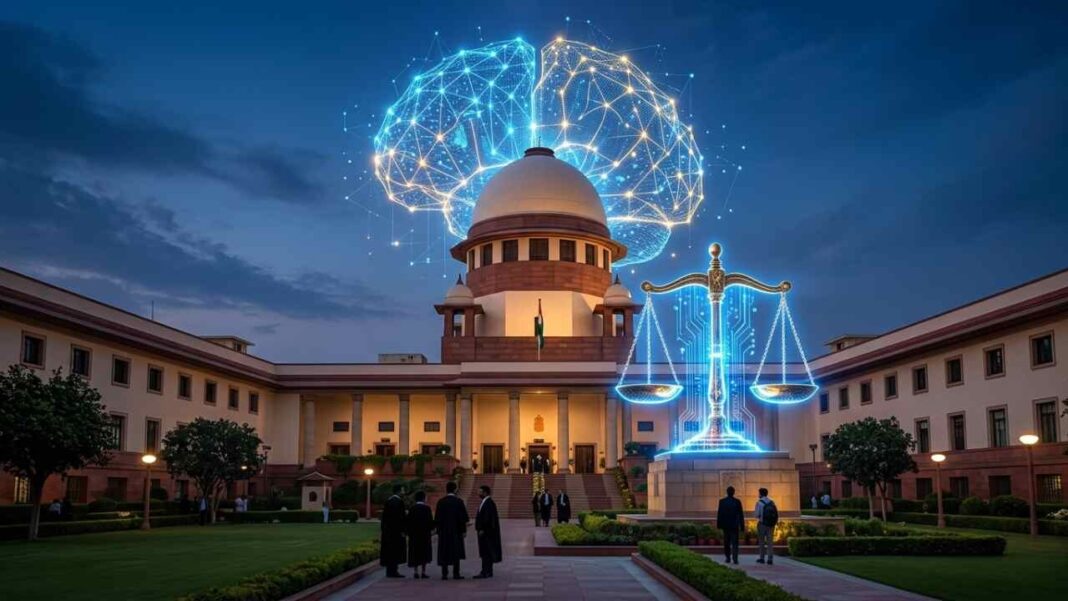
AI Hallucination, NCLT, IBC: Supreme Court Voids Insolvency Orders Built on Fabricated Precedents
On July 2, 2026, the Supreme Court of India set aside orders of both the NCLT Mumbai Bench and the NCLAT after finding that both forums had relied on six non-existent, AI-hallucinated judicial precedents in an insolvency dispute concerning Essel Infraprojects Ltd.
A bench of Justices PS Narasimha and Alok Aradhe held that citing AI-generated fake precedents without verification constitutes misconduct on the part of an advocate, and declared that any decision tainted by even an iota of such fabricated material is void — according to LiveLaw and Bar & Bench.
Background & Case History
The insolvency proceedings were initiated by Jammu and Kashmir Bank Ltd. against Essel Infraprojects Ltd. as a corporate guarantor. In December 2013, the bank had sanctioned a Rs 200 crore credit facility to Pan India Utilities Distribution Company Ltd.
Essel Infraprojects argued it was no longer liable as a guarantor due to a Bombay High Court-approved demerger and amalgamation involving group entities, which was sanctioned in 2014. The bank filed a Section 7 application under the Insolvency and Bankruptcy Code (IBC) to initiate the Corporate Insolvency Resolution Process.
The case is captioned Pooja Ramesh Singh v. J&K Bank, and the NCLT Mumbai Bench — comprising Judicial Member Rita Kohli and Technical Member Madhu Sinha — admitted the insolvency application on August 28, 2024, recording a claimed default of Rs 87.43 crore, as reported by Bar & Bench.
- December 2013: Jammu and Kashmir Bank sanctions Rs 200 crore credit facility to Pan India Utilities Distribution Company Ltd.
- 2014: Bombay High Court approves demerger and amalgamation involving Essel Infraprojects group entities.
- August 28, 2024: NCLT Mumbai Bench admits the Section 7 insolvency application, recording a default of Rs 87.43 crore.
- September 11, 2025: NCLAT upholds the NCLT order on appeal.
- May 5, 2026: AI hallucinated citation issue first surfaced during a Supreme Court hearing, when appellant Pooja Ramesh Singh flagged the non-existent citations.
- May 11, 2026: Pooja Ramesh Singh filed an affidavit before the Supreme Court alleging that multiple citations relied upon by the NCLT were untraceable in any recognised legal database.
- July 2, 2026: Supreme Court sets aside both the NCLT and NCLAT orders and issues its landmark ruling on AI-generated fake precedents.
Arguments & Submissions
Appellant Pooja Ramesh Singh brought the hallucinated citations to the Supreme Court’s attention on May 5, 2026, and followed up with a formal affidavit on May 11, 2026, asserting that the precedents cited in the NCLT order were non-existent and untraceable in any recognised legal database, per LiveLaw Biz.
Significantly, Jammu and Kashmir Bank filed its own affidavit stating that its counsel had never cited the disputed judgments. The bank’s submission indicated that the NCLT had located the fabricated precedents through its own independent research — making this an instance of judicial, not only advocate, reliance on AI-hallucinated material, as reported by Bar & Bench.
Essel Infraprojects had argued before the NCLT that it was discharged from guarantor liability by virtue of the 2014 Bombay High Court-approved demerger. The NCLT rejected this contention, relying partly on the six hallucinated citations — a finding the Supreme Court ultimately found fatally flawed.
The Ruling: Key Findings
The bench of Justices PS Narasimha and Alok Aradhe, after independently verifying the citations, confirmed they were entirely fictitious and set aside both the NCLT’s August 28, 2024 order and the NCLAT’s September 11, 2025 appellate order, according to LiveLaw.
The six hallucinated citations identified by the Court were: State Bank of India v. Shree Ram Urban Infrastructure Ltd., Everest Kento Cylinders Ltd. v. Union of India, ICICI Bank Ltd. v. Urban Infrastructure Real Estate Ltd., V.S. Dempo & Co. Ltd. v. Reliance Communications Ltd., Canara Bank v. N.G. Subbaraya Setty & Anr., and Sarbjit Singh v. Union Bank of India — per LiveLaw Biz.
The bench declared in unambiguous terms: “It is necessary for Courts to adopt a zero-tolerance mode for producing, citing or using AI-generated precedents without verification. It is a misconduct on the part of an advocate to cite such judgments without verification.”
On judicial reliance, the Court added: “Equally, it is a serious lapse if a judge relies on such fake or hallucinated AI-generated material as precedents in support of the determination.”
The Court then declared: “We have no hesitation in declaring that such a decision is no decision in the eyes of the law, irrespective of whether such material had a direct or indirect bearing on the decision-making.”
On the broader stakes, the bench stated: “More than the inevitable consequence of setting aside such judgment, what is significant for our decision making is our resolve to adopt artificial intelligence technology in aid of adjudication while at the same time asserting and declaring total and absolute control over adjudications with a human in the loop at every stage.”
Legal Analysis & Implications
The proceedings arose under Section 7 of the Insolvency and Bankruptcy Code (IBC), which allows a financial creditor to file an application to initiate the Corporate Insolvency Resolution Process against a corporate debtor upon proof of default.
The Supreme Court’s ruling creates a significant doctrinal bright line: the contamination standard requires voiding a decision if even an iota of AI-hallucinated material entered the decision-making process, regardless of whether it was directly determinative. This sets a stricter standard than typical procedural irregularity.
The Court invoked a striking analogy to underscore the danger, stating: “The production of fake, non-existing and hallucinated material and its utilisation as precedents in law, is like the release of methyl isocyanate in the province of law and justice: invisible, insidious, and catastrophic by the time anyone notices.” — as reported by Deccan Chronicle and LiveLaw Biz.
The ruling is particularly consequential because the fabrication originated not with a party’s counsel but with the NCLT’s own independent research — extending the Court’s zero-tolerance standard squarely into judicial conduct, not merely advocacy.
Reactions & Stakeholder Response
The Supreme Court directed the Bar Council of India (BCI) to constitute a committee of experts to examine issues arising from the use of artificial intelligence in adjudication and to frame guiding principles, with prescribed disciplinary action for lawyers who place hallucinated AI material before courts — per LiveLaw and Bar & Bench.
The BCI directive signals that institutional regulation of AI use in legal practice is now an active priority, with the apex court making clear that self-regulation or informal norms are insufficient given the stakes to judicial integrity.
What’s Next
The Supreme Court remanded the Section 7 insolvency application to the NCLT for fresh adjudication, directing it to decide the matter preferably within two weeks, with status quo maintained in the interim — as reported by Bar & Bench.
The BCI has been directed to constitute its expert committee and return with guiding principles; legal observers will watch whether the committee’s framework extends to AI research tools used by both advocates and tribunals in their independent research functions.
More legal news at The Courtroom.
Disclaimer
Disclaimer: This article is for general information only and does not constitute legal advice. Laws may change or vary by case — consult a qualified lawyer before acting. The Courtroom is not liable for any reliance on this content.

