


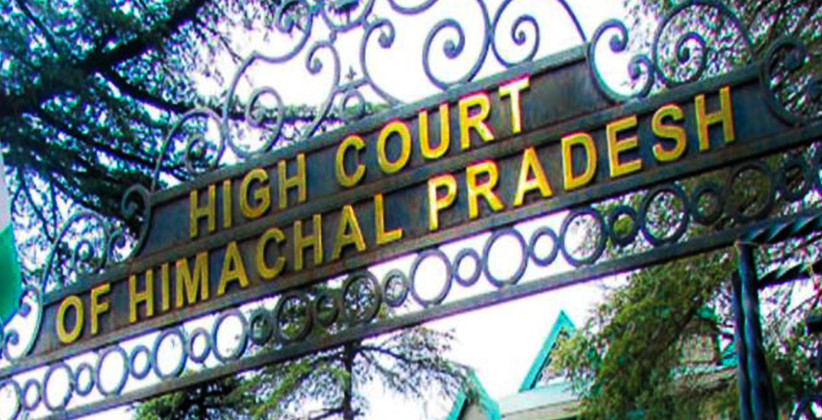
The Himachal Pradesh High Court has held that an FIR registered under the Prevention of Corruption Act cannot be quashed merely because the investigation or filing of the charge-sheet has been delayed, unless the accused demonstrates actual prejudice to a fair trial.
Justice Rakesh Kainthla dismissed the petition filed by Rajesh Kakkar, who had sought quashing of a 2016 corruption FIR nearly eight years after its registration, according to LiveLaw.
Background & Case History
The case originates from an FIR registered in 2016 by the State Vigilance and Anti-Corruption Bureau, Himachal Pradesh, in connection with alleged irregularities in the procurement of waste containers by the Municipal Committee, Dharamshala.
The case is titled Rajesh Kakkar v. State of Himachal Pradesh & Anr. and was heard before Justice Rakesh Kainthla of the Himachal Pradesh High Court. The petition was filed under Section 528 of the Bharatiya Nagarik Suraksha Sanhita, 2023, which corresponds to the inherent power formerly exercised under Section 482 of the Code of Criminal Procedure.
The matter came before the High Court after the investigation spanned nearly eight years from the date of FIR registration, without the petitioner securing any relief at earlier stages, as reported by LiveLaw.
- 2016: FIR registered by the State Vigilance and Anti-Corruption Bureau regarding alleged procurement irregularities involving the Municipal Committee, Dharamshala.
- The procurement in question involved waste containers worth over ₹1.45 crore, allegedly purchased in violation of prescribed financial and procurement procedures.
- The investigation continued for approximately eight years before the petitioner approached the High Court seeking quashing.
- June 24, 2026: Judgment reported by both SupremeToday.ai and LiveLaw, with the High Court dismissing the petition.
Arguments & Submissions
The petitioner, Rajesh Kakkar, contended that the investigation had dragged on for nearly eight years and that the continued pendency of criminal proceedings violated his fundamental right to a speedy trial guaranteed under Article 21 of the Constitution of India, according to LiveLaw.
On the prosecution side, the State submitted that municipal officials, in conspiracy with the petitioner, had procured waste containers worth over ₹1.45 crore in violation of the prescribed financial and procurement procedures, as reported by LiveLaw.
The prosecution maintained that the seriousness of the offences under the Prevention of Corruption Act and the involvement of public funds justified the continuation of the proceedings, notwithstanding the time elapsed since the FIR was registered.
The Ruling: Key Findings
Justice Rakesh Kainthla dismissed the petition, holding that delay in investigation or charge-sheet filing is not, by itself, sufficient ground to quash an FIR registered under the Prevention of Corruption Act, per LiveLaw.
The Court laid down the governing test in clear terms: “The test is whether the delay has caused such prejudice to the accused as to render the trial unfair or oppressive.”
Applying this test, the Court found that the petitioner had failed to demonstrate that his defence had been impaired, that crucial evidence had been lost, or that witnesses had become unavailable as a consequence of the delay, according to LiveLaw.
The Court further observed: “Thus, while the delay is substantial and regrettable, the Court is not persuaded that it infringes the Petitioner’s right to a fair and speedy trial under Article 21.”
The petition was dismissed with a specific clarification that the observations made by the Court would not affect the merits of the ongoing trial.
Legal Analysis & Implications
The judgment engages three key legal instruments: the Prevention of Corruption Act, under which the 2016 FIR was registered; Article 21 of the Constitution of India, which guarantees the right to life and personal liberty including a fair and speedy trial; and Section 528 of the Bharatiya Nagarik Suraksha Sanhita, 2023, which confers inherent powers on the High Court to quash proceedings.
The Court reinforced the principle that offences under the Prevention of Corruption Act carry substantial public interest and cannot ordinarily be terminated solely on account of the passage of time, as reported by LiveLaw.
Crucially, the ruling sets out a two-part threshold for quashing corruption FIRs: first, the delay must have caused actual, demonstrable prejudice to the accused; and second, such prejudice must be of a degree that renders the trial itself unfair or oppressive.
The Court also clarified that quashing of corruption-related FIRs should be confined to exceptional situations — specifically, where the record discloses absolutely no material or reasonable suspicion against the accused and the prosecution appears wholly mala fide, according to LiveLaw.
This ruling reinforces the judiciary’s consistent reluctance to permit procedural delay to become a shield against prosecution in cases involving misuse of public funds and office.
Reactions & Stakeholder Response
No statements from counsel, the petitioner, or civil society organisations in response to the judgment have been reported in the sources available. The Court’s clarification that its observations will not affect the trial’s merits signals an intent to preserve the integrity of ongoing proceedings.
What’s Next
With the High Court’s dismissal of the quashing petition, the case is set to continue before the trial court. The Court’s explicit clarification that its observations will not affect the merits of the trial means the proceedings will advance on the basis of the evidence and charge-sheet before the trial forum.
The petitioner retains the option of challenging the High Court’s order before the Supreme Court of India, though no such appeal has been reported in the available sources.
More legal news at The Courtroom.
Disclaimer
Disclaimer: This article is for general information only and does not constitute legal advice. Laws may change or vary by case — consult a qualified lawyer before acting. The Courtroom is not liable for any reliance on this content.

