


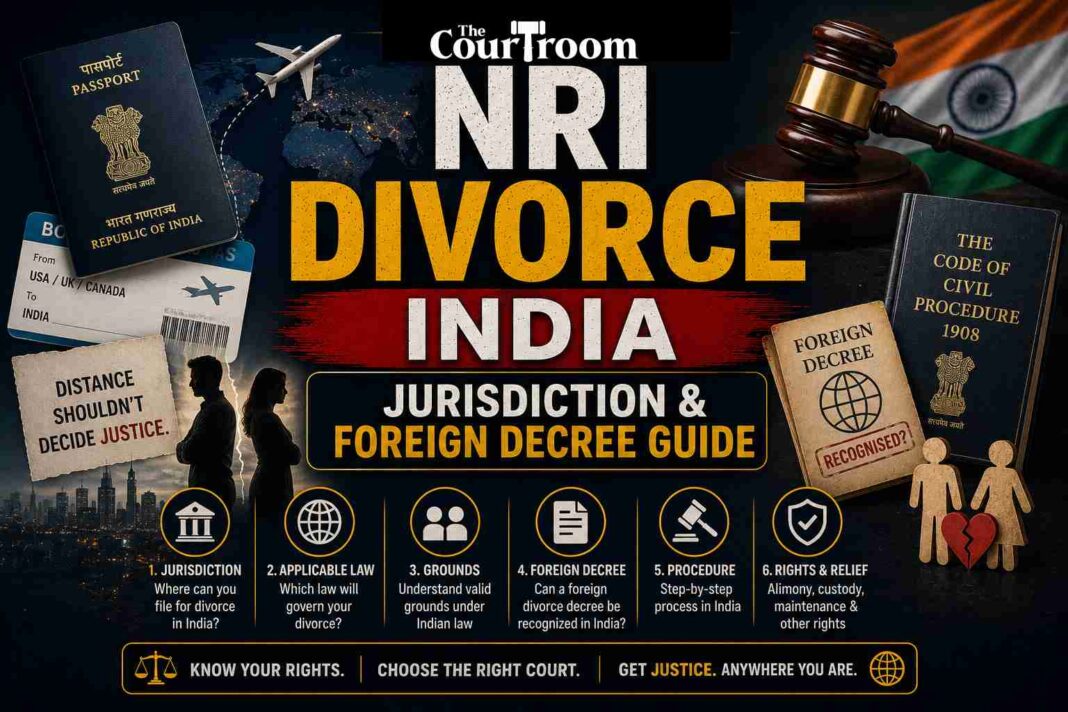
In short: NRI divorce India jurisdiction and foreign decree recognition are governed by personal laws such as the Hindu Marriage Act and the Special Marriage Act, read with the Code of Civil Procedure. Which court can hear your case, which law applies, and whether a foreign decree holds good in India all depend on where the marriage was solemnised and where the spouses reside.
Key points
- Indian courts retain jurisdiction over an NRI divorce when the marriage was solemnised in India, when the spouses last resided together in India, or when the respondent currently lives in India.
- The Hindu Marriage Act governs Hindus, Jains, Buddhists, and Sikhs worldwide — including NRIs — if the marriage was solemnised under Hindu customs.
- Civil or inter-faith marriages registered under the Special Marriage Act remain subject to Indian law regardless of where the parties now live, provided the jurisdictional conditions are met.
- A foreign divorce decree is not automatically valid in India; its recognition is tested under the Code of Civil Procedure’s provisions on foreign judgments alongside the relevant personal law.
- If a marriage was solemnised in India under any Indian personal law, a foreign court’s decree generally has no legal force here unless both spouses explicitly consented and the proceedings were consistent with Indian law principles.
- Dedicated family courts, established under the Family Courts Act, 1984, are the primary forums for NRI divorce, maintenance, and custody disputes in India.
Which court has jurisdiction over an NRI divorce in India?
Jurisdiction is the first question you must answer before filing — or responding to — any divorce petition in India.
Hindu marriages: Section 19 of the Hindu Marriage Act
For Hindus, Buddhists, Jains, and Sikhs, jurisdiction in divorce proceedings is set out in Section 19 of the Hindu Marriage Act, 1955. A petition may be presented to the district court within whose jurisdiction the marriage was solemnised.
Jurisdiction also lies where the spouses last resided together in India. Where the respondent is outside India, the petitioner’s own place of residence can also ground jurisdiction under the Act.
Civil and inter-faith marriages: the Special Marriage Act
For couples married under the Special Marriage Act, 1954 — which covers non-Hindu NRIs and Overseas Citizens of India — Section 31 of that Act governs jurisdiction. Indian courts retain authority whenever the statutory conditions are satisfied, even if one or both spouses now live abroad.
Family courts as the practical forum
In practice, NRI couples bring matrimonial disputes — divorce, maintenance, and child custody — before family courts established under the Family Courts Act, 1984. These courts exist in most district headquarters and are experienced in NRI matters.
Which law applies to an NRI divorce?
The applicable law tracks the personal law under which the marriage was solemnised, not the country where the couple currently lives.
| Community / Marriage type | Governing personal law | Covers NRIs? |
|---|---|---|
| Hindus, Jains, Buddhists, Sikhs | Hindu Marriage Act, 1955 | Yes — applies worldwide if marriage was under Hindu customs |
| Civil / inter-faith / OCI couples | Special Marriage Act, 1954 | Yes — if marriage registered in India or one spouse is domiciled in India |
| Indian national marrying a foreign national abroad | Foreign Marriage Act, 1969 | Yes — marriage may be registered at the Indian consulate |
| Muslims | Muslim Personal Law (Shariat) Application Act, 1937 | Yes — for marriages solemnised in India |
| Christians | Christian Marriage Act, 1872 | Yes — for marriages solemnised in India |
| Parsis | Parsee Marriage and Divorce Act, 1936 | Yes — for marriages solemnised in India |
One important clarification: the Bharatiya Nyaya Sanhita (BNS), which replaced the Indian Penal Code from 1 July 2024, does not replace or alter any of these personal laws. The Hindu Marriage Act, Special Marriage Act, and the others listed above remain fully in force.
What if you married in India but divorced abroad?
This is the scenario where NRIs most often encounter legal surprises. If your marriage was solemnised in India under any Indian personal law, only an Indian court can legally dissolve that marriage.
A foreign court’s decree — however fair or final it may appear — generally has no legal force in India unless both spouses explicitly consented to those proceedings and they were conducted on principles consistent with Indian law.
This rule applies equally whether the marriage was under the Hindu Marriage Act, the Special Marriage Act, the Muslim Personal Law, the Christian Marriage Act, the Parsee Marriage and Divorce Act, or the Anand Marriage Act.
For a broader overview of how Indian family law intersects with cross-border situations, see the related guides in our Law for You section.
When is a foreign divorce decree recognised in India?
Recognition of a foreign matrimonial decree is not automatic. Indian courts apply a two-part framework.
The Code of Civil Procedure test
The Code of Civil Procedure, 1908 contains provisions setting out the circumstances in which a foreign judgment is not conclusive in India. A foreign divorce decree will generally not be recognised if, among other grounds, the foreign court did not have jurisdiction under Indian private international law, the judgment was obtained by fraud, or it was passed in breach of natural justice.
The personal law overlay
Even if a foreign decree clears the Code of Civil Procedure hurdles, it must also be consistent with the personal law under which the marriage was solemnised. For a Hindu marriage conducted in India, for example, an ex parte foreign decree obtained without the other spouse’s participation is almost certainly unenforceable here.
Mutual consent as a pathway
Where both spouses voluntarily participated in foreign proceedings and explicitly consented, Indian courts have been more willing to recognise the resulting decree. However, each case turns on its own facts, and you should not assume recognition without qualified legal advice.
Practical steps for NRIs
If you are an NRI navigating a divorce with an Indian dimension, keep the following in mind.
First, identify the personal law under which your marriage was solemnised — this determines both the applicable law and the ground rules for recognition of any foreign proceedings.
Second, establish which court has jurisdiction. If the marriage was solemnised in India, consider whether to file in India from the outset rather than risk an unenforceable foreign decree.
Third, if divorce proceedings are already underway abroad, consult an Indian advocate before those proceedings conclude. Participation and consent can significantly affect enforceability in India.
Fourth, for ancillary matters — maintenance, child custody, property — Indian courts may assert jurisdiction independently even where a foreign divorce decree is in place.
Frequently asked questions
Can an NRI file for divorce in India without returning to the country?
An NRI can appoint a power-of-attorney holder to file a petition and handle procedural steps in India, but personal appearance may still be required at key stages — particularly in contested matters or for recording evidence. Whether your physical presence can be dispensed with depends on the facts of your case and the discretion of the court concerned. Consult a family law advocate in the relevant district before assuming you can avoid travel entirely.
Does a divorce granted in the USA, UK, or another country automatically dissolve an Indian Hindu marriage?
No. If the marriage was solemnised in India under the Hindu Marriage Act or any other Indian personal law, a foreign decree does not automatically dissolve it under Indian law. Recognition depends on whether both spouses participated and consented, and on whether the foreign court’s proceedings are consistent with Indian law principles as tested under the Code of Civil Procedure. An ex parte or uncontested foreign decree obtained without the other spouse’s involvement is likely unenforceable in India.
Which personal law governs an NRI Hindu couple who married in India but have lived in Canada for fifteen years?
The Hindu Marriage Act, 1955 continues to govern their marriage because it was solemnised under Hindu customs in India. The Act applies to Hindus, Jains, Buddhists, and Sikhs worldwide, irrespective of where they currently reside. Their divorce — if pursued in India — would be filed before the district court or family court with jurisdiction under the Act’s provisions on venue.
Primary sources
- India Code — bare text of the Hindu Marriage Act 1955, Special Marriage Act 1954, Foreign Marriage Act 1969, Family Courts Act 1984, and Code of Civil Procedure 1908
- Supreme Court of India — judgments on recognition of foreign matrimonial decrees and NRI jurisdiction
Written by Editorial Team, The Courtroom · Last verified 2026-07-09
This article is for general information only and is not legal advice. Laws change; verify against the primary sources cited and consult a qualified advocate for your situation.

