


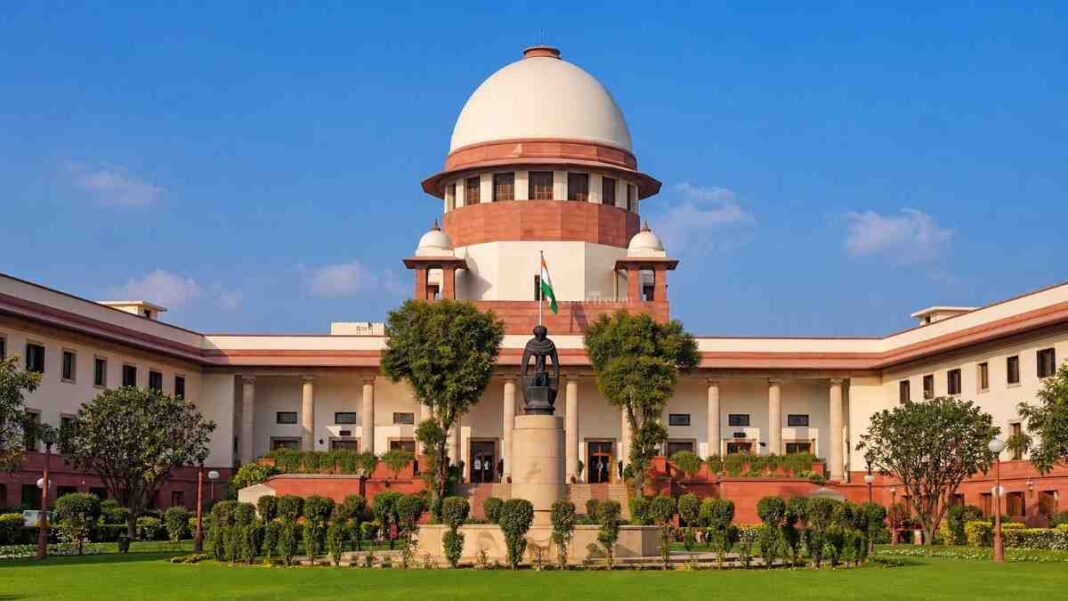
The Supreme Court of India on July 3, 2026 issued notice on the Meghalaya government’s petition challenging the High Court’s order upholding bail granted to Sonam Raghuvanshi, the prime accused in the Raja Raghuvanshi honeymoon murder case.
A bench of Justices M.M. Sundresh and Sheel Nagu declined to stay or cancel the bail, according to LiveLaw, because Sonam had already been released from custody and was in Shillong pursuant to conditions set by the trial court.
Background: How We Got Here
Raja Raghuvanshi, an Indore-based businessman, married Sonam Raghuvanshi on May 12, 2025. The couple disappeared on May 23, 2025 after checking out of a homestay in Nongriat, Meghalaya, during their honeymoon.
Raja’s body was discovered on June 2, 2025 in a deep gorge near Weisawdong Falls, East Khasi Hills. Sonam was found on June 8, 2025 near a dhaba on the Varanasi-Ghazipur highway, per LiveLaw.
- Police allege Sonam conspired with her alleged lover Raj Kushwaha and three hired assailants to murder her husband for financial gain. A 700-plus page chargesheet has been filed and trial is underway with 94 prosecution witnesses.
- The Shillong Additional Deputy Commissioner (Judicial) granted bail on April 27, 2026, on the ground that arrest documents erroneously cited Section 403(1) BNS — a non-existent provision — instead of the correct Section 103(1) BNS, which covers murder under the Bharatiya Nyaya Sanhita.
- On June 29, 2026, the Meghalaya High Court’s Justice W. Diengdoh upheld that bail order and dismissed the state’s appeal, finding serious procedural lapses in the manner of arrest, per Prokerala and NewsDrum.
The Ruling — Key Findings
The bench of Justices M.M. Sundresh and Sheel Nagu issued formal notice on the Meghalaya government’s petition and directed Sonam Raghuvanshi to file a counter-affidavit, according to Prokerala and India TV News.
Justice Sundresh was pointed in his assessment of the High Court’s order. As reported by Tribune India, the bench stated: “We have a reservation, prima facie, about the High Court order. We will see how the trial proceeds.”
The court’s restraint on cancellation was equally direct. Justice Sundresh observed: “But for the fact that she has been released, we would have stayed the order.”
On listing the matter, the bench noted: “Considering the submission that the order of bail has been given effect to, we are inclined to list the matter for further hearing on next Thursday,” per Prokerala.
Notably, Justice Sundresh also remarked: “However heinous the crime is, bail is the rule and jail is an exception,” per The Week — underscoring the constitutional principle that guided the court’s reluctance to revoke an already-executed bail.
The High Court’s Justice W. Diengdoh had found that the manner of preparing the grounds of arrest reflected a “total non-application of judicious mind” by the arresting agency, as reported by India TV News.
Reactions & What’s Next
Solicitor General Tushar Mehta appeared for the State of Meghalaya and termed the High Court’s bail order “really shocking,” arguing before the SC bench that the case involved a premeditated murder with three accomplices, according to LiveLaw and Tribune India.
Mehta contended that the wrong statutory citation — Section 403(1) BNS instead of Section 103(1) BNS — was a mere typographical error that caused no actual prejudice to the accused and should not have formed the basis for granting bail, per Tribune India.
The Supreme Court has posted the matter for further hearing the following Thursday, with Sonam Raghuvanshi directed to file her counter-affidavit in the interim, according to Prokerala and India TV News.
The operative effect of the July 3 order, as confirmed across reporting by LiveLaw, Tribune India, Prokerala, and India TV News, is that Sonam Raghuvanshi remains on bail. The SC’s notice signals, however, that the High Court’s reasoning faces serious judicial scrutiny at the apex level.
Disclaimer
Disclaimer: This article is for general information only and does not constitute legal advice. Laws may change or vary by case — consult a qualified lawyer before acting. The Courtroom is not liable for any reliance on this content.

