


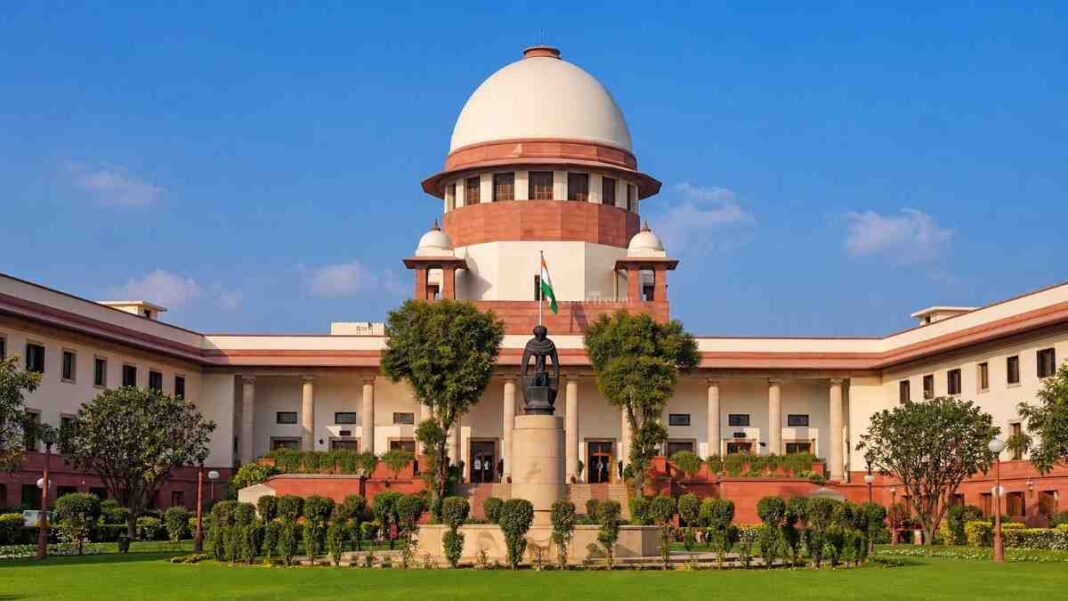
The doctrine of Article 226 forum non conveniens — which allows a High Court to decline jurisdiction in favour of a more convenient forum — has only a rare and limited role in constitutional writ proceedings, the Supreme Court of India ruled on June 9, 2026.
The landmark judgment, Baksish Ahmad v. Union of India & Anr. (2026 INSC 630), was delivered by a bench of Justice Dipankar Datta and Justice Satish Chandra Sharma, according to LiveLaw.
Article 226 Forum Non Conveniens and the BSF Constable’s Case
The case began with Baksish Ahmad, enrolled in the Border Security Force on December 31, 2010, and posted with the 44th Battalion in West Bengal, per Verdictum.
In October 2022, Ahmad was dismissed from service without pensionary benefits by his Commandant after a Staff Court of Inquiry found he had contracted a second marriage during the subsistence of his first marriage without obtaining requisite permission — an alleged violation of the BSF Rules, 1969 and the Central Civil Services (Conduct) Rules, 1964.
- Ahmad filed a statutory petition for reinstatement under Rule 28A of the BSF Rules, 1969, addressed to the Director General, BSF. It was rejected on December 22, 2023, by the Inspector General, Frontier Headquarters, BSF, Jammu.
- He then moved the Delhi High Court under Article 226. A Division Bench dismissed the petition on January 10, 2025, holding that the dismissal order was issued in West Bengal and the statutory petition was rejected in Jammu & Kashmir — making Delhi an inappropriate forum.
- The Delhi High Court had reasoned: “Merely because the office of the Director General, BSF and the Ministry of Home Affairs is situated at Delhi, it will not make this Court a forum conveniens.”
Ahmad appealed to the Supreme Court. The Union of India, represented by Additional Solicitor General Aishwarya Bhati, opposed the appeal, arguing that no part of the cause of action arose in Delhi and that the Calcutta High Court was the most appropriate forum, as reported by rawlaw.in.
What the Court Said
The Supreme Court bench of Justice Dipankar Datta and Justice Satish Chandra Sharma allowed Ahmad’s appeal, set aside the Delhi High Court’s January 10, 2025 order, and restored his writ petition for hearing on merits, according to LiveLaw.
The Court drew a sharp distinction between Article 226(1) — which confers jurisdiction based on the situs of the respondent authority — and Article 226(2), which confers jurisdiction based on where the cause of action arises. Because the Union of India and the Director General, BSF are located in Delhi, the Delhi High Court had valid jurisdiction under clause (1).
The bench further noted that under Rule 22, sub-rule (4) of the BSF Rules, 1969, every dismissal order must be reported to the Director General, BSF — thereby establishing a sufficient nexus with Delhi.
The Court relied on its earlier decision in Abrar Ali v. CISF, where it had held that the Delhi High Court possessed jurisdiction under Article 226(1) because the headquarters of the CISF were located in Delhi, per rawlaw.in.
In the bench’s own words: “Where the question of pursuing a constitutional remedy is involved and invocation of writ jurisdiction is traceable to clause (1) of Article 226, the doctrine of forum non conveniens may rarely apply.”
The Court was equally direct in its criticism of the lower court’s reasoning: “In our considered opinion, the doctrine of forum non conveniens has been misapplied by the Division Bench in the context of writ jurisdiction referable to Article 226 of the Constitution.”
The bench also observed: “A suitor having himself chosen the forum convenient to the respondents, application of the doctrine of forum non conveniens could be self-defeating and likely to deny access to justice rather than advancing it.”
The Court acknowledged that Ahmad could have alternatively approached the Calcutta High Court, the High Court of Jammu & Kashmir and Ladakh, or the Allahabad High Court — but held that Delhi was also a competent forum. Respondents were given two months to file a counter-affidavit, and Ahmad one month thereafter to file a rejoinder.
What It Means for You
This ruling carries significant practical implications for all CAPF personnel — including members of the BSF, CISF, CRPF, ITBP, and SSB — who seek to challenge adverse service orders in the Delhi High Court even when the cause of action arose in another state.
The Supreme Court has clarified that a petition grounded in Article 226(1) cannot be mechanically dismissed on the basis of forum non conveniens merely because the triggering events occurred outside Delhi. Access to justice takes precedence over forum convenience when a constitutional remedy is at stake.
It is important to note that the Supreme Court did not rule on the legality of Ahmad’s dismissal from BSF service — that substantive question remains open before the Delhi High Court, per rawlaw.in.
Read more at The Courtroom.
What did the Supreme Court rule about Article 226 and forum non conveniens in the Baksish Ahmad case?
The Supreme Court held that the doctrine of forum non conveniens has limited application in writ proceedings under Article 226, particularly where jurisdiction is founded on the location of the respondent authority under clause (1). Because the Union of India and the Director General, BSF are situated in Delhi, the Delhi High Court had valid jurisdiction to hear Ahmad’s petition despite the cause of action arising outside Delhi.
Why was Baksish Ahmad dismissed from the BSF, and what is the current status of his case?
Ahmad, a constable with the 44th Battalion in West Bengal, was dismissed in October 2022 after a Staff Court of Inquiry found he had contracted a second marriage without obtaining requisite permission, in alleged violation of the BSF Rules, 1969 and the Central Civil Services (Conduct) Rules, 1964. The Supreme Court has restored his writ petition to the Delhi High Court for adjudication on merits, but has not ruled on the legality of his dismissal.
Can CAPF personnel approach the Delhi High Court in service disputes even if the cause of action arose in another state?
Yes, per the Supreme Court’s June 9, 2026 ruling in 2026 INSC 630. Because the Union of India and the headquarters of central paramilitary forces such as the BSF are located in Delhi, CAPF personnel can invoke the Delhi High Court’s writ jurisdiction under Article 226(1), regardless of where the dismissal or other adverse action was issued.
Final Thoughts on Article 226 Forum Non Conveniens
The Supreme Court’s ruling in Baksish Ahmad v. Union of India (2026 INSC 630) firmly limits the reach of the forum non conveniens doctrine in constitutional writ proceedings, ensuring that CAPF personnel are not left without a convenient and competent forum to vindicate their service rights.
By restoring Ahmad’s petition and directing the Delhi High Court to hear it on merits, the bench has reinforced that access to justice under Article 226(1) cannot be defeated by a mechanical application of jurisdictional convenience principles. Stay updated at The Courtroom.
Disclaimer
Disclaimer: This article is for general information only and does not constitute legal advice. Laws may change or vary by case — consult a qualified lawyer before acting. The Courtroom is not liable for any reliance on this content.

