


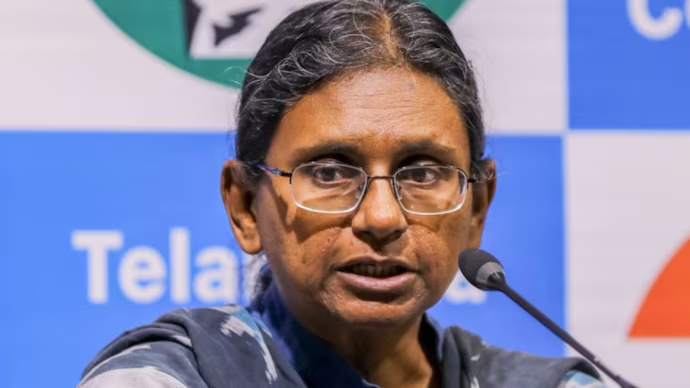
On June 12, 2026, the Supreme Court dismissed Congress leader Meenakshi Natarajan’s writ petition challenging the rejection of her Rajya Sabha nomination from Madhya Pradesh, holding the petition non-maintainable under Article 329 of the Constitution.
The bench of Justice Prashant Kumar Mishra and Justice Atul S. Chandurkar ruled that the constitutional bar on judicial interference in ongoing electoral matters prevents any direct approach under Article 32, according to LiveLaw. With Natarajan out, all three BJP candidates were declared elected unopposed.
Background: How We Got Here
Natarajan, a former Lok Sabha MP from Mandsaur and the AICC in-charge for Telangana, was fielded by Congress for the Rajya Sabha by-election from Madhya Pradesh scheduled for June 18, 2026.
On June 9, 2026, Returning Officer and Madhya Pradesh Assembly Principal Secretary Arvind Sharma rejected her nomination, per Tribune India and Lawbeat. The rejection came after BJP candidate Mahesh Kewat and BJP State General Secretary Rahul Kothari filed a complaint against her candidature.
- The ground for rejection: Natarajan allegedly failed to disclose in her Form 26 affidavit a private criminal complaint — No. 4472/2025 — pending before the IV Additional Judicial Magistrate, Hyderabad, where she is arrayed as Respondent No. 4, according to LiveLaw.
- The complaint was filed by former Congress worker A. Srilatha from Telangana, alleging molestation against a named accused and alleging Natarajan and other senior party functionaries failed to take action.
- On June 11, 2026, the Supreme Court agreed to list the matter urgently after Senior Advocate Abhishek Manu Singhvi made an urgent mention; the Court also raised maintainability concerns at that stage, per LiveLaw.
The writ petition was registered as W.P.(C) No. 766/2026, Diary No. 36330/2026, in the case of Meenakshi Natarajan v. Election Commission of India, according to LiveLaw.
The Ruling — Key Findings
The bench dismissed the petition with a clear constitutional rationale: Article 329(b) bars courts from entertaining challenges to an election — including a nomination rejection — through the writ route once electoral proceedings are underway.
The Court’s words were unambiguous. As reported by Lawbeat and LiveLaw, the bench declared: “However erroneous the decision may be, once a nomination is rejected, the remedy ordinarily lies elsewhere.”
The Court also warned against a fragmented approach to election disputes, stating: “We are afraid, that any such interpretation that in some of the matters this Court can interfere while leaving some others to avail the remedy of election tribunal cannot be encouraged.”
The bench formally ordered: “We are not inclined to entertain this petition and it is hereby dismissed,” per LiveLaw.
Crucially, the Court expressly reserved all merits questions — including whether the nomination rejection was legally correct — for consideration in an election petition under the Representation of the People Act, 1951, as reported by Lawbeat. It stated it had expressed no opinion on the substance of Natarajan’s challenge.
Reactions & What’s Next
Singhvi argued vigorously that no cognizance had been taken in the Hyderabad case and that Section 33A of the RPA only mandates disclosure of criminal cases in which charges have actually been framed. He contended: “If there is no cognizance, there is no case in the eye of law,” per Lawbeat and The Federal.
Opposing him, Senior Advocate Mukul Rohatgi — appearing for BJP candidate Mahesh Kewat — argued that the right to contest an election is purely statutory, not a fundamental right, making Article 32 unavailable as a remedy. Rohatgi also invoked Article 329(b) and the precedent in NP Ponnuswamy v. Returning Officer, according to LiveLaw.
Senior Advocate Dama Seshadri Naidu appeared for the Election Commission, similarly contending that election disputes fall within the exclusive jurisdiction of election tribunals, per Lawbeat. Solicitor General Tushar Mehta also sought to argue for the respondents after Rohatgi was disconnected during the virtual hearing, according to LiveLaw.
Following Natarajan’s disqualification, BJP’s Tarun Chugh, Rajneesh Agrawal, and Mahesh Kewat were declared elected unopposed to Rajya Sabha from Madhya Pradesh, per Tribune India and Republic World.
Natarajan’s legal team retains the option of pursuing an election petition under the RPA, 1951 — the exclusive forum the Supreme Court has now pointed her to. No further Supreme Court hearing is scheduled in this matter.
More legal news at The Courtroom.
Why did the Supreme Court dismiss Meenakshi Natarajan’s Rajya Sabha nomination petition?
The Court held the writ petition non-maintainable because Article 329 of the Constitution bars courts from judicially interfering in an ongoing electoral process via Article 32. The bench ruled that the remedy for an improperly rejected nomination lies exclusively in an election petition under the Representation of the People Act, 1951, not a direct writ to the Supreme Court.
On what ground was Natarajan’s nomination rejected by the Returning Officer?
Returning Officer Arvind Sharma rejected her nomination on June 9, 2026, on the ground that she failed to disclose in her Form 26 affidavit a private criminal complaint — No. 4472/2025 — pending before the IV Additional Judicial Magistrate, Hyderabad, in which she is arrayed as Respondent No. 4, according to LiveLaw.
What happens next for Meenakshi Natarajan after this Supreme Court ruling?
The Supreme Court granted her liberty to file an election petition under the Representation of the People Act, 1951, and expressly stated it had not ruled on the merits of her challenge. All substantive legal questions — including whether the nomination rejection was valid — remain open for an election tribunal to decide, per Lawbeat.
Who were the BJP candidates declared elected unopposed after Natarajan’s disqualification?
Following Natarajan’s disqualification, BJP’s Tarun Chugh, Rajneesh Agrawal, and Mahesh Kewat were declared elected unopposed to the Rajya Sabha from Madhya Pradesh, according to Tribune India and Republic World.
Disclaimer
Disclaimer: This article is for general information only and does not constitute legal advice. Laws may change or vary by case — consult a qualified lawyer before acting. The Courtroom is not liable for any reliance on this content.

