


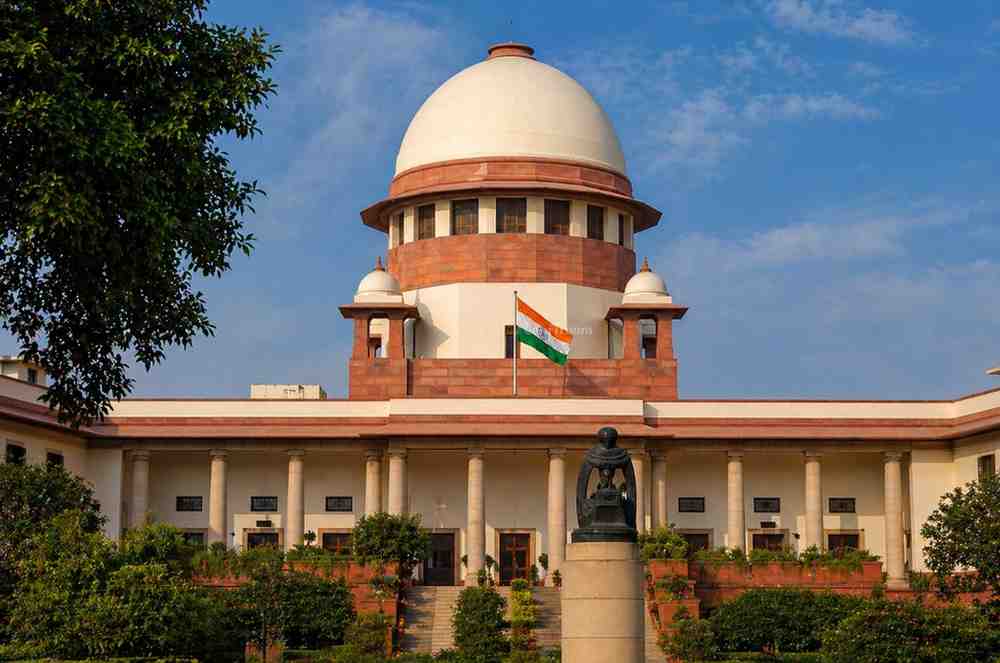
The Supreme Court of India on August 6, 2026, stayed the arrest of Sumit Roy — Personal Assistant to TMC MP and national general secretary Abhishek Banerjee — in connection with the Salboni land-grabbing case in Paschim Medinipur, West Bengal.
The relief came just days after the Calcutta High Court rejected Roy’s anticipatory bail plea on August 3, 2026, according to LiveLaw. Roy subsequently filed a Special Leave Petition challenging that order before the apex court.
Background & Case History
The case stems from allegations that Sumit Roy illegally grabbed and fraudulently transferred government-vested land in Salboni, Paschim Medinipur district, West Bengal, using forged documents.
An FIR was registered at Salboni Police Station as Case No. 133 of 2026 under multiple provisions of the Indian Penal Code. The Special Leave Petition before the Supreme Court is captioned Sumit Roy v. State of West Bengal, bearing Diary No. 46817/2026.
Roy had argued before the Calcutta High Court that he was not named in the FIR and that his alleged involvement emerged only during the course of the investigation, as reported by LawBeat.
- June 2026: A Midnapore court issued an arrest warrant against Roy after the investigating agency reported he could not be traced; the CID of West Bengal Police also issued a lookout notice against him.
- June 2026: Police searched Abhishek Banerjee’s Kalighat residence in Kolkata and Roy’s in-laws’ residence in Serampore, but did not find him.
- August 3, 2026: The Calcutta High Court, through a single-judge bench of Justice Tirthankar Ghosh, rejected Roy’s anticipatory bail plea, holding it was not a fit case for relief, citing the serious nature of the allegations, seizure of forged title deeds, and witness statements about threats by Roy.
- August 6, 2026: Roy filed an SLP before the Supreme Court; the bench led by CJI Surya Kant stayed his arrest and issued notice on the petition.
Arguments & Submissions
Senior Advocate Gopal Sankaranarayanan appeared for Roy before the Supreme Court. He informed the bench that the Calcutta High Court had separately granted anticipatory bail to Roy in a cash-for-jobs scam case, according to LiveLaw.
Solicitor General Tushar Mehta appeared for the State of West Bengal and strongly opposed interim relief. He argued that custodial interrogation was necessary and that prior arrest attempts had been repeatedly obstructed.
SG Mehta made a pointed allegation on the floor of the court: “Whenever we went to arrest him, it was obstructed. The former Chief Minister (Mamata Banerjee) herself obstructed it,” as reported by Bar & Bench.
The Ruling: Key Findings
The three-judge bench comprising Chief Justice of India Surya Kant, Justice Joymalya Bagchi, and Justice V. Mohana stayed Roy’s arrest and issued notice on his SLP, per Bar & Bench and LiveLaw.
The bench ordered: “Petitioner (Sumit Roy) shall cooperate with the investigation. His arrest shall remain stayed.”
The court imposed detailed conditions. As per the bench’s order: “He should not be accompanied by any advocate or any other person. He shall remain available for any investigation from 10:00 a.m. to 6:00 p.m. with the usual breaks. However, his arrest will remain stayed.”
The stay is further conditional on Roy furnishing a bail bond to the satisfaction of the investigating officer. The bench’s operative order reads: “His arrest shall remain stayed, subject to furnishing bail bond to the satisfaction of the investigating officer.”
When SG Mehta raised concerns about past obstruction, CJI Surya Kant remarked from the bench: “I hope you are not saying the police is the problem,” as reported by Bar & Bench.
Legal Analysis & Implications
The FIR against Roy invokes a broad set of IPC provisions: Section 420 (cheating), Section 467 (forgery of valuable security), Section 468 (forgery for purpose of cheating), Section 471 (using a forged document as genuine), Sections 472 and 473 (making or possessing counterfeit seals), Section 406 (criminal breach of trust), Section 409 (criminal breach of trust by a public servant), and Section 120B (criminal conspiracy).
The combination of forgery and conspiracy charges alongside breach-of-trust provisions underscores the gravity that the Calcutta High Court had noted when it declined anticipatory bail on August 3.
The Supreme Court’s decision to grant a conditional stay — rather than outright interim bail — signals a calibrated approach. By requiring Roy to present himself for questioning without legal accompaniment and to furnish a bail bond, the court balanced his liberty interest against the investigation’s integrity.
Roy’s separate anticipatory bail in the cash-for-jobs scam case, granted by the Calcutta High Court, was placed on record by his counsel and may have weighed on the bench’s assessment of his general conduct, according to LiveLaw.
Reactions & Stakeholder Response
The State of West Bengal, represented by SG Mehta, made clear it intends to contest the relief vigorously, arguing before the bench that previous attempts to execute the arrest warrant had faced obstruction at the highest political level.
No formal statement from Abhishek Banerjee or the TMC was reported in the verified sources at the time of publication. Roy’s counsel, Senior Advocate Gopal Sankaranarayanan, did not make any public statement beyond his in-court submissions as reported.
What’s Next
The Supreme Court has issued notice on Roy’s SLP (Diary No. 46817/2026) and the matter is expected to come up for further hearing. Roy must in the meantime comply with all conditions — appearing before the investigating agency between 10 AM and 6 PM, unaccompanied, and furnishing the required bail bond.
Any breach of the court-imposed conditions could expose Roy to cancellation of the stay and immediate arrest. The West Bengal CID’s lookout notice against him remains a live instrument pending the next order from the apex court.
More legal news at The Courtroom.
Disclaimer
Disclaimer: This article is for general information only and does not constitute legal advice. Laws may change or vary by case — consult a qualified lawyer before acting. The Courtroom is not liable for any reliance on this content.

