


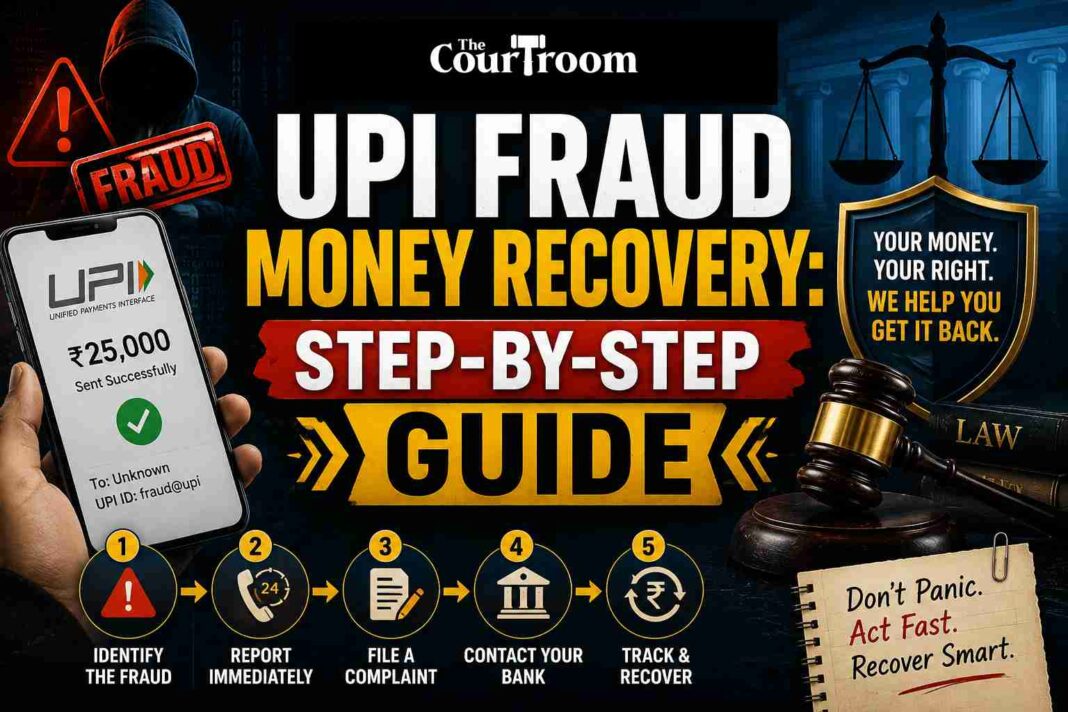
In short: UPI fraud money recovery in India is possible if you act fast. Call 1930 immediately to freeze the fraudster’s account, notify your bank in writing within three working days for zero liability, and escalate through cybercrime.gov.in, an FIR, and the RBI Ombudsman if the bank does not resolve your complaint.
Key points
- Dial 1930 within minutes of the fraud — this is the National Cyber Crime Helpline operated by I4C under the Ministry of Home Affairs, and it alerts the receiving bank to freeze the credited funds before they can be withdrawn.
- Under RBI Circular DBR.No.Leg.BC.78/09.07.005/2017-18, reporting an unauthorized transaction within three working days means you bear zero liability, and the bank must provisionally reverse the amount within ten working days.
- The RBI’s revamped Integrated Ombudsman Scheme (RB-IOS 2026), in effect from 1 July 2026, can award up to ₹30 lakh for consequential financial loss and up to ₹3 lakh for harassment and mental anguish — higher limits than the superseded 2021 scheme.
- Criminal complaints are now filed under the Bharatiya Nyaya Sanhita (BNS), 2023 and FIRs are registered under Section 173 of the BNSS, 2023 — the new codes that replaced the IPC and CrPC from 1 July 2024.
- Consumer court is free to use for amounts up to ₹50 lakh under the Consumer Protection Act, 2019, and is available if other avenues fail.
- If you transferred money to a wrong UPI ID by your own mistake, RBI compensation rules do not apply automatically — act through the bank’s grievance process and, if needed, through the Ombudsman.
Step 1 — Call 1930 the moment you realise what happened
Time is everything in UPI fraud money recovery. The moment you spot an unauthorized debit, call 1930 — the National Cyber Crime Helpline. Have your UTR number ready; you will find it in the debit SMS your bank sent.
The 1930 portal is run by the Indian Cyber Crime Coordination Centre (I4C) under the Ministry of Home Affairs. When you report, it sends an alert to the receiving bank to freeze the credited amount before the fraudster can withdraw it. A call placed minutes after the fraud stands a far better chance of stopping the funds than one placed hours later.
Step 2 — Notify your bank in writing within three working days
A phone call to your bank is not a timestamped legal record for RBI liability purposes. Send an email — to the branch address and the main customer service address — as soon as possible after calling 1930.
Under RBI Circular DBR.No.Leg.BC.78/09.07.005/2017-18, if the breach was caused by a third party and you had no contributory negligence, your liability depends entirely on how quickly you report:
| When you report | Your liability | Bank’s obligation |
|---|---|---|
| Within 3 working days | Zero — you bear nothing | Provisional reversal within 10 working days |
| 4 to 7 days | Limited — capped at a maximum amount set by RBI | Resolve within 90 days of complaint |
| Beyond 7 days | Determined by the bank’s board-approved policy | Resolve within 90 days of complaint |
Crucially, the burden of proving that you were at fault lies on the bank — not on you. The bank must resolve the complaint and establish any customer liability within 90 days of receiving the complaint.
One important limit: if you sent money to a wrong UPI ID by your own mistake, this is not an “unauthorized” transaction under RBI rules and automatic compensation does not apply. You will need to pursue the bank’s internal grievance process and, if that fails, the Ombudsman.
Step 3 — File a complaint on cybercrime.gov.in
Go to cybercrime.gov.in and file a financial fraud complaint. Upload screenshots of the fraudulent transaction, your bank statement, and any messages from the fraudster. Save the acknowledgement number — you will need it for every subsequent step.
Step 4 — File an FIR at your nearest police station
Filing an FIR creates a formal legal record and can trigger action to freeze accounts and trace the fraudster. Under the Bharatiya Nagarik Suraksha Sanhita (BNSS), 2023 — which replaced the CrPC from 1 July 2024 — the registration of a cognizable offence is now governed by Section 173 of the BNSS.
If your local police station is reluctant because the fraud originated elsewhere, insist on a Zero FIR. Any police station in India can register a Zero FIR for a cognizable offence regardless of where it occurred. This prevents delays caused by jurisdictional disputes and helps preserve crucial digital evidence while it still exists.
The substantive criminal law that applies to the fraud itself is the Bharatiya Nyaya Sanhita (BNS), 2023, which came into force on 1 July 2024 replacing the Indian Penal Code. For detailed guidance on how criminal complaints work under the new codes, see our Law for You guides on criminal procedure and your rights as a complainant.
Step 5 — Escalate to the RBI Ombudsman if your bank does not respond
When can you approach the Ombudsman?
You must first complain to your bank. If the bank does not respond within 30 days — or within any longer timeline prescribed by RBI, NPCI, or card network rules — you can escalate to the RBI Ombudsman. You must do so within 90 days of that deadline passing.
What has changed under RB-IOS 2026?
The Reserve Bank’s revamped Integrated Ombudsman Scheme (RB-IOS 2026) came into effect on 1 July 2026. It covers banks, certain NBFCs, prepaid payment instrument issuers, and credit information companies. The compensation limits have increased significantly compared to the superseded 2021 scheme:
| Type of loss | Under RB-IOS 2021 | Under RB-IOS 2026 |
|---|---|---|
| Consequential financial loss from deficiency in service | Up to ₹20 lakh | Up to ₹30 lakh |
| Harassment, mental anguish, loss of time, expenses | Up to ₹1 lakh | Up to ₹3 lakh |
Complaints already filed under the 2021 scheme will continue to be decided under the earlier framework. Fresh complaints from 1 July 2026 onwards are governed by RB-IOS 2026.
Step 6 — Go to consumer court if everything else fails
If your bank or payment platform has provided a deficient service and the Ombudsman route has not resolved your complaint, you can approach the District Consumer Disputes Redressal Commission (commonly called the district consumer court) under the Consumer Protection Act, 2019.
Filing a consumer court complaint is free for claims up to ₹50 lakh. You do not need a lawyer, though one can help. This route runs parallel to — and does not replace — the criminal FIR process.
Frequently asked questions
What is the most important thing to do immediately after UPI fraud?
Call 1930 — the National Cyber Crime Helpline — as soon as you notice the unauthorized transaction. Have your UTR number from the bank’s debit SMS ready. The helpline alerts the receiving bank to freeze the credited funds, which is your best chance of stopping the money before it is withdrawn. Follow this immediately with a written complaint to your own bank, sent by email so it is timestamped.
What if I sent money to a wrong UPI ID by mistake — can I still recover it?
A self-initiated wrong transfer is not treated as an “unauthorized transaction” under RBI’s automatic compensation rules, so you cannot claim zero liability. You should still contact your bank immediately and request them to reach out to the recipient’s bank. If the bank is unhelpful, escalate through the RBI Ombudsman. Recovery depends on whether the recipient cooperates or a court orders a reversal, and there is no guarantee of automatic refund.
How much compensation can the RBI Ombudsman award under the new 2026 scheme?
Under RB-IOS 2026, which came into effect on 1 July 2026, the Ombudsman can award up to ₹30 lakh for consequential financial losses arising from a deficiency in service by the regulated entity. Additionally, up to ₹3 lakh can be awarded separately for harassment, mental anguish, loss of time, and expenses. These limits are higher than the ₹20 lakh and ₹1 lakh limits that applied under the superseded 2021 scheme.
Primary sources
- Bharatiya Nyaya Sanhita (BNS), 2023 and Bharatiya Nagarik Suraksha Sanhita (BNSS), 2023 — India Code (indiacode.nic.in)
- RBI Circular DBR.No.Leg.BC.78/09.07.005/2017-18 on customer liability and RB-IOS 2026 — Reserve Bank of India (rbi.org.in)
- National Cyber Crime Reporting Portal — cybercrime.gov.in (Ministry of Home Affairs / I4C)
- Consumer Protection Act, 2019 — India Code (indiacode.nic.in)
Written by Editorial Team, The Courtroom Published 2026-07-09 · Last verified 2026-07-09
This article is for general information only and is not legal advice. Laws change; verify against the primary sources cited and consult a qualified advocate for your situation.

