


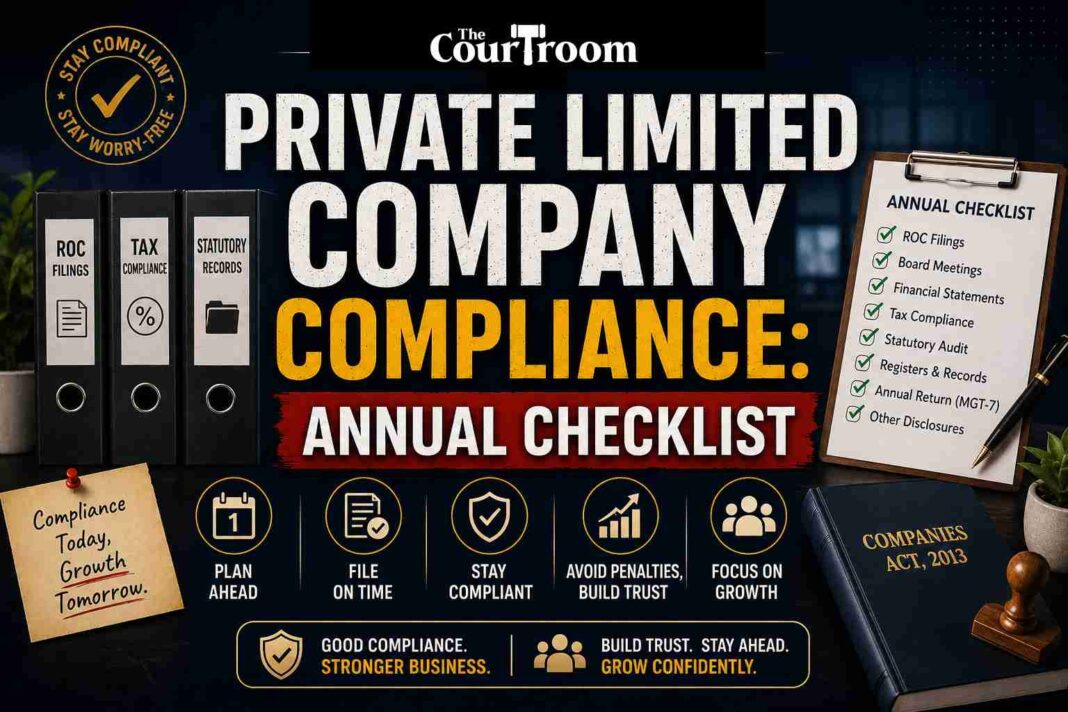
In short: Private limited company compliance in India is mandatory every year regardless of turnover or activity. Under the Companies Act, 2013, the Income Tax Act, 1961, and the GST framework, your company must hold board meetings and an AGM, file financial statements and an annual return, and meet tax obligations — or face escalating penalties.
Key points
- Every company registered under the Companies Act, 2013 — including dormant companies — must complete annual filings, with no exemption for zero-turnover entities.
- A private limited company must hold at least four board meetings per financial year, with no more than 120 days between consecutive meetings, and give directors at least seven days’ notice before each meeting.
- The AGM must be held within six months of the end of the financial year — for a March year-end, that means on or before 30 September every year.
- Financial statements must be filed with the Registrar of Companies in Form AOC-4 within 30 days of the AGM, attracting a late penalty of ₹100 per day per form with no upper cap.
- The MCA has extended the due date for AOC-4 filings to 27 September 2026 for OPCs and 29 October 2026 for other companies under the updated MCA V3 system.
- Annual compliance requirements span three overlapping frameworks: the Companies Act, 2013, the Income Tax Act, 1961, and the Goods and Services Tax framework.
Why does private limited company compliance apply even if you are not operating?
Many founders assume that a company with no revenue or activity can skip annual filings. That assumption is incorrect and costly. The Companies Act, 2013 requires every registered company — active, inactive, or dormant — to meet annual compliance obligations every year without exception.
Skipping a single year’s filing can trigger daily penalties that compound quickly, and persistent non-compliance can ultimately result in the company being struck off the register. Reinstating a struck-off company is far more expensive and time-consuming than staying current in the first place.
What are the mandatory board meeting requirements?
A private limited company must hold a minimum of four board meetings in every financial year. The gap between any two consecutive meetings must not exceed 120 days. Each meeting requires a formal notice of at least seven days sent to every director at their address registered with the company, as required by Section 173(3) of the Companies Act, 2013.
There is a limited exemption worth knowing. If your company qualifies as a small company, startup private company, dormant company, or OPC, and has not defaulted on its annual return or financial-statement filings, it may hold just one board meeting in each half of the calendar year — provided the two meetings are at least 90 days apart.
What is the AGM deadline and what happens if you miss it?
Under Section 96 of the Companies Act, 2013, every company except a One Person Company must hold an Annual General Meeting each year. Where the financial year ends on 31 March, the AGM must take place on or before 30 September.
Every shareholder must receive written notice at least 21 clear days before the AGM date, as required by Section 101. If your company misses the AGM deadline, Section 99 provides for a fine of up to ₹1 lakh on the company and every defaulting officer, plus an additional ₹5,000 per day for each day the default continues.
The MCA had allowed AGMs to be held by video conferencing until 30 September 2025 under General Circular No. 09/2024. No confirmed extension of that facility beyond that date was available at the time this article was verified. Check the MCA portal for any subsequent notifications before your next AGM.
How do you file financial statements — Form AOC-4?
Once the AGM is done, you have 30 days to file your audited financial statements with the Registrar of Companies. This is done through Form AOC-4 on the MCA portal, as required by Section 137 of the Companies Act, 2013.
The financial statements package that must be filed includes the Balance Sheet, the Statement of Profit and Loss, a Cash Flow Statement (required for companies above the small company threshold), notes to accounts, and the Board’s Report under Section 134.
In 2026, the MCA updated the AOC-4 form on the MCA V3 platform. The Directors’ Report, AOC-1, and AOC-2 are now integrated as linked forms rather than separate PDF annexures — a procedural change that affects how you prepare and upload your documents.
The late-filing penalty is ₹100 per day per form, and there is no maximum cap. On a form left unfiled for a full year, that amounts to ₹36,500 in penalties for that one form alone.
AOC-4 due dates for 2026
| Company Type | Form | MCA-Notified Due Date (2026) |
|---|---|---|
| One Person Company (OPC) | AOC-4 / AOC-4 Non-XBRL | 27 September 2026 |
| Other companies (including private limited) | AOC-4 / AOC-4 CFS / AOC-4 XBRL / AOC-4 Non-XBRL | 29 October 2026 |
Always confirm current due dates on the official MCA portal, as the ministry sometimes issues further extensions by circular.
Which other frameworks does annual compliance cover?
MCA and ROC filings are only one part of the picture. Your private limited company’s annual compliance obligations also run under the Income Tax Act, 1961 and the Goods and Services Tax framework. Income tax filings, tax audit requirements (where applicable), and GST annual returns each have their own deadlines and penalty structures.
Because the rules across these three frameworks interact — for instance, your audited accounts feed into both your ROC filings and your income tax return — getting the sequencing right matters. For plain-language explanations of related obligations, see the Law for You guides on The Courtroom, which cover foundational legal concepts for founders and small businesses.
A quick compliance calendar overview
| Obligation | Governing Provision | Deadline (March year-end) | Penalty for Default |
|---|---|---|---|
| Hold minimum 4 board meetings | Section 173, Companies Act | Throughout the year; max 120-day gap | Penalties under Companies Act |
| Annual General Meeting (AGM) | Section 96, Companies Act | On or before 30 September | Up to ₹1 lakh + ₹5,000/day continuing default |
| File financial statements (AOC-4) | Section 137, Companies Act | Within 30 days of AGM (MCA extended to 29 Oct 2026) | ₹100/day/form, no cap |
| Income tax and GST filings | Income Tax Act, 1961; GST framework | Per respective deadlines | Per respective Acts |
Frequently asked questions
Does a dormant or zero-revenue private limited company still need to file annual returns?
Yes. The Companies Act, 2013 requires annual filings from every company registered under it, regardless of whether the company carried out any business or earned any revenue during the year. Dormant companies are explicitly included. Skipping filings even in a zero-activity year attracts daily penalties that accumulate without a ceiling.
What is the penalty for filing Form AOC-4 late?
A late filing of Form AOC-4 attracts a penalty of ₹100 per day per form, and there is no maximum cap under the Companies Act, 2013. The penalty starts running from the day after the due date and continues until the form is actually filed. On top of any financial penalty, persistent non-compliance can put the company and its directors at risk of further regulatory action.
Can a private limited company hold its AGM by video conferencing?
The MCA permitted AGMs by video conferencing under General Circular No. 09/2024 until 30 September 2025. No confirmed extension of that facility beyond that date was available when this article was last verified. You should check the MCA portal for any subsequent circulars before planning a virtual AGM. In the absence of a current extension, the default position under the Companies Act applies.
Primary sources
- Companies Act, 2013 — India Code (indiacode.nic.in)
- Income Tax Act, 1961 — India Code (indiacode.nic.in)
- Ministry of Corporate Affairs — MCA portal for circulars, forms, and due-date notifications (mca.gov.in)
- GST Council and GSTN portal for GST annual return obligations (gst.gov.in)
Written by Editorial Team, The Courtroom · Published 2026-07-09 · Last verified 2026-07-09
This article is for general information only and is not legal advice. Laws change; verify against the primary sources cited and consult a qualified advocate for your situation.

