


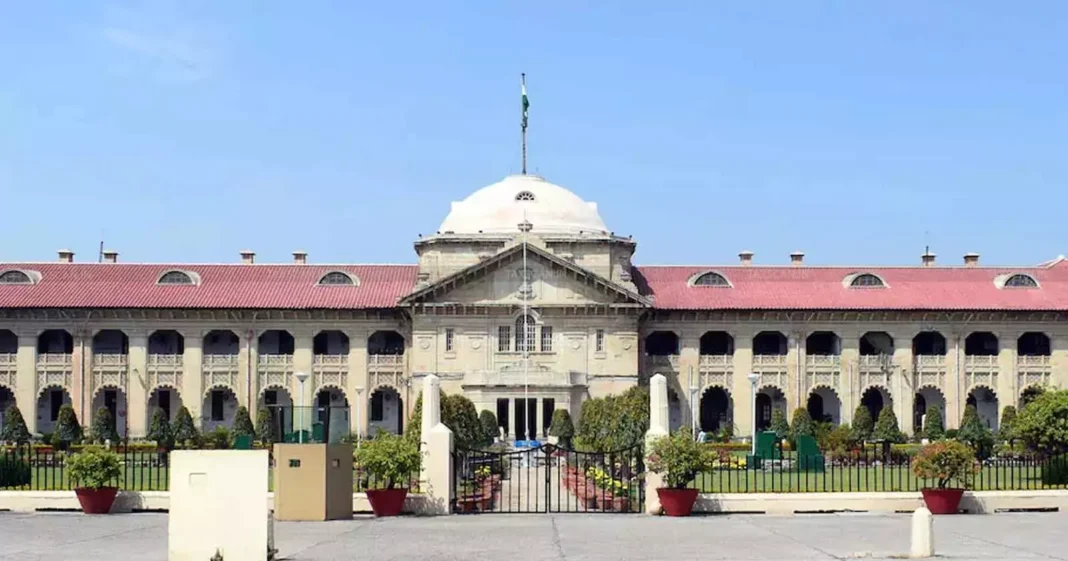
The Allahabad High Court’s Lucknow Bench has ordered the immediate release of a juvenile accused of theft, holding his detention prima facie illegal after UP Police ignored binding Supreme Court arrest guidelines and a Magistrate remanded the minor to custody three times without once verifying his age.
A bench of Justice Rajesh Singh Chauhan and Justice Divesh Chandra Samant delivered sharp oral remarks against the UP Police, according to LiveLaw, stating that officers have “nothing to do with reading and studying” the law and choose to act entirely on their own whims.
Background: How We Got Here
The case centres on a juvenile who was below 17 years of age at the time the FIR was registered against him. He was accused of theft under Section 303(3) of the Bharatiya Nyaya Sanhita (BNS), which carries a maximum punishment of three years, and Section 317 of the Bharatiya Nagarik Suraksha Sanhita (BNSS), which carries a maximum of five years.
Both offences fall well below the seven-year threshold. Under Section 35(3) BNSS — the provision that replaced the corresponding CrPC rule — police are required to serve a notice rather than effect a physical arrest for such offences. The Supreme Court’s landmark judgment in Satender Kumar Antil v. CBI (2022), cited as 2023 LiveLaw (SC) 233 and MANU/SC/0851/2022, makes this mandatory.
According to LiveLaw, officers arrested the juvenile without following this procedure. Critically, a co-accused in the very same FIR had already been identified as a juvenile — yet police still failed to verify the petitioner’s age before taking him into custody. The grounds of arrest were never communicated to the petitioner either.
- On June 2, 2026, police sought remand before Additional Chief Judicial Magistrate-V, Lucknow. The Magistrate granted a 14-day remand order — bizarrely dated “up to May 16, 2026,” a date already in the past at the time it was passed, according to LiveLaw.
- The Magistrate had by then granted remand on three separate occasions without applying judicial mind to the juvenile’s age or the nature of the offences, a pattern the bench characterised as “mechanical.”
- Advocate Skand Bajpai appeared for the petitioner before the High Court.
The Ruling — Key Findings
On June 4, 2026, the bench ordered the juvenile’s immediate release, holding his continued detention prima facie illegal, as reported by PTI via NewsDrum and Edinburgh Post. The court simultaneously summoned the arresting police officers and directed ACJM-V, Lucknow to file a personal affidavit explaining how the remand order had been passed.
The bench minced no words in its oral observations. According to LiveLaw’s follow-up report of around July 4, 2026, the court declared: “They will do exactly as they please. What do they care about laws and regulations? They are simply not made for laws and regulations!”
The court also stated it would take the matter seriously, observing per LiveLaw: “it would take it seriously that a juvenile has been sent for judicial custody granting remand to the arresting authority not once, but by means of three orders as on today.”
The bench warned that if the explanations offered by police and the ACJM are not found plausible and proper, it would pass appropriate orders — including directions for departmental inquiry — against the officials concerned, according to SupremeToday.ai.
The court’s findings highlighted a systemic failure on two parallel tracks: a police force that disregards a binding Supreme Court mandate on arrests, and a Magistrate who mechanically rubber-stamped remand without the most basic verification of the accused’s juvenile status.
Reactions & What’s Next
The petitioner was represented by Advocate Skand Bajpai, according to LiveLaw. No formal response from UP Police or the ACJM-V has been reported in the available sources at the time of publication.
The matter was first listed for hearing on July 3, 2026 per the PTI report of June 4, 2026. As per SupremeToday.ai, the case has been listed for further hearing on July 16, 2026, when the court is expected to examine the affidavits filed by the arresting officers and the Magistrate.
If the explanations are found unsatisfactory, the Lucknow Bench has signalled it may order departmental proceedings against the officials involved — a rare and serious escalation that underscores the court’s concern about systemic non-compliance with the Satender Antil guidelines across Uttar Pradesh.
Disclaimer
Disclaimer: This article is for general information only and does not constitute legal advice. Laws may change or vary by case — consult a qualified lawyer before acting. The Courtroom is not liable for any reliance on this content.

