


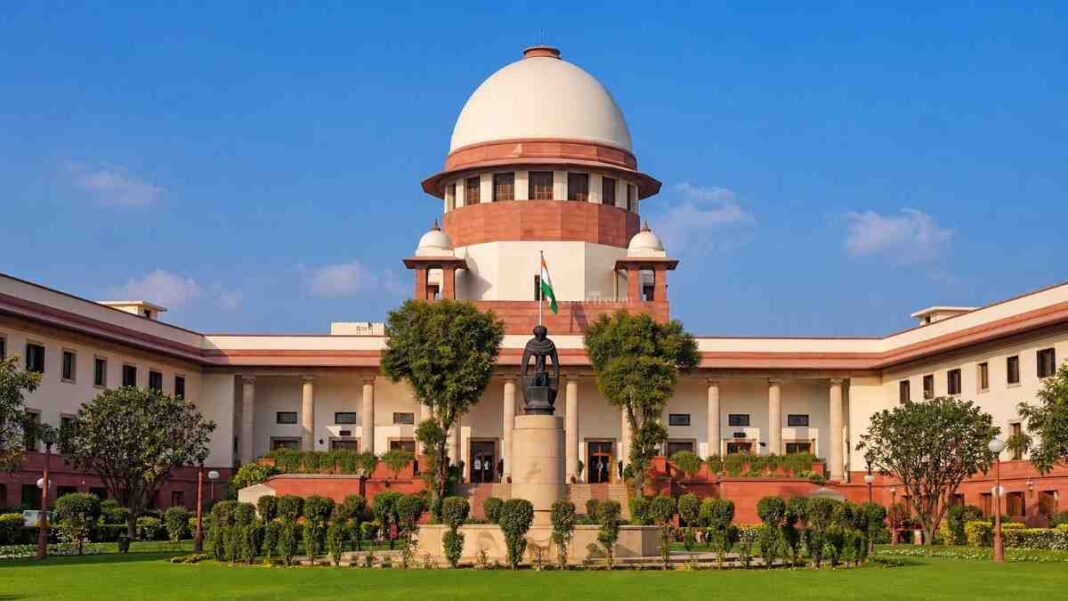
On June 3, 2026, a three-judge Supreme Court bench led by Chief Justice of India Surya Kant formally constituted a five-member High-Powered Committee (HPC) to scientifically reassess the definition and demarcation of the Aravalli Hills and Ranges.
The committee is chaired ex officio by Kanchan Devi, Director General of the Indian Council of Forestry Research and Education (ICFRE) — a 1991-batch Indian Forest Service officer from the Madhya Pradesh cadre — according to reports by Tribune India and Business Standard.
Background: How We Got Here
The Aravalli range — spanning Rajasthan, Haryana, Delhi, and Gujarat — has faced mounting pressure from mining operations and urban encroachment for decades. The current legal crisis was triggered in November 2025.
The suo motu writ petition is titled “Definition of Aravalli Hills and Ranges and Ancillary Issues,” and the bench comprises CJI Surya Kant, Justice Joymalya Bagchi, and Justice Vipul M. Pancholi, as reported by Bar & Bench and Business Standard.
- On November 20, 2025, the Supreme Court accepted the Union environment ministry’s revised definition classifying only landforms with an elevation of 100 metres or more above local relief as Aravalli hills — a threshold critics warned would strip vast ecologically connected lowland areas of legal protection.
- On December 28, 2025, the Supreme Court took suo motu cognisance of mounting concerns over that revised definition, per NewsonAir.
- On December 29, 2025, the bench stayed its own November 20 order. The court observed: “We deem it necessary that the committee recommendation and directions of this court be kept in abeyance.”
- On January 21, 2026, the court extended the stay and directed Additional Solicitor General Aishwarya Bhati and amicus curiae K. Parameshwar to suggest expert names within four weeks, per NewsonAir.
- On February 26, 2026, CJI Surya Kant’s bench formally requested the ministry to furnish a panel of domain experts, stating: “We request the ministry to suggest a panel of domain experts along with their profile.”
The Ruling — Key Findings
On June 3, 2026, the Supreme Court formally constituted the Aravalli Hills expert committee, directing it to conduct what the bench called a “fair, impartial and independent expert opinion” on the range’s scientific definition, according to Business Standard.
The four named members of the HPC are Dr. Subhash Ashutosh (former Director General, Forest Survey of India), Dr. Rajendra Kumar Sharma (retired Director, Geological Survey of India), Brij Mohan Singh Rathore (former Joint Secretary, MoEFCC), and Prof. Ashok K. Bhatnagar (former Head, Department of Botany, Delhi University), as reported by NewKerala and Lawbeat.
Two special invitees were also designated: Prof. Jagdish Krishnaswamy (Dean, School of Environment and Sustainability, Indian Institute for Human Settlements) and Prof. Laxmikant Sharma (Central University of Haryana), per The Statesman.
An officer of the rank of Director from the Ministry of Environment, Forest and Climate Change (MoEFCC) will serve as Member Secretary of the committee, according to Business Standard.
The HPC is mandated to address “critical ambiguities” in the Centre’s earlier findings, per Tribune India, and to conduct its review in a manner that is fair, impartial, and independent of executive pressure.
The committee has been specifically directed to issue a public notice inviting representations from all interested persons — including state governments, environmental groups, mining lease holders, farmers, mine workers, and local communities — as reported by The Statesman.
On the question of mining, the court clarified that no new mining leases or renewals in the Aravalli region will be permitted without specific Supreme Court approval. The bench had earlier declined to impose a blanket ban on mining, observing that total prohibitions often encourage illegal mining rather than curbing environmental damage, per Lawbeat.
Reactions & What’s Next
The HPC has been given a firm deadline of August 31, 2026, to submit its comprehensive report to the Supreme Court after consulting all relevant stakeholders, according to NewKerala and Lawbeat.
The Supreme Court’s next scheduled hearing in the matter is September 7, 2026, after the committee completes its assessment and files its report, per thewaveandaman.com.
The formation of this committee marks a significant procedural pivot — the court is effectively pausing its own earlier ruling and delegating the definitional question to a multi-disciplinary scientific body before issuing any final directions on mining and ecological protection across all four states the range traverses.
Full coverage: NewKerala. More legal news at The Courtroom.
Who chairs the Supreme Court’s Aravalli Hills expert committee?
The five-member High-Powered Committee is chaired ex officio by Kanchan Devi, the Director General of ICFRE (Indian Council of Forestry Research and Education). She is a 1991-batch Indian Forest Service officer from the Madhya Pradesh cadre, as reported by Tribune India and Business Standard.
What is the deadline for the Aravalli Hills expert committee report?
The HPC has been directed by the Supreme Court to submit its comprehensive report by August 31, 2026. The next court hearing is scheduled for September 7, 2026, according to NewKerala and Lawbeat.
Why did the Supreme Court stay its November 2025 Aravalli order?
On December 29, 2025, the Supreme Court stayed its November 20, 2025 order after observing that the expert committee’s report and the court’s own directions were being “misconstrued.” The court took suo motu cognisance of concerns that the elevation-based definition — limiting Aravalli hills to landforms 100 metres or more in height — would expose large ecologically connected low-lying areas to mining, per NewsonAir and Gulf News.
Can mining continue in the Aravalli region during the committee’s review?
The Supreme Court has clarified that no new mining leases or renewals in the Aravalli region will be permitted without specific Supreme Court approval. However, the bench declined to impose a blanket ban, noting that total prohibitions can encourage illegal mining rather than curbing environmental damage, per Lawbeat.
Disclaimer
Disclaimer: This article is for general information only and does not constitute legal advice. Laws may change or vary by case — consult a qualified lawyer before acting. The Courtroom is not liable for any reliance on this content.

