


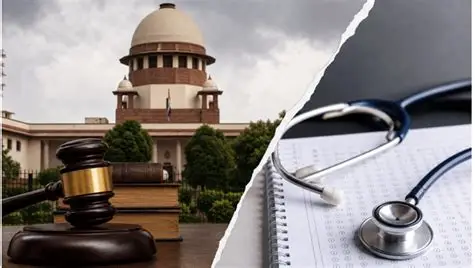
On July 15, 2026, the Supreme Court of India dismissed a writ petition challenging NTA’s decision to cancel and re-conduct NEET UG 2026 for nearly 22 lakh candidates, holding the matter infructuous.
The bench of Justice PS Narasimha and Justice Alok Aradhe ruled that since the re-examination had already been held on June 21, 2026, no effective judicial relief could be granted, according to LiveLaw.
Background: How We Got Here
The controversy began on May 3, 2026, when NTA conducted the original NEET UG 2026 examination in pen-and-paper mode. Over 22.7 lakh aspirants appeared across 551 cities in India and 14 cities abroad.
On May 12, 2026, NTA cancelled the exam following paper leak allegations. The Rajasthan Police Special Operations Group had reportedly found a guess paper containing more than 100 questions similar to those in the exam.
- The writ petition was filed as W.P.(C) No. 753/2026 — Mangala Kohli v. Union of India and Ors. — by Dr. Mangala Kohli, former Assistant Director General of Health Services, through Advocate-on-Record Abhishek Chandra Mishra, as reported by Telangana Today.
- On June 1, 2026, the Supreme Court separately refused a plea to conduct the NEET UG retest in Computer Based Test (CBT) mode, per Business Standard.
- On June 17, 2026, Chief Justice of India Surya Kant declined an urgent hearing on this PIL, observing that NEET UG 2026 matters were already being heard by the bench led by Justice PS Narasimha, according to National Herald India.
The NEET UG 2026 re-examination was ultimately conducted on June 21, 2026. More than 20 lakh candidates appeared at 5,440 centres in India and 14 centres abroad, as reported by Telangana Today.
The re-examination was conducted under sweeping security measures. Over 95,000 exam rooms were monitored by 1.38 lakh CCTV cameras, 51,000 signal jammers were installed, and Aadhaar-based biometric verification was deployed throughout, per Telangana Today.
The Ruling — Key Findings
The bench of Justice PS Narasimha and Justice Alok Aradhe dismissed Writ Petition (Civil) No. 753/2026 as infructuous on July 15, 2026, holding that the challenge to the retest order had lost its purpose once the re-examination was completed.
Justice Narasimha stated orally: “This petition has become infructuous. We will consider it; implead yourself with the pending matter.”
The Court’s direction was clear: the petitioner should intervene in the pending batch of cases seeking NTA institutional reforms, rather than pursuing this petition separately, according to LiveLaw and Lawbeat.
While dismissing the specific retest challenge as infructuous, the bench indicated that the broader question of institutional reform within NTA still survives as a live issue before the same bench, per Lawbeat.
The petition had challenged the retest as violating Articles 14, 19(1)(g), and 21 of the Constitution of India — covering the Right to Equality, the Right to practise any profession, and the Right to Life and Personal Liberty — as reported by LiveLaw.
Reactions & What’s Next
The petition had argued that the blanket nationwide cancellation was disproportionate and unconstitutional. Dr. Kohli contended it unfairly penalised bona fide candidates who had no connection to the alleged irregularities.
The petition cited CBI investigations pointing to a “localised operational compromise through specific organised networks” rather than nationwide contamination of the examination process, according to National Herald India.
Dr. Kohli had also sought structural and technological reforms within NTA — including encrypted digital question delivery, biometric authentication, and AI-assisted monitoring — as part of the relief sought before the Court.
With the retest challenge now dismissed, the focal point shifts to the pending batch of cases on NTA institutional reforms before the bench of Justice PS Narasimha. The petitioner has been granted liberty to intervene in those proceedings, as confirmed by LiveLaw and Lawbeat.
The dismissal effectively closes the door on any judicial reversal of the June 21 re-examination result. Students who appeared on June 21 can now expect the process to move forward without further court-ordered disruption to the 2026 cycle.
Disclaimer
Disclaimer: This article is for general information only and does not constitute legal advice. Laws may change or vary by case — consult a qualified lawyer before acting. The Courtroom is not liable for any reliance on this content.

