


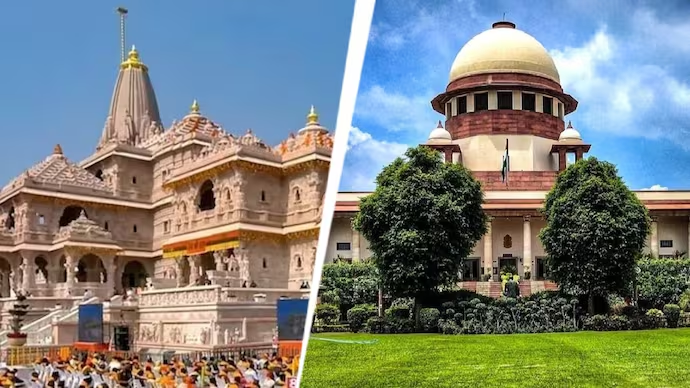
Ram Mandir Donation Theft: Supreme Court Bench of CJI Surya Kant to Hear CBI Probe Pleas on July 13
The Supreme Court of India has listed three writ petitions seeking a CBI-led probe into alleged embezzlement of donations at the Ram temple in Ayodhya for hearing on July 13, 2026, before a bench comprising Chief Justice of India Surya Kant, Justice Joymalya Bagchi, and Justice V Mohana.
The petitions seek a CBI investigation, a CAG audit, and a Supreme Court-monitored forensic audit of the Sri Ram Janmabhoomi Theerth Kshetra Trust’s finances, according to LiveLaw.
Background: How We Got Here
The controversy erupted publicly on June 7, 2026, when Samajwadi Party chief Akhilesh Yadav cited reports that crores in donations were missing and urged courts to take suo motu cognisance of the matter.
The Trust, constituted in February 2020 following the Supreme Court’s Ayodhya verdict, is estimated to have received approximately Rs 3,500 crore in cash donations since inception, along with jewellery and other offerings.
Allegations of misappropriated amounts range from Rs 7 crore to Rs 7.5 crore, per former SP MLA Pawan Pandey. A cash trail of Rs 77 lakh was reportedly recovered, according to LiveLaw.
The Uttar Pradesh government constituted a three-member SIT on June 13, 2026, on a request from the temple trust itself. The SIT comprises Lucknow Divisional Commissioner Vijay Vishwas Pant, Inspector General of Police Kiran S, and Special Secretary (Finance) Neel Ratan.
Based on the SIT’s preliminary findings, an FIR was lodged on June 25, 2026 at Ram Janmabhoomi Police Station, Ayodhya, on a complaint filed by Trust member Krishna Mohan against eight named accused and unknown persons, as reported by Business Standard.
The eight accused are: Avinash Shukla, Anukalp Mishra, Lavkush Mishra, Manish Kumar Yadav, Karunesh Pandey, Ramashankar Mishra, Subhash Srivastava, and Ram Shankar Yadav alias Tinnu.
Charges under the Bharatiya Nyaya Sanhita include Sections 305, 306, 316(5), 317(4), 317(5), 61, and 3(5) — covering theft, criminal breach of trust, receiving and concealing stolen property, and criminal conspiracy. Section 13(1)(a) of the Prevention of Corruption Act was also invoked.
- All eight accused were arrested on June 25–26, 2026, hours after the FIR was registered, per BusinessToday.
- On June 29, 2026, a local court sent all eight accused to 14-day judicial custody.
- On July 7, 2026, an Ayodhya court granted one-day police remand for three of them — Anukalp Mishra, Lavkush Mishra, and Karunesh Pandey — according to Deccan Chronicle.
The Petitions — What Each Seeks
Three separate writ petitions are now before the Supreme Court, each seeking escalation beyond the state-constituted SIT, according to LiveLaw and Business Standard.
The first petition, WP(C) 790/2026, was filed by Narendra Kumar Goswami appearing in person. It seeks a CBI probe and a CAG audit of the Trust’s finances.
Goswami argued in the petition: “Such an inquiry would inspire greater public confidence than a preliminary probe conducted by a special investigation team comprising administrative officers.”
The second petition, WP(Crl) 241/2026, was filed by Ajay Kumar Rai and Dinesh Kumar Yadav, also appearing in person. It seeks a CBI-led multi-disciplinary SIT probe into the Trust’s alleged financial irregularities.
Petitioner Ajay Kumar Rai stated in the petition: “Whether or not the reports regarding missing funds and other alleged irregularities concerning the Shri Ram Janmbhoomi Teerth Kshetra Trust are ultimately found to be true.”
The third petition was filed by RJD MP Sudhakar Singh, who moved the Supreme Court on July 3, 2026. It seeks a Supreme Court-monitored CBI probe and a comprehensive forensic audit of the entire finances of the temple trust, per LiveLaw.
The Supreme Court had earlier declined to urgently list these petitions during partial court working days. A bench headed by Justice B V Nagarathna had asked a petitioner to mention the matter for hearing on a later date, according to Business Standard.
The Allahabad High Court separately refused to entertain a similar PIL seeking a CBI probe. A bench of Justice Rajan Roy and Justice Manjive Shukla declined, noting that a comparable matter was already pending before the Supreme Court, as reported by LiveLaw.
Reactions & What’s Next
The petitioners have collectively argued that a CBI-led investigation is essential to ensure public confidence in the integrity of one of India’s most prominent religious trusts, particularly given the scale of donations involved.
The Allahabad High Court’s refusal to entertain the PIL has effectively concentrated judicial scrutiny at the apex court level, making the July 13 hearing a critical juncture for the case.
As of July 10, 2026, no ruling has been issued — the Supreme Court has listed all three petitions for hearing before the bench of CJI Surya Kant, Justice Joymalya Bagchi, and Justice V Mohana on July 13, 2026, according to Business Standard.
More legal news at The Courtroom.
Who is on the Supreme Court bench hearing the Ram Mandir donation theft petitions on July 13?
The bench comprises Chief Justice of India Surya Kant, Justice Joymalya Bagchi, and Justice V Mohana, according to Business Standard and LiveLaw.
How many people were arrested in the Ram temple donation theft case and what are the charges?
Eight accused were arrested on June 25–26, 2026. Charges include theft, criminal breach of trust, criminal conspiracy, and receiving stolen property under the Bharatiya Nyaya Sanhita, along with Section 13(1)(a) of the Prevention of Corruption Act.
What relief have petitioners sought from the Supreme Court in the Ram Mandir donation case?
The three petitions collectively seek a CBI-led probe, a CAG audit, a comprehensive forensic audit, and a Supreme Court-monitored oversight committee for the Sri Ram Janmabhoomi Theerth Kshetra Trust’s finances.
What is the total amount of donations the Ram temple trust has received, and how much is alleged to have been stolen?
The Trust is estimated to have received approximately Rs 3,500 crore in cash donations since its inception in February 2020. Allegations of misappropriated amounts range from Rs 7 crore to Rs 7.5 crore, with a cash trail of Rs 77 lakh reportedly recovered.
Disclaimer
Disclaimer: This article is for general information only and does not constitute legal advice. Laws may change or vary by case — consult a qualified lawyer before acting. The Courtroom is not liable for any reliance on this content.

