


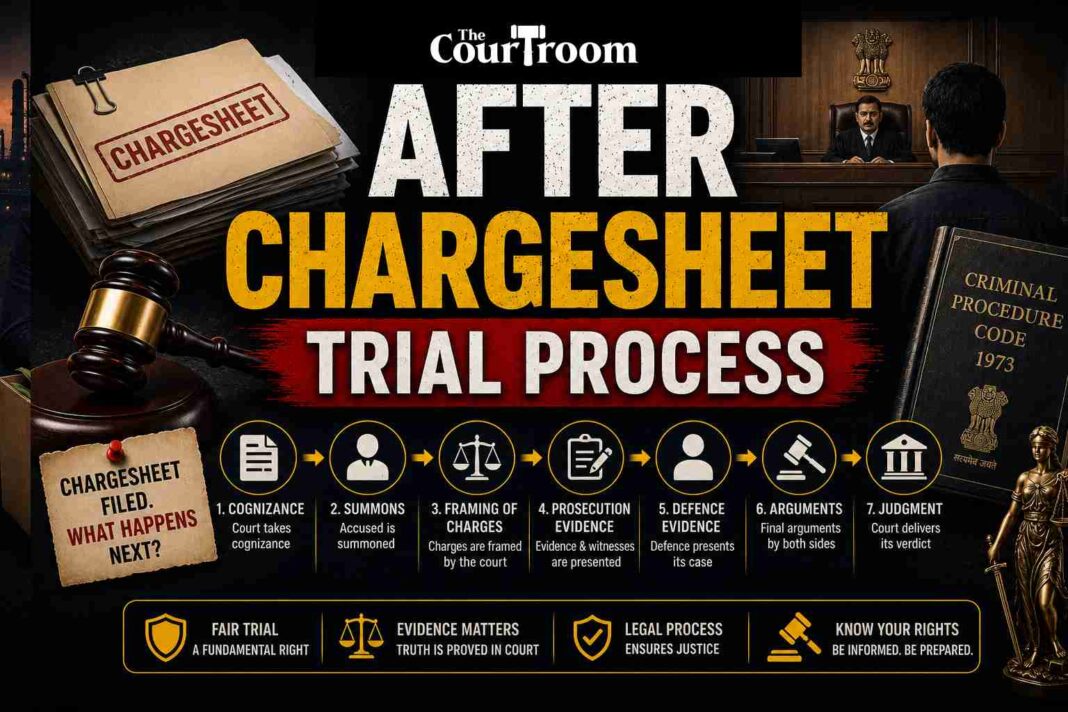
In short: The after chargesheet BNSS trial process begins when police file their final report in court. A magistrate must decide within 14 days whether to take cognizance. From there, the case moves through charge-framing, evidence, arguments, and judgment — each stage governed by the Bharatiya Nagarik Suraksha Sanhita, 2023 (BNSS).
Key points
- India replaced the old Code of Criminal Procedure, 1973 (CrPC) with the BNSS at midnight on 1 July 2024. Cases that were already pending on that date continue under the old CrPC rules.
- A chargesheet is the police’s formal, written allegation against you. It is defined under Section 193 of the BNSS and serves as the foundation on which the prosecution builds its case in court.
- The magistrate is legally required to decide whether to take cognizance of the chargesheet within 14 days of receiving it.
- Once cognizance is taken, the court must direct the investigating agency to hand a copy of the chargesheet to the accused.
- If your FIR was registered on or after 1 July 2024, the BNSS applies to you. If it was registered before that date, the CrPC still governs your case for most purposes.
- The victim or informant must be kept informed of investigation progress within 90 days, including through electronic communication, under BNSS.
Which law applies to your case?
Three new criminal laws came into force at midnight on 1 July 2024: the Bharatiya Nyaya Sanhita, 2023 (BNS), the Bharatiya Nagarik Suraksha Sanhita, 2023 (BNSS), and the Bharatiya Sakshya Adhiniyam, 2023 (BSA).
They replaced the Indian Penal Code, 1860, the Code of Criminal Procedure, 1973, and the Indian Evidence Act, 1872 respectively.
The single most important question for your family right now is: when was the FIR registered?
| When the FIR was filed | Law that governs the trial |
|---|---|
| On or after 1 July 2024 | BNSS (and BNS, BSA) |
| Before 1 July 2024 — trial, inquiry or investigation pending | CrPC continues to apply until the case concludes |
Two parallel rulebooks are running at once in Indian courts today. If you are unsure which applies to you, check with your advocate immediately — the answer affects every procedural right you have.
What exactly is a chargesheet?
A chargesheet is the final report that a police officer or investigative agency files after completing their investigation. Under the BNSS, this is governed by Section 193.
Not every investigation ends in a chargesheet. If the police find insufficient evidence, they file a closure report instead — that is a separate document under Section 189 of the BNSS. A chargesheet means the police believe there is enough material to prosecute.
The chargesheet formally sets out the allegations against the accused and is the foundation on which the prosecution will argue its case before the court.
Step 1: The magistrate takes cognizance
After the chargesheet is filed, the magistrate examines it. Even if the offence is ultimately triable by a sessions court, the chargesheet first comes before the magistrate.
Under the BNSS, the magistrate must decide within 14 days whether to take cognizance — that is, whether to formally acknowledge that an offence appears to have been committed and that the case should proceed.
Once cognizance is taken, the court can issue a warrant or summons to ensure the accused appears before it. The court must also direct the investigating agency to hand over a copy of the chargesheet to the accused.
This is a critical right: you are entitled to know exactly what is alleged against you before the trial proper begins.
Step 2: Hearing the accused — a new protection under BNSS
The BNSS introduced a notable change when cognizance is being considered on a private complaint (as opposed to a police chargesheet): the accused now has a right to be heard before the magistrate decides to take cognizance in certain circumstances.
This is a departure from the old CrPC position, where the accused typically had no say at this early stage. If you have received a notice or summons at this stage, do not ignore it — appearing and engaging can make a real difference.
Step 3: Committal to sessions court (if applicable)
Many serious offences under the BNS are triable exclusively by a sessions court. In such cases, after the magistrate takes cognizance, the case is committed — that is, formally transferred — to the sessions court for trial.
Families often find this stage confusing because the case seems to move between courts without anything visible happening. This is normal. The magistrate’s role at this point is largely administrative — receiving the chargesheet and committing the case upward.
Step 4: Framing of charges
Once the sessions court receives the case, the judge frames charges. This is the formal recitation of the exact accusations the accused must answer at trial.
At this stage, the accused has the opportunity to argue that the charges as framed are not supported by the material on record — a process sometimes called a discharge application. If the court agrees, the accused can be discharged from one or more charges before trial even begins.
Framing of charges is not a finding of guilt. It is simply the court deciding that there is sufficient material to proceed to a full trial.
Step 5: Evidence — prosecution first, then defence
After charges are framed, the prosecution presents its evidence. This includes examination of witnesses, production of documents, and any electronic or forensic material.
The accused or their advocate has the right to cross-examine every prosecution witness. This is one of the most consequential phases of a trial and is often where cases are won or lost.
Once the prosecution closes its case, the court records a statement from the accused. The accused then has the opportunity to present a defence — calling witnesses or producing documents — though there is no obligation to do so.
Step 6: Arguments and judgment
After all evidence is recorded, both sides make their final arguments. The judge then delivers a judgment. If the accused is acquitted, they are released. If convicted, the court hears arguments on sentencing before passing the final sentence.
For a plain-language guide to your rights at each of these stages — including bail, anticipatory bail, and the right to legal aid — visit our Law for You guides at The Courtroom, where we break down each step of the criminal justice process for ordinary people and families.
A quick reference: Key BNSS provisions mentioned in this guide
| BNSS Section | What it covers |
|---|---|
| Section 189 | Closure report by police (insufficient evidence) |
| Section 193 | Definition and filing of chargesheet |
| Section 193(3)(ii) & (iii) | Informing victim/informant of investigation progress within 90 days |
| Section 210(1)(b) | Magistrate takes cognizance on a police report |
| Section 227 | Magistrate issues warrant to secure accused’s presence |
| Section 230 | Court directs agency to supply chargesheet copy to accused |
Note: Always verify section numbers against the bare Act on India Code (indiacode.nic.in) before relying on them, as notifications and amendments may have updated the numbering.
What families should do right now
If a chargesheet has just been filed against someone you know, here is what matters most in the immediate term.
First, find out whether the case is under BNSS or CrPC — your advocate can tell you this from the FIR date. Second, ensure the accused receives a copy of the chargesheet from the court; this is a legal entitlement, not a favour. Third, attend every court date — missing a hearing can result in a warrant being issued.
Finally, if you cannot afford a lawyer, you have the right to free legal aid. Contact the District Legal Services Authority (DLSA) in your district. This right exists regardless of which law governs your case.
Frequently asked questions
How long does a magistrate have to take cognizance after a chargesheet is filed under BNSS?
Under the BNSS, a magistrate must decide whether to take cognizance within 14 days of the chargesheet being filed before them. This is a mandatory timeline introduced by the new law — there was no equivalent fixed deadline under the old CrPC.
My family member’s case started before 1 July 2024. Does BNSS apply?
No, not for that pending case. The BNSS contains a clear transitional rule: any appeal, application, trial, inquiry, or investigation that was pending immediately before 1 July 2024 continues to be governed by the old CrPC as if the BNSS had not come into force. Only new cases — where the FIR was registered on or after 1 July 2024 — fall under the BNSS.
Is a chargesheet the same as a conviction or a finding of guilt?
No. A chargesheet is simply the police’s formal report stating they believe there is sufficient evidence to prosecute. It is the starting point of the court process, not the end. The accused is presumed innocent and has the full opportunity to contest every allegation during trial before any finding of guilt can be recorded.
Primary sources
- Bharatiya Nagarik Suraksha Sanhita, 2023 — bare Act on India Code (indiacode.nic.in)
- Bharatiya Nyaya Sanhita, 2023 — bare Act on India Code (indiacode.nic.in)
- Bharatiya Sakshya Adhiniyam, 2023 — bare Act on India Code (indiacode.nic.in)
- Supreme Court of India — judgments and orders (sci.gov.in)
Written by Editorial Team, The Courtroom · Reviewed by [Advocate name] · Published 2026-07-09 · Last verified 2026-07-09
This article is for general information only and is not legal advice. Laws change; verify against the primary sources cited and consult a qualified advocate for your situation.

