


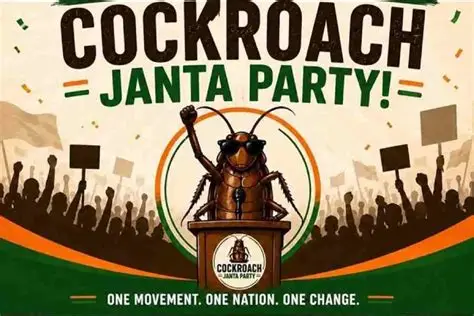
The Delhi High Court on July 7, 2026 ordered the unblocking of the X account of the Cockroach Janta Party (CJP), a satirical social media collective, after the Central government told the court it had no objection to restoration.
Justice Swarana Kanta Sharma passed the direction after Solicitor General Tushar Mehta appeared for the Union of India and stated the government was no longer opposed to the account’s revival, according to Bar & Bench.
Background: How We Got Here
The CJP’s X account, @CJP_2029, was withheld in India on May 21, 2026 — over six weeks before the unblocking order — by the Ministry of Electronics and Information Technology (MeitY) under Section 69A of the Information Technology Act, 2000.
The blocking was based on inputs from the Intelligence Bureau citing threats to national security and sovereignty, according to MediaNama. The petition challenging the block was filed by Abhijit Dipke, CJP’s founder, and was registered as Abhijit Dipke v. Union of India [2026 LiveLaw (Del) 626].
- On May 29, 2026, Justice Purushaindra Kumar Kaurav heard the matter and declined to grant immediate interim relief, observing that restoration could only be ordered after hearing the government given the far-reaching consequences, per the Free Press Journal.
- Justice Kaurav directed the statutory Review Committee under the IT (Procedure and Safeguards for Blocking for Access of Information by Public) Rules, 2009, to examine the petitioner’s grievances, as reported by ANI.
- Senior Advocate Akhil Sibal, representing Dipke, argued that even if certain posts were objectionable, those specific posts could remain blocked while the account itself should be restored. He also sought production of the original blocking order, per The Print.
CJP describes itself as a satirical political collective founded by Dipke, a Boston-based Indian, using humour to comment on unemployment, institutional accountability, and media freedom, according to Bar & Bench.
The group had been protesting at Jantar Mantar demanding the resignation of Union Education Minister Dharmendra Pradhan over the alleged leak of NEET and other competitive examination question papers, as reported by Bar & Bench.
The Ruling — Key Findings
Justice Swarana Kanta Sharma allowed the petition on July 7, 2026, and directed the unblocking of the CJP X account. The court found that the Centre’s primary concern — the potential for chaos among NEET examination students and their parents — had ceased to exist following the conclusion of the exam, according to LiveLaw.
Solicitor General Mehta explained the government’s original rationale in open court. As reported by Bar & Bench and LiveLaw, he stated:
“It was blocked at a time when NEET examination was to take place. Lakhs of students were to appear. Several posts (on X) which would have created chaos among student and parents. Now the examination is over.”
Mehta also addressed the broader concern about online content, adding: “I have no difficulty. I just want everyone to be more circumspect.”
With the government’s stated justification no longer operative, the court revoked the Section 69A blocking order and allowed the petition, per LiveLaw’s coverage of the proceedings.
The ruling is significant in the context of IT Act Section 69A free speech jurisprudence, as it underscores that blocking orders premised on time-limited concerns must not outlive the underlying emergency.
Reactions & What’s Next
CJP founder Abhijit Dipke described the court’s order as a significant win. The Tribune India reported Dipke calling it a “big win” for the collective and for free expression on social media platforms.
The Internet Freedom Foundation had previously criticised the block as a blatant misuse of state power and a disproportionate attempt to stifle freedom of speech under Article 19(1)(a) of the Constitution, according to MediaNama.
With the petition having been allowed, the immediate next step is the technical restoration of @CJP_2029 on the X platform for Indian users. No further hearing date was reported in the pre-verdict coverage.
Disclaimer
Disclaimer: This article is for general information only and does not constitute legal advice. Laws may change or vary by case — consult a qualified lawyer before acting. The Courtroom is not liable for any reliance on this content.

