


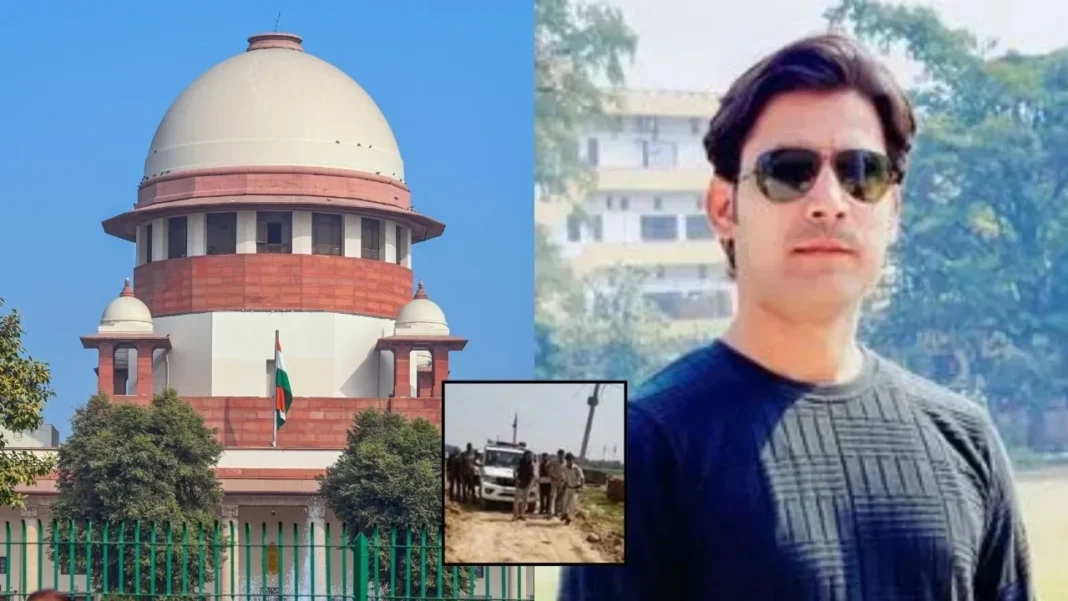
The Supreme Court of India on June 30, 2026, declined to entertain a public interest litigation seeking a Central Bureau of Investigation probe into the alleged fake encounter killing of Bharat Bhushan Tiwari in Bihar’s Bhojpur district.
A vacation bench of Justice M.M. Sundresh and Justice Sheel Nagu directed petitioner Advocate Vishal Tiwari, who appeared in person, to approach the Patna High Court as the appropriate forum for relief.
The case, registered as Vishal Tiwari v. Union of India, W.P.(Crl.) No. 242/2026, was filed under Article 32 of the Constitution of India.
Background
Bharat Bhushan Tiwari, a student and social activist from Bilauti village under Shahpur police station limits in Bhojpur district, Bihar, died in a police encounter on June 17, 2026.
Most sources report his age as 28 years; several other outlets cite 26. This discrepancy is not independently resolved, and official records have not been confirmed.
Tiwari had approximately 1.6 lakh Facebook followers and was known as a vocal digital activist raising awareness of local civic issues, including flooding, displacement, and corruption.
Bihar Police and the Special Task Force (STF) maintain that Tiwari fired at officers first and that they retaliated in self-defence. He sustained a bullet injury and died while being taken to Patna Medical College and Hospital.
His family and witnesses allege he had thrown away his pistol or surrendered before being shot. A Facebook Live video reportedly showing events before the encounter exists, though its contents have not been independently adjudicated.
Notably, on June 16, 2026 — one day before the encounter — Bhojpur Police issued a statement describing Tiwari as “mentally unstable” and said efforts were underway to take him into safe custody.
Verified Details
The PIL sought four specific reliefs: registration of an FIR against the police personnel involved; a court-monitored CBI probe; an independent expert committee headed by a former Supreme Court judge; and directions to the Union Government to ensure compliance with PUCL guidelines on encounter deaths.
The PIL also raised broader concerns about “half encounters” and what it described as a growing encounter culture in Uttar Pradesh, alongside the Bihar incident.
The petition had been mentioned earlier before a bench headed by Justice B.V. Nagarathna, which declined urgent listing and directed the petitioner to approach the Registrar first.
Following Tiwari’s death, four police officers including the local Station House Officer were suspended. One source cites six suspensions; the precise total and identities of all suspended officers beyond SHO Rajesh Malakar are not independently verified from official Bihar Police statements.
An FIR was registered against police personnel — including Jagdishpur Sub-Divisional Police Officer Rajesh Kumar Sharma and SHO Rajesh Malakar — following a complaint by Tiwari’s mother, Asha Devi.
SDPO Rajesh Kumar Sharma was removed from his post and transferred to Bihar Police Headquarters, Patna. He was replaced by Pankaj Kumar Mishra.
Bihar Chief Minister Samrat Choudhary on June 20, 2026, ordered an independent judicial inquiry to be conducted by a retired High Court judge. The identity of the retired judge appointed to lead the inquiry is information not publicly available in sources reviewed.
Significance
The Supreme Court’s refusal to entertain the petition under Article 32 and its redirection to the Patna High Court signals the bench’s view that the matter does not, at this stage, warrant direct constitutional intervention at the apex level.
Whether any interim stay or other interim order was issued by the Supreme Court is not confirmed in sources reviewed.
Industry Context
The PIL invoked PUCL v. State of Maharashtra (2014) 10 SCC 635, a landmark Supreme Court judgment of September 23, 2014, which laid down 16 mandatory guidelines for the investigation of police encounter deaths across India.
These guidelines require, among other measures, independent investigation of all encounter killings and magisterial inquiries. The PIL argued that these standards had not been followed in the Tiwari case.
Regulatory or Legal Context
Article 32 of the Constitution grants citizens the right to move the Supreme Court directly for enforcement of fundamental rights. The court’s direction to approach the Patna High Court suggests it did not find sufficient grounds to bypass the conventional jurisdictional hierarchy.
The case number on record is W.P.(Crl.) No. 242/2026, filed in the Supreme Court of India.
Why It Matters
The Bharat Bhushan Tiwari encounter has drawn significant political attention in Bihar, with multiple prominent figures publicly commenting on the case in the weeks preceding the Supreme Court hearing.
The PIL’s broader framing — linking the Bihar encounter to an alleged pattern of extra-judicial killings in Uttar Pradesh — indicates an attempt to have the apex court address what petitioners characterise as a systemic issue, not an isolated incident.
The Patna High Court now becomes the primary judicial forum for scrutiny of the Bihar government’s response, including the conduct of the state-ordered judicial inquiry.
Conclusion
The Supreme Court’s June 30, 2026 order closes the immediate avenue for a CBI-monitored central investigation into the Bharat Bhushan Tiwari encounter at the apex level.
The matter now rests with the Patna High Court, while a state-ordered judicial inquiry — whose presiding retired judge remains publicly unidentified — proceeds in parallel.
The outcome of those proceedings will determine whether the family’s demands for accountability and compliance with PUCL guidelines are ultimately addressed.

